
It seems we can’t find what you’re looking for. Perhaps searching can help.
Best Hotels & Places to Stay in Guilin
Guilin lists more than 4,500 places to sleep, but the hotels in Guilin actually worth your time sit in three zones: the city center, Yangshuo, and the Longji rice terraces. Each zone runs on its own rhythm, and booking the wrong one quietly drains your trip. I’ve stayed in all three more than once, so I have firm opinions about who fits where. Below I’ve broken down the best hotels in Guilin, China by area and budget, plus where to stay in Guilin on a first visit. Treat this page as your sorting table before you open a booking site. For the full region picture, start with our Guilin travel guide.
⏱️ Where to Stay in Guilin — Three Areas at a Glance
Start with the short version. Thirty seconds, and you’ll know your zone — and where the best hotels in Guilin actually sit.
Prices are 2026 estimates at roughly 1 USD ≈ 7.0 CNY; expect them to climb in peak season.
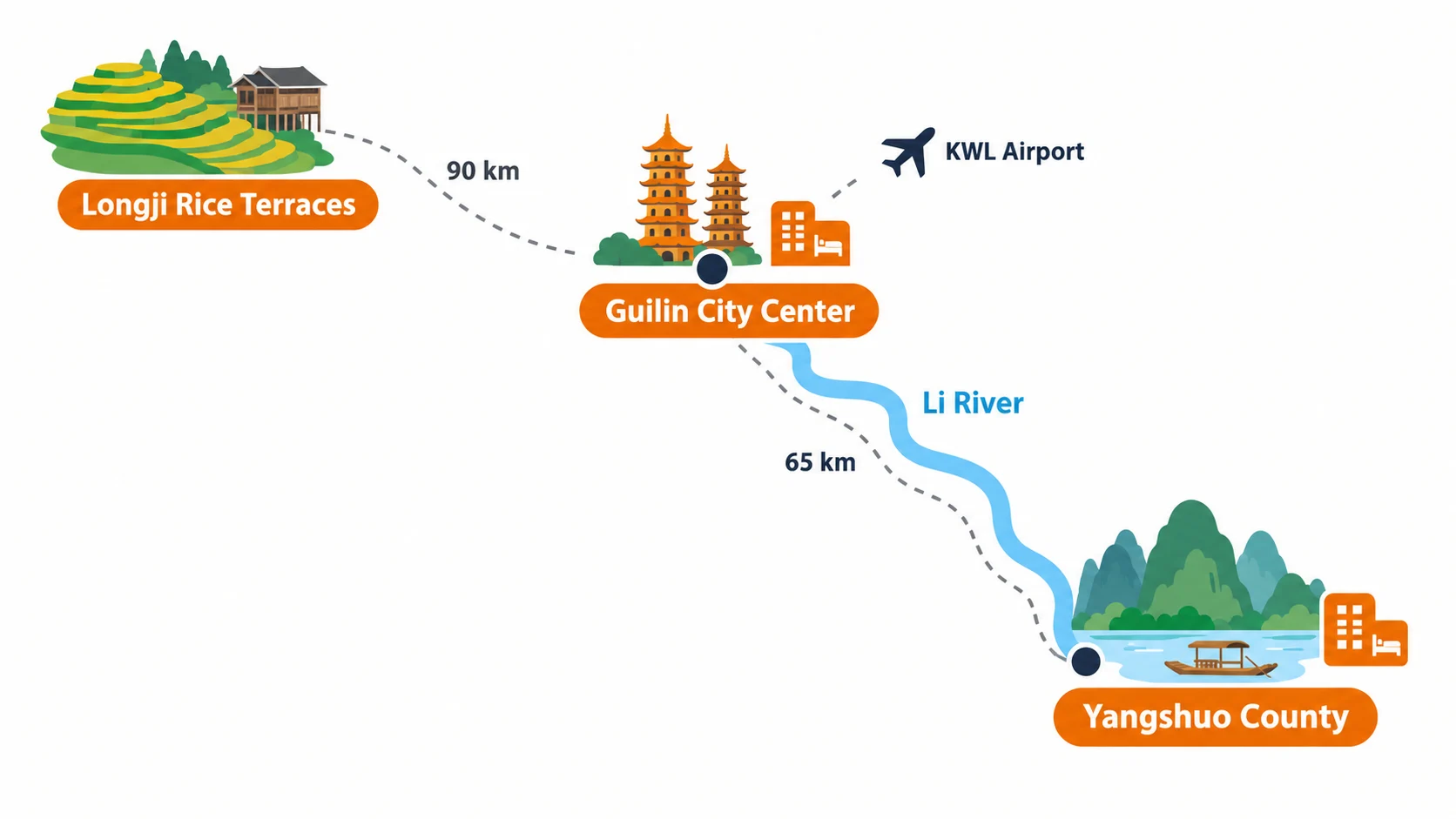
Most Guilin hotels fall into one of these three buckets, and each bucket suits a different traveler. One line to remember: the city is the hub, Yangshuo is the main event, Longji is the bonus.
🛏️ Guilin City Center — Best for First-Timers
Why start your trip here
The city center wins on one word: easy. Guilin Liangjiang International Airport (KWL) is about 30 km out, and a ride-share or taxi takes 45–60 minutes for ¥80–100. And don’t default to Guilin Station when you book the train. It’s closest to downtown, yes, but most high-speed trains from Guangzhou and Hong Kong pull into Guilin North (about 20–25 minutes by taxi to the center). Heading straight to Yangshuo? Book all the way to Yangshuo Station, near Xingping, and land even closer to the scenery. Sleep one night in the city first — it beats dragging a suitcase into Yangshuo after midnight.
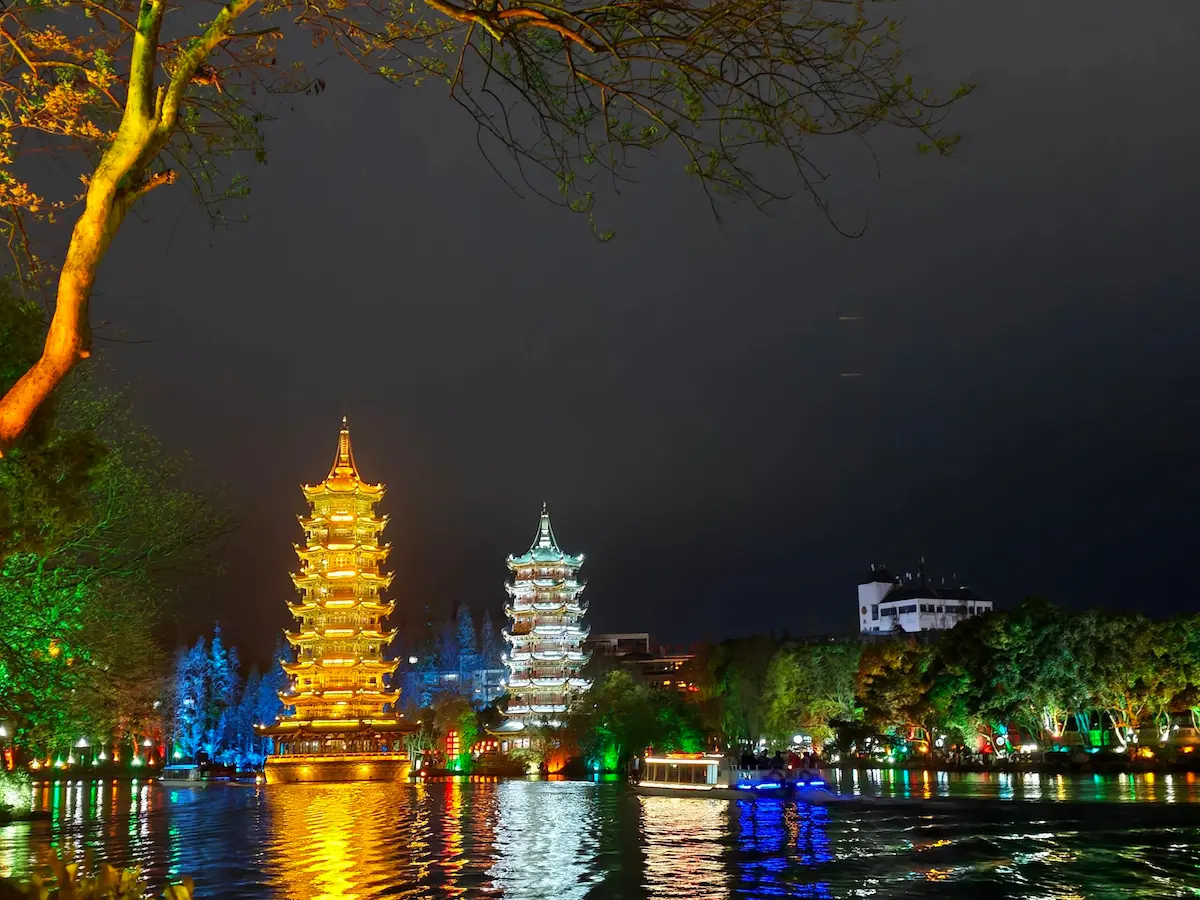
The sights and the food pile up in the same walkable pocket: Elephant Trunk Hill, the Sun and Moon Pagodas, East-West Lane, and the Two Rivers and Four Lakes. After dark, the pagodas light up and shiver across the lake, and your hotel is right there — no night drive. For the full sightseeing list, see our things to do in Guilin. Next morning, hop a Li River cruise at the dock and drift four hours to Yangshuo, big luggage riding along — step off and check straight into your Yangshuo hotel. That’s the smoothest handoff in the region.
And the rice noodles? The old shops hide in residential lanes. A bowl — a few slices of char siu and crispy pork, plus pickled bamboo shoots and chili you add yourself — costs ¥5–7, barely USD 1. For the full eating list, see what to eat in Guilin.
The best hotels in Guilin city center, by budget
Budget — ¥180–320 / USD 25–45 a night (Trip.com 9.2–9.4, Booking 8.8+)
Hostels like Wada Hostel and small local boutique stays sit near the pedestrian streets. Clean and easy. Rooms run small and walls run thin. Light sleepers, beware.
Mid-range — ¥430–720 / USD 60–100 a night (Trip.com 9.5–9.7)
Chain hotels like Ji Hotel and Atour (Central Square branch) are the safe pick. Beds and soundproofing follow a standard, and the locations land in the core. Hard to go wrong.
High-end — ¥850–1,800 / USD 120–250 a night (Trip.com 9.4–9.6, Booking 9.0+)
Shangri-La Guilin sits along the Li River with big gardens and mountain-and-river views — a comfortable home base with kids. Sheraton Guilin is right downtown, near the lakes and the walking street. Both are solid 5-star anchors. Want to see Elephant Trunk Hill and the pagodas from bed? Hunt for a lake-view room along Binjiang Road.
🛏️ Yangshuo — Best for Karst Scenery
Yangshuo is the main event, so park two to three nights here. You only have two real choices, and they’re simple: West Street for buzz, the Yulong River for quiet.
Best hotels in Yangshuo
West Street area — ¥250–580 / USD 35–80 a night (Trip.com 9.4–9.7)
The upside of West Street is stepping out into night markets and bars. The catch: don’t take a room on the street itself. The music runs past 1 or 2 a.m. Pick a place in the 10–15 minute walking ring around it, and you keep the buzz without the bass.
Yulong River / Ten-Mile Gallery — ¥800–2,000 / USD 110–280 a night (Trip.com 9.6–9.7, Booking 9.2+)
This is sleeping inside the landscape. Open the window to layered karst peaks and wake to morning mist and bamboo rustling instead of a bar’s subwoofer. Around Jima and Jiuxian, guesthouses let you watch Yulong River rafts drift past from bed. Quiet travelers and photographers, start here. Look at Four Seasons Yunqi Resort and LS Hotel, among others.
💡 Heads-up for families and older travelers: the hand-poled Yulong River rafts have hard age and height limits — children under 1.2 m (or about 5 years old) and seniors over 65 can’t ride (exact rules change by dock, so check on the day). Don’t build your whole Yangshuo stay around the raft if someone in your group won’t be allowed on.

Top-end hideaways — ¥2,500–4,300+ / USD 350–600+ a night (Trip.com 9.7, Booking 9.4+)
Sugar House and Banyan Tree Yangshuo are the ceiling. Sugar House repurposed an old sugar mill — industrial bones under a Chinese skin, the room itself is the exhibit. Banyan Tree spreads out as traditional southern garden villas ringed by peaks. If the budget allows and you want one stay to remember, these two are it.
(Traveling with kids and want all-inclusive ease? Club Med Guilin sits on the road from the city to Yangshuo — a full resort for lying low. We’ll cover it in its own review later.)
🌾 Longji Rice Terraces — Best for Photographers and Hikers
Longji sits northwest of Guilin, about 90 km out — a 2–2.5 hour car or shared ride, with a stretch of 28 hairpin bends. Motion-sick people, medicate first. My advice: spend one night. A day trip just leaves you panting on the mountain road and missing both sunset and sunrise.
Ping’an vs Dazhai (Jinkeng)
Ping’an is the oldest and most developed, with the Seven Stars and Moon and Nine Dragons and Five Tigers viewpoints. Gentler slopes — good for first-timers, families, and anyone short on legs. Dazhai (Jinkeng) is bigger and more dramatic, with a cable car straight to the No. 3 viewpoint at Golden Buddha Peak. Skip the cable car and the stone-path climb is seriously steep — better for photographers and fit hikers.
Guesthouse prices: Ping’an ¥400–800 / USD 55–110 a night, Dazhai ¥280–650 / USD 40–90, with Trip.com scores mostly 9.2–9.8. After the crowds leave, the terraces stack down in golden evening light, then the morning cloud sea rolls over them. Worth one night.
💡 Luggage warning: cars stop at a public lot at the base of the village, and from there it’s a 20–45 minute stair climb to your guesthouse. Big suitcases are brutal to haul — most people hire a local Yao woman with a bamboo basket, ¥50–100 per bag one way. Leave the 28-inch suitcase at your city or Yangshuo hotel and carry up one backpack with toiletries and a change of clothes. Most terrace guesthouses are also all-wood stilt houses with weak soundproofing, so light sleepers should look for a modern concrete structure with a wooden exterior.

📍 Where to Stay: Guilin or Yangshuo?
Where to stay — Guilin or Yangshuo? I get asked this more than anything, and my answer is blunt: don’t choose one, split your nights.
- Short trip (2–3 days): lean on Yangshuo, with one city night as a buffer. Guilin city’s value is the transport hub, a bowl of noodles, and one night of lights — don’t give it more nights than that.
- Longer trip (4+ days): one city night, two to three Yangshuo nights, and one Longji night if you have the time.
Match yourself to a zone:
- Convenience, early trains, love to eat and wander → the city center, near Guilin Station or the Two Rivers and Four Lakes.
- Sleeping inside the scenery, Yulong River rafts, Ten-Mile Gallery cycling → Yangshuo, riverside first.
- Photography, hiking, terrace sunrise → Longji, Ping’an or Dazhai.
📌 One honest line: the city’s night view is pretty, but Guilin’s soul lives in Yangshuo and Longji’s mountains. Don’t spend all your evenings in town. For how many days to give each stop, see our Guilin itinerary.
⚠️ 5 Mistakes to Avoid When Booking Hotels in Guilin
1. Picking the wrong spot on West Street. West Street is a bar strip, and street-side rooms boom past 1 a.m. Light sleepers: take the 10–15 minute ring outside it, or head to the Yulong River.
2. Peak-season price surges and “filter” guesthouses. During National Day (first week of October) and summer (July–August), Yangshuo prices can double or triple. Plenty of new “Instagram” guesthouses shoot with wide lenses and heavy filters, then the real room is small and badly soundproofed. Scroll recent reviews and focus on noise insulation and bathroom cleanliness.
3. Underestimating Longji’s logistics. From the scenic-area gate it’s another 30–40 minutes of hairpin road to the villages, the car stops at the base, and then it’s a 20–45 minute stair climb with paid porters for your bags. Don’t treat Longji as a “quick stop.”
4. Trusting the OTA ranking over the map. The same hotel one street over can feel like a different place. Before booking, open the map and measure the real distance to the station, dock, or walking street — don’t trust the word “downtown.”
5. Not locking rooms early in peak season. Good Yulong River and Longji guesthouses book out one to two weeks ahead in summer and on National Day. Once your dates are set, reserve early. Last-minute means whatever’s left, pricey and far.
More arrival logistics and how to get around live in our Guilin travel tips.
❓ FAQ — Hotels in Guilin
Should I stay in Guilin city or Yangshuo?
Depends on your trip. Short on time or love the buzz — stay in the city. Want the scenery — Yangshuo. The ideal split is one city night as a buffer, then two to three Yangshuo nights.
Where’s the safest place to stay for a first visit?
The city center around the Two Rivers and Four Lakes or Guilin Station. Sights and food are walkable, and you can head to Yangshuo the next day.
How many nights do I need in Guilin?
City plus Yangshuo needs three (one city, two Yangshuo); add Longji and four is more comfortable. For the day-by-day, see our Guilin itinerary.
What’s a realistic hotel budget in Guilin?
City budget runs ¥180–320 / USD 25–45, mid-range ¥430–720 / USD 60–100; Yangshuo riverside boutique runs ¥800–2,000 / USD 110–280. For a splurge, Banyan Tree or Sugar House start around ¥2,500 / USD 350+.
So — city, Yangshuo, or a night on the Longji terraces? Whichever you pick, book the bed before the flight.