2 Week China Itinerary: A Classic Route for First-Time Travelers
Planning your first trip to China feels like staring at a giant puzzle. The country is vast—you could spend two months here and still barely scratch the surface. But if you have exactly 14 days and want to walk away feeling like you’ve truly seen China, there’s a route that just works. Think of this as your on-the-ground china travel guide for a two-week trip: visas, trains, apps, food—all laid out step by step.
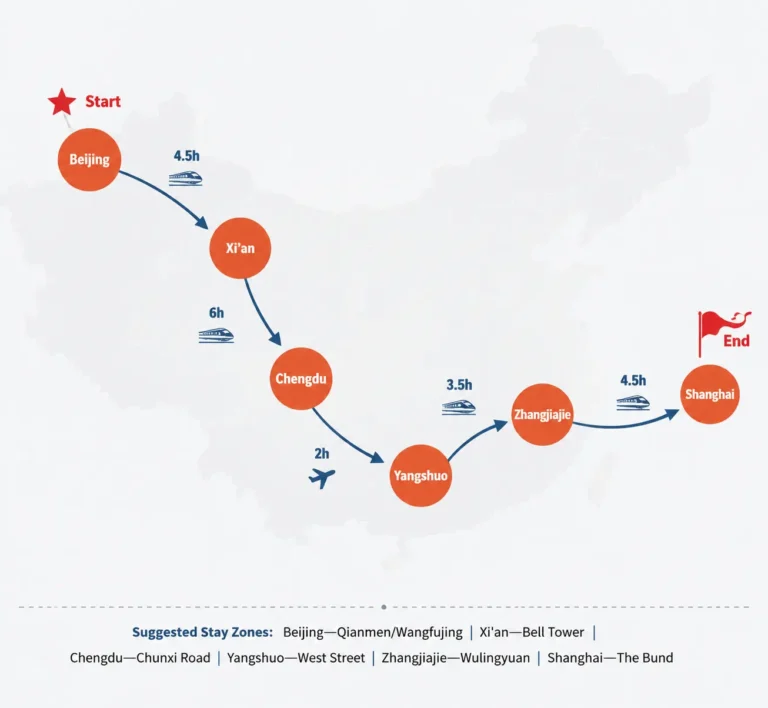
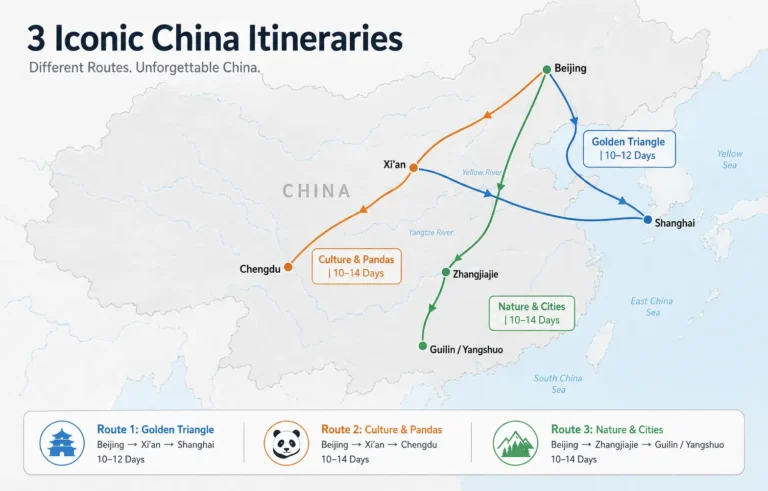
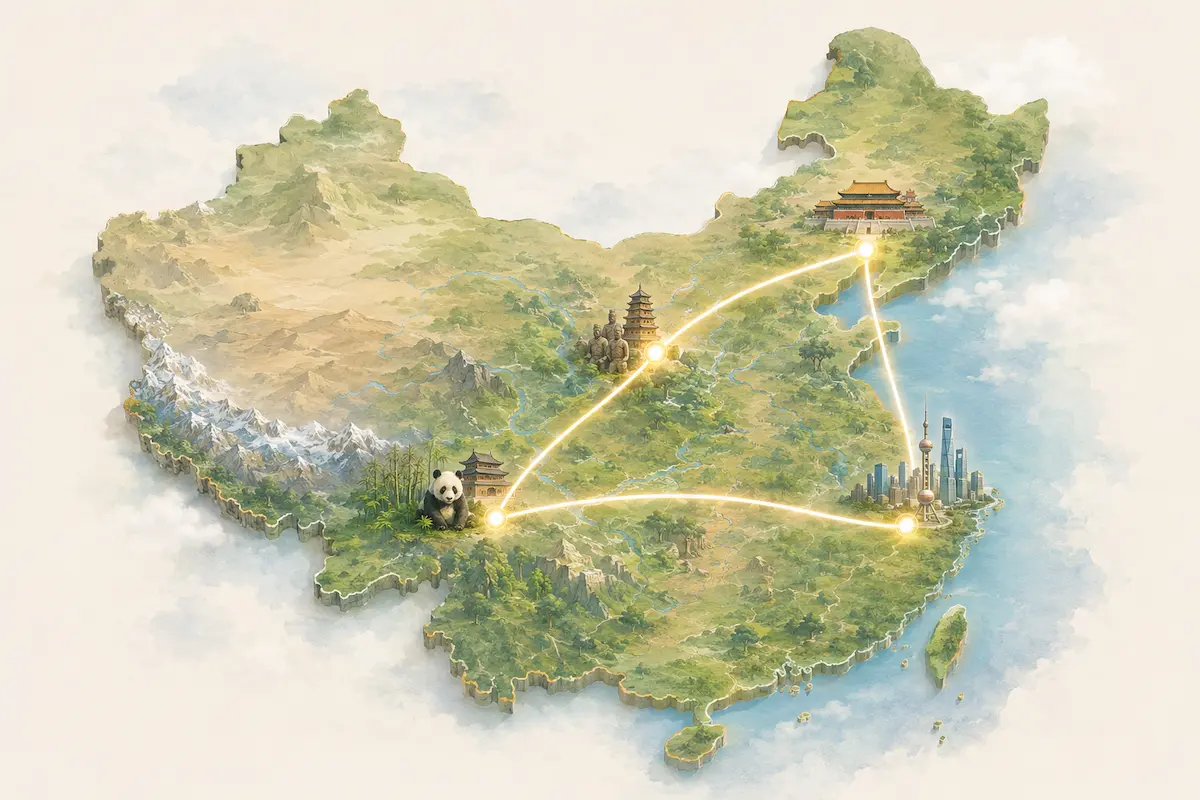
Beijing → Xi’an → Chengdu → Shanghai. Four cities. Four completely different faces of China—imperial powerhouse, ancient capital, laid-back tea-house life, and futuristic skyline. All stitched together by high-speed rail except one short flight at the end.
This 2 week china itinerary is built for first-timers. It doesn’t cram 12 cities into 14 days. It doesn’t make you wake up at 5 a.m. every morning. Each city gets enough breathing room that you actually remember what you saw. If you’re looking for the best china itinerary that balances pacing with coverage, you’re in the right place.
Only have 10 days? Jump to the china itinerary 10 days section near the bottom—a trimmed version is waiting. For other trip lengths and guided options, browse our china itinerary collection.
- Before Diving Into This 2 Week China Itinerary: 7 Things to Sort Out First
- The Classic 2 Week China Itinerary at a Glance
- Day-by-Day: Your 2 Week China Trip Itinerary
- Only Have 10 Days? China Itinerary 10 Days
- Getting Around: China's High-Speed Trains
- Where to Stay (Mid-Range Picks)
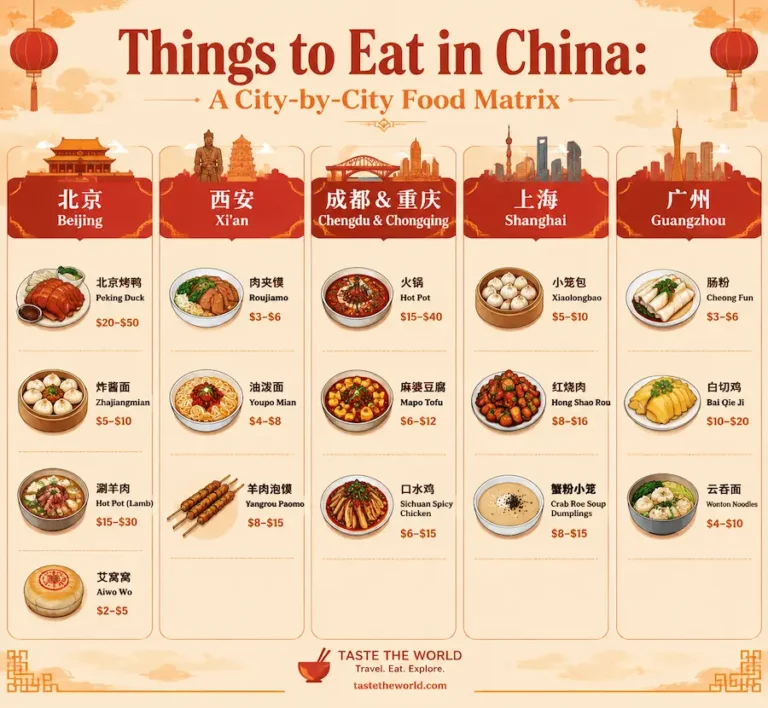
- What to Eat in Each City
- Bathrooms, Tipping, and Other Things Nobody Tells You
- Quick Answers to Questions You Probably Have
Before Diving Into This 2 Week China Itinerary: 7 Things to Sort Out First
1. Visa (Updated June 2026)
China’s china visa rules have loosened considerably. For a full step-by-step walkthrough, see our china visa application guide. Two main options exist for most tourists right now.
240-Hour Transit Without a Visa (10 days): Covers citizens of 55 countries—including the US, Canada, UK, Australia, New Zealand, Japan, South Korea, and most EU nations. The condition: you must hold an onward ticket to a third country or region. Flying New York → Beijing → Tokyo? You’re covered. New York → Beijing → New York? Not eligible. The 240 hours start counting from midnight after you land. You can travel across 24 designated provinces. No extensions allowed.
Unilateral Visa-Free Entry (15–30 days): Covers citizens of 50 countries for tourism, business, or family visits. No onward-ticket trick required. Just show up with your passport, return flight, and hotel bookings.
One important thing: visa-free doesn’t mean automatic entry. Border officers can ask for proof of onward travel and accommodation. Keep printouts handy. And always double-check the latest country list on your local Chinese embassy website—these lists get updated frequently.
2. When to Go
Spring (March to May) and autumn (September to November) are the best time to visit China for this route. Mild temperatures, manageable crowds. Beijing’s autumn colors on the Great Wall will stay with you for years.
Summer (June to August) gets hot and humid, but Chengdu’s greenery looks its best. Winter (December to February) is cold and dry—but tourists are scarce, prices drop, and the Forbidden City under snow is stunning.
Avoid: the first week of October (Golden Week—the entire country travels at once) and Chinese New Year (late January or early February—mass chaos at every train station).
3. What This 2 Week China Itinerary Costs
Here’s a realistic budget for one person traveling at mid-range comfort, not counting international flights:
- Budget travel: ¥400–600/day (≈57–86 USD) — hostels, street food, public transport
- Mid-range: ¥800–1,300/day (≈114–186 USD) — 4-star hotels, nice restaurants, high-speed trains, attraction tickets
- High-end: ¥2,000+/day (≈286+ USD) — 5-star hotels, private car, fine dining
For a 14-day mid-range trip, expect to spend roughly ¥12,000–18,000 per person (≈1,714–2,571 USD). Two people sharing a room brings the per-person number down noticeably.
4. Internet: The VPN Question
Google, Instagram, Facebook, WhatsApp, Gmail—none of them work in mainland China without help. Two ways around this:
Option A (easier): Buy an eSIM before you leave home (Airalo and Holafly both have China plans). These route data through overseas carriers, so everything works without a VPN. Or turn on your home carrier’s international roaming package.
Option B: Get a local Chinese SIM card on arrival and install a reliable VPN before you leave your home country. Do not wait until after you land—VPN websites are blocked in China, and you’ll be stuck.
5. Money: China Doesn’t Do Cash Anymore
Seriously. Street vendors selling pancakes take QR codes. You’ll need:
- Alipay: Supports foreign Visa/Mastercard. No Chinese phone number required.
- WeChat Pay: Also supports foreign cards now. Broader coverage in smaller towns and individual shops.
To link a card on WeChat: open the app → Me → Services → Wallet → Add Bank Card → follow the prompts. Visa, Mastercard, Discover, JCB, and Diners Club all work. You can use your overseas phone number for registration.
Carry ¥500–1,000 (≈71–143 USD) in cash as backup. You’ll probably never touch it, but some rural spots still prefer paper.
6. Apps You’ll Actually Use
| App | What It Does |
|---|---|
| Alipay | Payments, ride-hailing, attraction tickets, food delivery |
| Messaging, payments, museum bookings | |
| DiDi | China’s Uber. English interface available |
| Amap / Baidu Maps | Navigation. Google Maps data in China is badly outdated—switch to one of these |
| Trip.com | Hotels, flights, train tickets. Full English interface |
| Dianping | Restaurant reviews from actual locals |
| Google Translate | Camera translation for menus and signs. Life-saver |
| VPN | Install before departure. Test it |
7. Hotel Registration Rules
Hotels handle everything—hand over your passport at the front desk and they register you with the police automatically. You do nothing extra.
Airbnb and private apartments are different. You or the host must visit the local police station within 24 hours of check-in to register (bring your passport and the host’s contact info). Skip this and you risk a warning or fine. If that sounds like a headache, stick to hotels.
The Classic 2 Week China Itinerary at a Glance
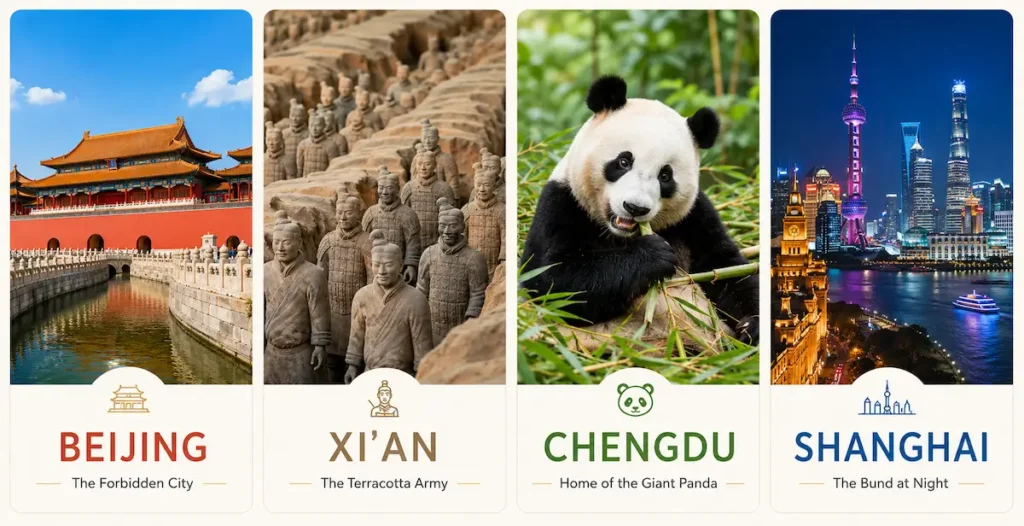
Thousands of travelers have used a similar china itinerary 2 weeks framework and come back calling it the perfect introduction to the country. This classic china route strings together four cities that each show a completely different side of China. Every stop gets 3 to 4 days—enough to hit the essentials without turning your vacation into a checklist race.
| Days | City | Core Experience |
|---|---|---|
| Day 1 | Arrive Beijing | Settle in, beat jet lag, evening walk on Qianmen Street |
| Day 2 | Beijing | Tiananmen Square → Forbidden City (full day) |
| Day 3 | Beijing | Great Wall (Mutianyu or Badaling) → Olympic Park |
| Day 4 | Beijing → Xi’an | Temple of Heaven → Summer Palace or hutong bike ride → evening train to Xi’an |
| Day 5 | Xi’an | Muslim Quarter → Bell & Drum Towers → City Wall at sunset |
| Day 6 | Xi’an | Terracotta Warriors (full day, including round-trip) |
| Day 7 | Xi’an | Shaanxi History Museum → Giant Wild Goose Pagoda → Great Tang All Day Mall |
| Day 8 | Chengdu | High-speed train to Chengdu → Kuanzhai Alley → People’s Park tea house |
| Day 9 | Chengdu | Giant Panda Base (morning) → Wuhou Shrine → Jinli Old Street |
| Day 10 | Chengdu | Leshan Giant Buddha day trip (1-hour train) |
| Day 11 | Shanghai | Fly to Shanghai → the Bund at night |
| Day 12 | Shanghai | Nanjing Road → Shanghai Museum → Xintiandi or Tianzifang |
| Day 13 | Shanghai | Yuyuan Garden → Lujiazui (Shanghai Tower observation deck) → Huangpu River night walk |
| Day 14 | Shanghai departure | Last-minute shopping → head to airport |
This 2 week china itinerary is designed so each city unfolds at a rhythm that feels natural—not rushed, not empty. Below is how it plays out on the ground.
Day-by-Day: Your 2 Week China Trip Itinerary
Beijing (Days 1–4)
Day 1 — Land, breathe, ease in. You’ll arrive at either Capital Airport or Daxing Airport. Take the airport express train or a DiDi to your hotel. A solid pick: Beijing Overseas Chinese Rui Shi Hotel near Wangfujing (¥700–1,000/night, ≈100–143 USD). In the evening, walk Qianmen Street—a restored historic commercial strip on Beijing’s central axis. Don’t over-schedule Day 1. Your body needs time to adjust, and easing into this 2 week china itinerary the right way pays off later.
Dinner: Siji Minfu Roast Duck. Locals choose this over the tourist-famous Quanjude. The roast duck here is consistently excellent.
Day 2 — Tiananmen Square and the Forbidden City. Tiananmen Square is free and open. Walk through the Tiananmen Gate straight into the Forbidden City.
Booking note: tickets go on sale 7 days in advance at 8:00 p.m. Beijing time via the Palace Museum’s official mini-program or multilingual website. Foreign passports are accepted for both booking and entry. Online payment supports Visa and Mastercard. If you absolutely cannot get a ticket online, the museum offers limited same-day window tickets for international visitors—use this as a last resort.
Plan at least 4 hours inside. Follow the central axis to the Imperial Garden, then explore a few side halls. When you exit through the north gate, walk to the corner tower for the classic moat-and-palace photo.
Evening: wander through Nanluoguxiang and the Shichahai lake area. Craft beer bars, snack stalls, and old hutong lanes that look best at dusk.
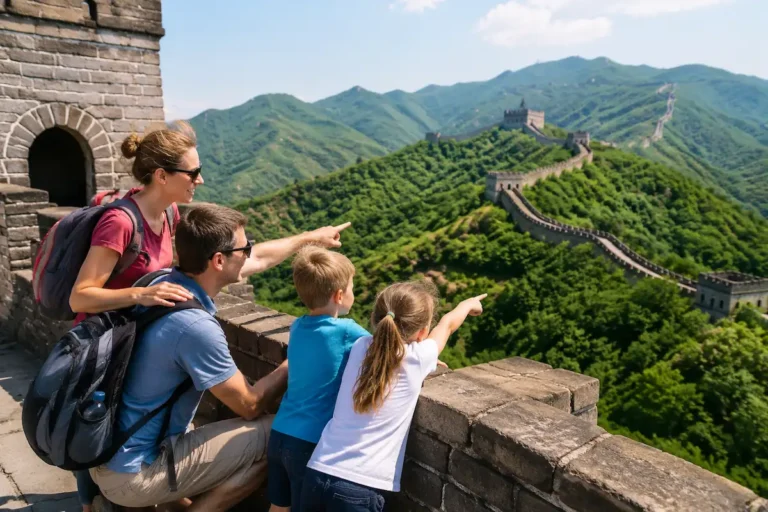
Day 3 — Great Wall. Two solid options: Mutianyu (fewer crowds, better for foreign visitors, cable car up, toboggan slide down) or Badaling (the most famous section, well-maintained, busier). Either way, budget 6–7 hours round-trip. Hiring a car or joining a small-group English tour makes the logistics painless.
On the way back, swing past the Olympic Park to see the Bird’s Nest and Water Cube from the outside. Then grab dinner in Sanlitun—Beijing’s expat-friendly bar and dining district.
Day 4 — Temples, gardens, then off to Xi’an. Morning at the Temple of Heaven. The Hall of Prayer for Good Harvests is the most photogenic single building in Beijing. Lunch in Niujie (Beijing’s Muslim quarter)—more authentic and less touristy than Nanluoguxiang.
Afternoon: pick between the Summer Palace (royal gardens on a grand scale) or a hutong bike ride through the Shichahai and Drum Tower area. By evening, head to Beijing West Station for your high-speed train to Xi’an (about 4.5–5.5 hours).
Xi’an hotel pick: Xi’an Drum Tower Jinmao Hotel (¥500–800/night, ≈71–114 USD) for location, or the Sofitel Legend Xi’an (¥1,200–1,800/night, ≈171–257 USD) for something special.
Xi’an (Days 5–7)
Day 5 — Food streets and ancient walls. Start in the Muslim Quarter. The main street is a tourist conveyor belt—walk through it, take photos, but eat in the side lanes: Xiyangshi and Dapiyuan. Order roujiamo (Chinese-style meat sandwich), yangrou paomo (lamb soup with torn flatbread), biangbiang noodles, and a sour plum drink.
Afternoon: the Bell Tower and Drum Tower sit at the city’s geographic heart. Climb one for the view, then head to the City Wall. Enter at the South Gate (Yongningmen), rent a bike, and ride the full 14-kilometer loop (1.5–2 hours). Sunset from the wall, with the old city spread out below, is one of those moments that makes a china itinerary 2 weeks feel like the right amount of time.
Day 6 — Terracotta Warriors. This is the main event. From downtown Xi’an, it’s about an hour by taxi or public bus (Route 306 / “Tourist Bus 5”). Go through the pits in this order: Pit 2 → Pit 3 → Pit 1. Pit 1 is the big one—the one from every photograph—and saving it for last builds anticipation. Hire an English-speaking guide at the site. Without context, they’re clay figures. With context, you’re staring at an emperor’s obsession to take his army into the afterlife.
Day 7 — Museums and Tang Dynasty vibes. Morning at the Shaanxi History Museum—one of China’s finest. It’s free, but tickets are infamously hard to grab. If you miss out, the Small Wild Goose Pagoda + Xi’an Museum combo is a quieter, easier alternative.
Afternoon: Giant Wild Goose Pagoda and Daci’en Temple. Evening: Great Tang All Day Mall—a pedestrian strip with Tang Dynasty-themed lights, architecture, and street performances. It’s crowded. Embrace it or skip it.
Chengdu (Days 8–10)
Day 8 — Arrive and slow down. The morning train from Xi’an to Chengdu (Xi-Cheng High-Speed Railway, about 3.5–4 hours) cuts through the Qinling Mountains. Window seat recommended.
Hotel pick: Chengdu Chunxifang Atour Hotel near Chunxi Road (¥500–700/night, ≈71–100 USD) for a solid mid-range option. If budget allows, The Temple House in Taikoo Li (¥1,500–2,500/night, ≈214–357 USD) is one of the best-designed hotels in China.
Afternoon: Kuanzhai Alley—three parallel Qing Dynasty lanes, now polished for tourism. Worth a walk, but the real Chengdu moment happens next. Walk to People’s Park and find the Heming Tea House. Order a cup of jasmine tea. Sit. Watch locals play mahjong, get their ears cleaned, and talk for hours. This is the Chengdu experience: doing nothing, intentionally. It’s also why this 2 week china itinerary includes Chengdu—without it, you miss China’s soul.
A quick word on spice. Chengdu’s “mild” is closer to what many countries call “extra hot.” Memorize these: bù yào là (不要辣) = no chili at all. Wēi wēi là (微微辣) = the absolute minimum. Hot pot restaurants offer yuānyāng guō (鸳鸯锅)—a split pot, half spicy and half plain. Order it.

Day 9 — Pandas and Three Kingdoms. Get to the Chengdu Research Base of Giant Panda Breeding by 7:30 a.m.—when the gates open. Pandas eat in the morning and sleep after 10 a.m. Arriving early also means you beat the tour bus crowds that flood in by 9:30.
Afternoon: Wuhou Shrine, dedicated to Zhuge Liang, the strategist from China’s Three Kingdoms period. Next door, Jinli Old Street lights up nicely after dark. For dinner, try chuanchuan (串串)—think hot pot on skewers. You grab what you want, dunk it, eat.
Day 10 — Leshan Giant Buddha. A 1-hour high-speed train from Chengdu drops you in Leshan. The Buddha is 71 meters tall, carved into a cliff face during the Tang Dynasty. You can walk the narrow staircase from head to foot, or take a river cruise for the best straight-on photo. Back in Chengdu by evening.
Shanghai (Days 11–14)
Day 11 — Touch down and hit the Bund. Fly from Chengdu to Shanghai (about 3 hours, ¥600–1,200 ≈ 86–171 USD). An overnight sleeper train exists (11–12 hours) if you’d rather save a hotel night, but flying is faster and simpler.
Hotel pick: Holiday Inn Shanghai Nanjing Road (¥600–900/night, ≈86–129 USD)—walkable to the Bund. For a splurge: Waldorf Astoria Shanghai on the Bund (¥2,000–3,500/night, ≈286–500 USD).
Evening: the Bund. Colonial-era buildings on one side, Pudong’s sci-fi skyline on the other. Pro tip: cross the river (take the 2-yuan ferry, not the expensive sightseeing tunnel) and walk the Pudong promenade. Looking across the water toward the Bund’s lit-up heritage buildings is the better photograph.
Day 12 — Shopping, museums, and lane houses. Walk Nanjing Road from end to end, passing through People’s Square. The Shanghai Museum is free and has world-class collections of ancient bronzes and ceramics.
Evening: pick between Xintiandi (upscale dining in restored shikumen lane houses) or Tianzifang (a labyrinth of narrow alleyways packed with tiny shops, galleries, and bars). Tianzifang is more chaotic and more fun.
Day 13 — Old gardens and new skylines. Morning at Yuyuan Garden—a 400-year-old Ming Dynasty private garden tucked among skyscrapers. The adjacent City God Temple snack street is touristy but entertaining.
Afternoon: cross to Pudong’s Lujiazui district, home to China’s densest cluster of skyscrapers. Go up the Shanghai Tower observation deck (632 meters, the world’s second-tallest building). The view puts the entire city into perspective.
Evening walk along the Huangpu River. No ticket needed—just find a spot on the promenade and watch the lights. This is the final evening of your 2 week china itinerary, and it delivers.
Day 14 — One last morning, then home. If your flight is late, spend the morning in the Wukang Road / Anfu Road area—Shanghai’s former French Concession. Tree-lined streets, bakeries, coffee shops. A quiet way to close out two weeks. Then head to Pudong International or Hongqiao Airport.
Only Have 10 Days? China Itinerary 10 Days
A lot of people search for a china itinerary 2 weeks but actually have 10 days of vacation. Not everyone searching for a 2 week china itinerary can take two full weeks off. Here’s the trimmed version: same route, minus Chengdu.
| Days | City | Plan |
|---|---|---|
| Day 1 | Arrive Beijing | Settle in + Qianmen Street |
| Day 2 | Beijing | Tiananmen Square + Forbidden City (full day) |
| Day 3 | Beijing | Great Wall (Mutianyu or Badaling) |
| Day 4 | Beijing → Xi’an | Morning Temple of Heaven, afternoon train to Xi’an (4.5–5.5h) |
| Day 5 | Xi’an | Terracotta Warriors day trip |
| Day 6 | Xi’an | City Wall bike ride + Shaanxi History Museum + Great Tang All Day Mall |
| Day 7 | Xi’an → Shanghai | Free morning, afternoon flight to Shanghai (~2.5h) |
| Day 8 | Shanghai | The Bund + Nanjing Road + Shanghai Museum |
| Day 9 | Shanghai | Yuyuan Garden + Lujiazui (Shanghai Tower) + Tianzifang / Xintiandi |
| Day 10 | Shanghai departure | Last shopping → head to airport |
The logic here is simple. Cutting Chengdu saves 3 days without sacrificing the core of Beijing and Xi’an. You still get imperial palaces, the Great Wall, the Terracotta Warriors, and Shanghai’s skyline. If pandas and Sichuan food are non-negotiable for you, swap Shanghai for Chengdu instead—but know that international flight options out of Chengdu are far fewer.
Getting Around: China’s High-Speed Trains
China’s high speed rail network is the largest on the planet. On this china trip itinerary, trains are your backbone—fast, punctual, and far less hassle than flying. The china bullet train system connects all four cities on this route with impressive comfort—second-class seats here offer legroom comparable to European first class.
| Route | Duration | Second Class (approx.) |
|---|---|---|
| Beijing → Xi’an | 4.5–5.5 hours | ¥550 (≈79 USD) |
| Xi’an → Chengdu | 3.5–4 hours | ¥263 (≈38 USD) |
| Chengdu → Shanghai | 3-hour flight or 11–12-hour sleeper train | Flight: ¥600–1,200 (≈86–171 USD) |
Buy tickets on Trip.com (full English interface) or the 12306 English website. Both accept foreign passports. Book 7–14 days ahead on popular routes—they really do sell out. At the station, go through the manual gate with your passport. No paper ticket needed; China uses electronic tickets, and your passport is scanned for entry.
Each carriage has large luggage racks at both ends. The official limit is 20 kg per piece, but enforcement is rare.
Where to Stay (Mid-Range Picks)
| City | Hotel | Area | Price/Night |
|---|---|---|---|
| Beijing | Beijing Overseas Chinese Rui Shi Hotel | Wangfujing | ¥700–1,000 (≈100–143 USD) |
| Xi’an | Xi’an Drum Tower Jinmao Hotel | Bell Tower | ¥500–800 (≈71–114 USD) |
| Xi’an (splurge) | Sofitel Legend Xi’an | Bell Tower | ¥1,200–1,800 (≈171–257 USD) |
| Chengdu | Chengdu Chunxifang Atour Hotel | Chunxi Road | ¥500–700 (≈71–100 USD) |
| Chengdu (splurge) | The Temple House | Taikoo Li | ¥1,500–2,500 (≈214–357 USD) |
| Shanghai | Holiday Inn Shanghai Nanjing Road | Nanjing Road | ¥600–900 (≈86–129 USD) |
| Shanghai (splurge) | Waldorf Astoria Shanghai on the Bund | The Bund | ¥2,000–3,500 (≈286–500 USD) |
What to Eat in Each City
| City | Must Eat | Notes |
|---|---|---|
| Beijing | Roast duck, zhajiang noodles, copper-pot lamb hot pot | For duck: Siji Minfu. For hot pot: Jubao Yuan or Nanmen Hot Pot |
| Xi’an | Roujiamo, yangrou paomo, biangbiang noodles, cold skin noodles | Skip the Muslim Quarter main street—eat deep in Xiyangshi and Dapiyuan lanes |
| Chengdu | Hot pot, chuanchuan skewers, mapo tofu, dandan noodles | “Mild” = very hot. Order yuanyangguo (split pot) for hot pot |
| Shanghai | Xiaolongbao (soup dumplings), shengjianbao (pan-fried buns), scallion oil noodles, red-braised pork | Best xiaolongbao: Nanxiang Steamed Bun Restaurant or Jiajia Tang Bao |
General food tips: Tap water is not drinkable—hotels provide free bottled water or an electric kettle. Restaurants serve hot tea or room-temperature water by default; ask for “bīng shuǐ” (冰水) if you want cold water. Pick restaurants with long lines and high turnover—hot food made continuously is generally safest. And there is no tipping culture in China. Restaurants, hotels, taxis, and guides do not expect tips.
Bathrooms, Tipping, and Other Things Nobody Tells You
Public toilets in tourist areas are mostly squat-style and do not always stock toilet paper or soap. Carry a small pack of tissues, wet wipes, and hand sanitizer. In city centers, upscale malls and five-star hotel lobbies usually have clean seated toilets—keep this in mind when you’re out exploring.
Riding the subway? Bags go through an X-ray scanner at every station entrance—it’s routine, not suspicious. Allow an extra minute.
Want to visit the Forbidden City on short notice? Tickets open 7 days ahead at 8:00 p.m. Beijing time. Set a calendar reminder. If you miss the online window, there’s a small allocation of same-day tickets for international visitors at the gate—but treat this as a backup, not a plan.
For more practical advice—packing lists, safety tips, and money-saving tricks—check our china travel tips page.
Quick Answers to Questions You Probably Have
Can I travel in China without speaking Chinese?
Yes, with tools. Google Translate’s camera function handles menus and signs surprisingly well. Metro systems in major cities have English signage. High-speed train stations have English announcements. Learn “nǐ hǎo” (hello), “xiè xie” (thank you), and “duō shǎo qián” (how much)—those three phrases alone change the tone of every interaction.
Is 2 weeks enough for China?
Enough to see the greatest hits without feeling rushed. This 2 week china itinerary covers four cities with 3–4 days each. You won’t see everything—nobody does—but you’ll leave with a real sense of the country’s range, from ancient walls to panda forests to neon skylines.
Should I pick the 2-week or 10-day version?
If you can swing 14 days, take the full route. The Chengdu leg adds a completely different texture—slower, greener, more personal. If 10 days is your limit, the china itinerary 10 days version (Beijing → Xi’an → Shanghai) still packs in more than most travelers see in a month.
Is China safe?
Exceptionally. Walking alone at night in any of these four cities carries almost zero risk. The most common danger to tourists is the occasional scam—tea-house invitations from friendly strangers, monks asking for donations. Basic street smarts apply, same as anywhere.
What’s the best first time china itinerary for someone who hates crowds?
The route in this guide already favors slightly less-packed alternatives: Mutianyu over Badaling for the Great Wall, early-morning panda visits, the quieter Small Wild Goose Pagoda as a backup for the Shaanxi History Museum. Traveling in shoulder season (March–April or late September–November) makes the biggest difference of all.
This classic china route has been walked by thousands of first-timers before you. Most of them come back saying the same thing.
They wish they’d come sooner.
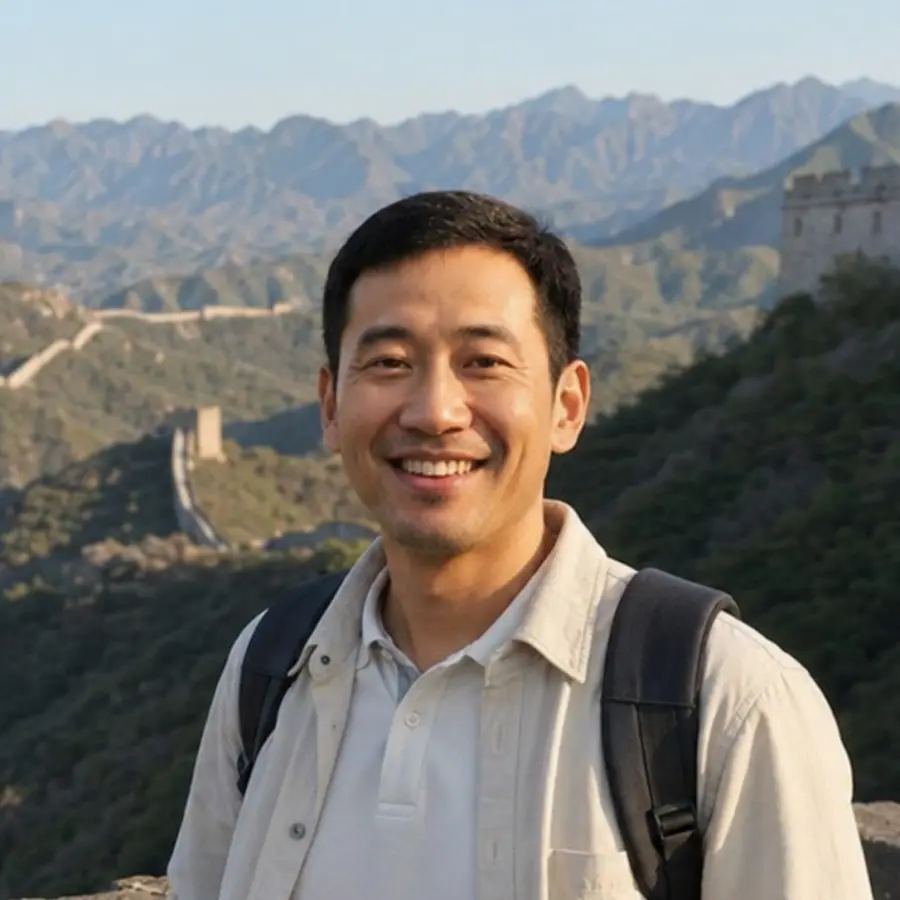
Ke Ping — Founder, InsiderChinaTravel
I personally reply to every email and create free, custom trip frameworks. Already have a plan? I can arrange vetted local guides and private drivers. Over 5,000 travelers from 30+ countries have started their journey this way.
📋 Tell me about your trip ideaReplied within 24 hours. No charge, no obligation.