China Itinerary 3 Weeks for First-Timers: Route, Map & What It Costs
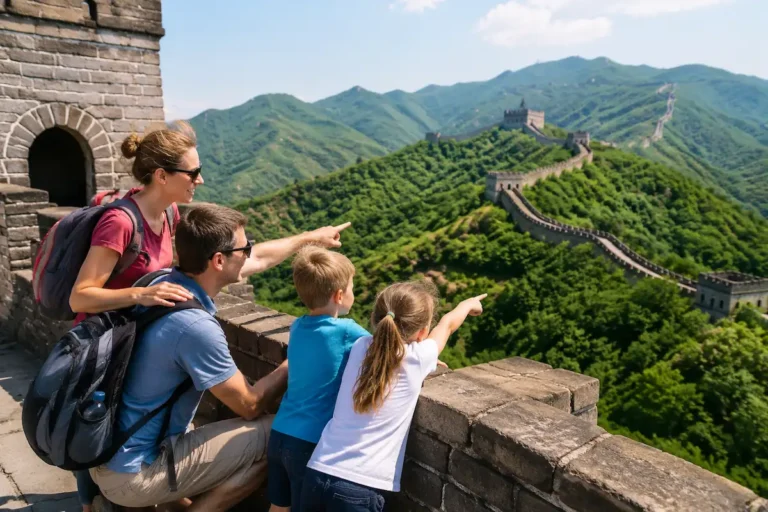
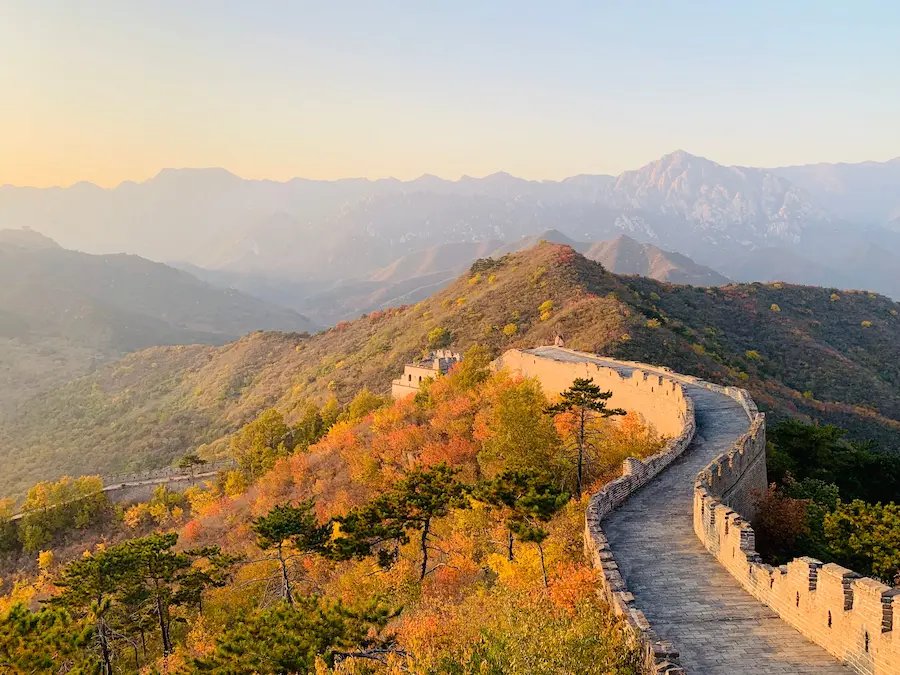
Mutianyu Great Wall, 6:17 a.m.
The fog hadn’t burned off yet. I stood at a watchtower parapet, looking down at the wall snaking across the ridgeline like a gray spine someone forgot about. No tour guide flags. No selfie sticks. No one saying “excuse me.” Just me, my friend, and a crooked pine tree swaying in the wind.
Three weeks earlier, if someone had told me I’d watch sunrise on an empty section of the Great Wall — I wouldn’t have believed them. Isn’t China supposed to be packed?
Not always. This china itinerary 3 weeks long took me from Beijing’s hutong alleys to Yangshuo’s rice paddies, from a bubbling Sichuan hotpot to the floating sandstone pillars of Zhangjiajie. Six cities, seven high-speed trains, and a grand total of roughly ¥23,000 / USD 3,300 (excluding international flights).
If you’re mapping out a china itinerary 3 weeks from now and want something battle-tested — a route that balances imperial history, otherworldly nature, and futuristic cities without burning you out — this is it. Below is the exact day-by-day plan, what it costs, and the mistakes I made so you don’t have to.
China Itinerary 3 Weeks: Your Day-by-Day Route at a Glance
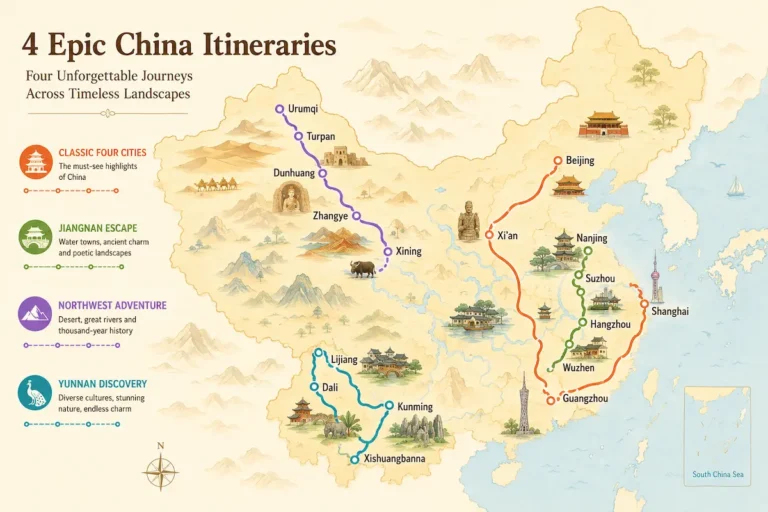
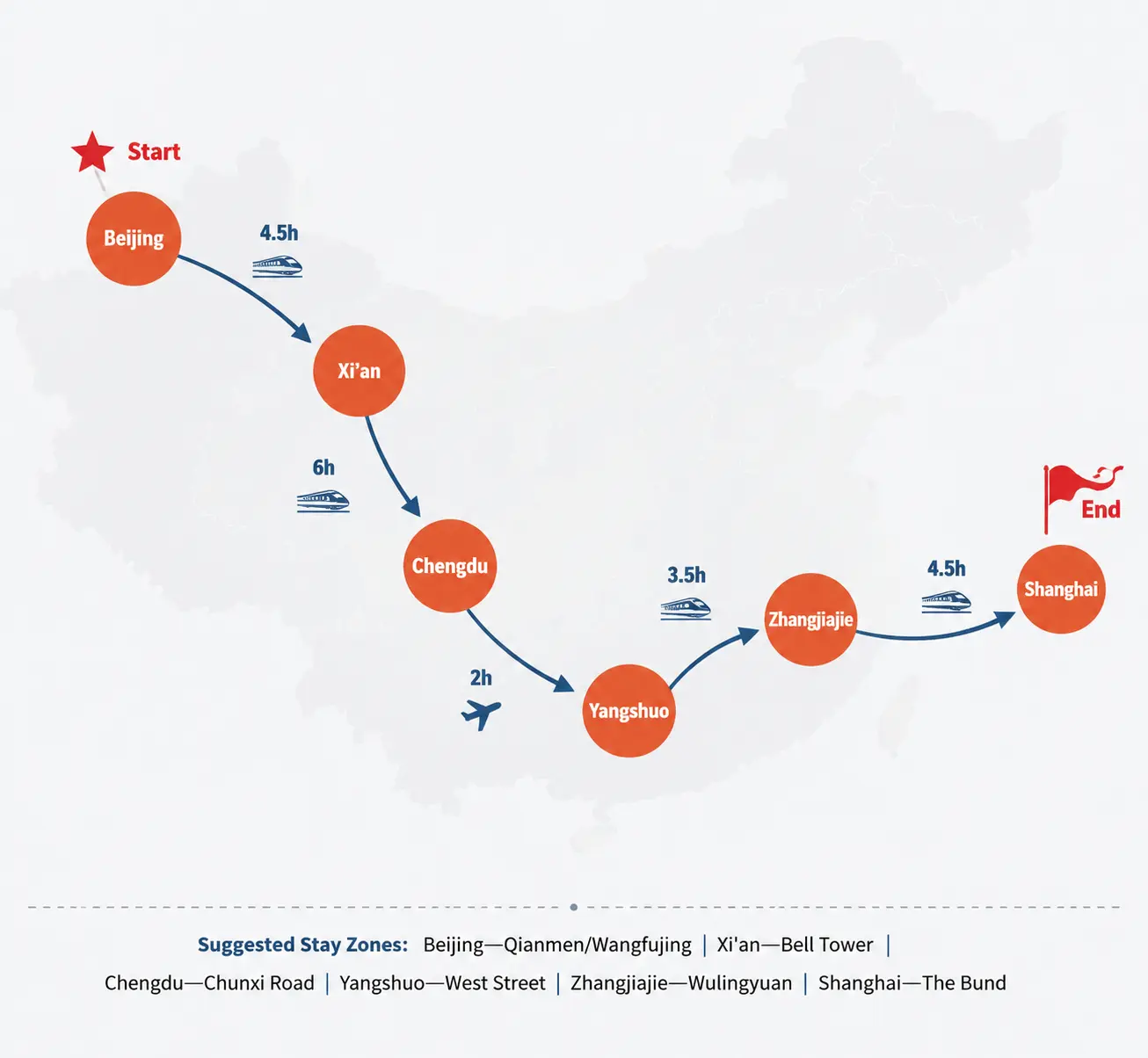
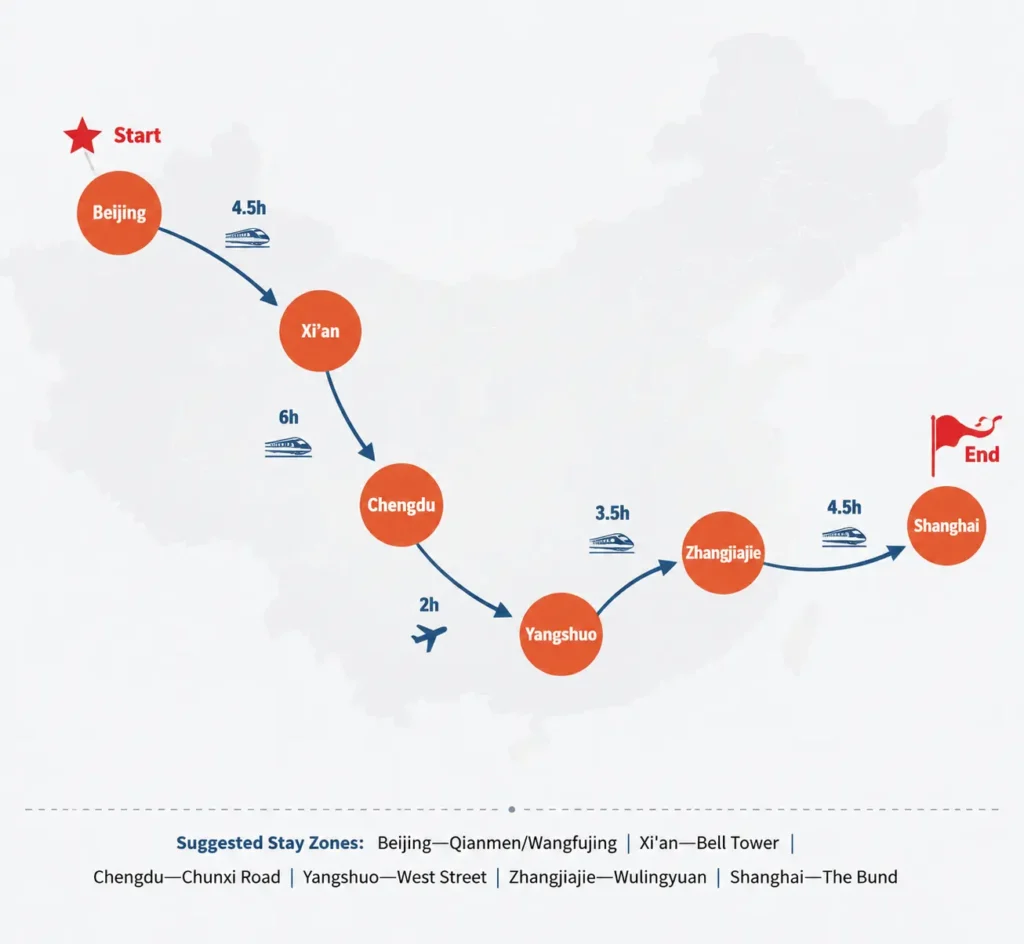
This china itinerary 3 weeks runs north to south, then hooks east — a clean arc with zero backtracking across six cities. Here’s the full 21-day China itinerary in one table:
| City | Days | What You’re Here For | Next Leg |
|---|---|---|---|
| Beijing | 1–4 | Forbidden City, Mutianyu Great Wall, Summer Palace, hutong biking | 🚄 4.5h → Xi’an |
| Xi’an | 5–7 | Terracotta Army, city wall cycling, Muslim Quarter food crawl | 🚄 3.5h → Chengdu |
| Chengdu | 8–10 | Giant pandas, tea houses, Sichuan hotpot, Leshan Giant Buddha | 🚄 6.5h → Yangshuo |
| Guilin / Yangshuo | 11–14 | Li River bamboo raft, karst peaks, countryside e-bike, Xianggong Hill sunrise | 🚄 5h → Zhangjiajie |
| Zhangjiajie | 15–17 | Avatar mountains, Tianzi Mountain, Tianmen Mountain & Heaven’s Gate | ✈️ 2h → Shanghai |
| Shanghai | 18–21 | The Bund, French Concession, Yu Garden, Suzhou water town day trip | ✈️ Home |
This is very much a first time in China itinerary — it prioritizes the greatest hits but leaves room to breathe. If you’ve been dreaming of a China grand tour, here’s the blueprint for spending 3 weeks in China without rushing through it.
Week 1: Imperial Beijing & Ancient Xi’an (Days 1–7)
Day 1 — Land, breathe, do nothing else. Check into a hotel near Qianmen or Wangfujing. You’ll thank yourself later when most sights are walking distance. Grab dumplings or a bowl of Lanzhou noodles nearby. Sleep early. A china itinerary 3 weeks long gives you the luxury of a soft launch — use it.
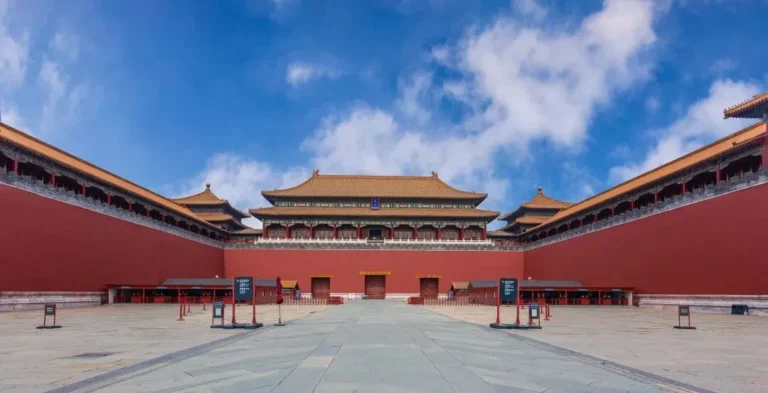
Day 2 — Tiananmen Square → Forbidden City → Jingshan Park. Book the Forbidden City at least 7 days in advance on the official website. No ticket at the gate. Walk the central axis from Meridian Gate to the Imperial Garden — about 3 to 4 hours. Cross the street behind the exit, climb Jingshan Hill. That panoramic shot of the Forbidden City you’ve seen everywhere? You’re standing on it. Entry ¥60 / USD 8.5.
Day 3 — Mutianyu Great Wall. Skip Badaling. (I’ll explain why in the mistakes section.) Mutianyu sits 70 km north of the city. Hire a car for ¥500–600 / USD 71–86, or take Bus 916 from Dongzhimen then a shuttle. Leave at 6 a.m. Arrive by 9. Take the cable car up, walk toward Watchtower 23 — the further you go, the thinner the crowd gets. Bring water and snacks. There is no convenience store on a 600-year-old wall. Entry ¥45 / USD 6.5, cable car round-trip ¥120 / USD 17.
Day 4 — Summer Palace + aimless hutong biking. Morning at the Summer Palace. Stroll Kunming Lake, find the Marble Boat (the one Empress Dowager Cixi allegedly spent the navy budget on). Afternoon: scan a shared bike with Alipay (¥1.5 / USD 0.2 to start), aim for Houhai and the alleys around Nanluoguxiang. No route. Just ride. You’ll smell scallion pancakes from a side lane. You’ll pass a half-open gate where an old man plays chess alone. This is Beijing’s lining, not its surface.
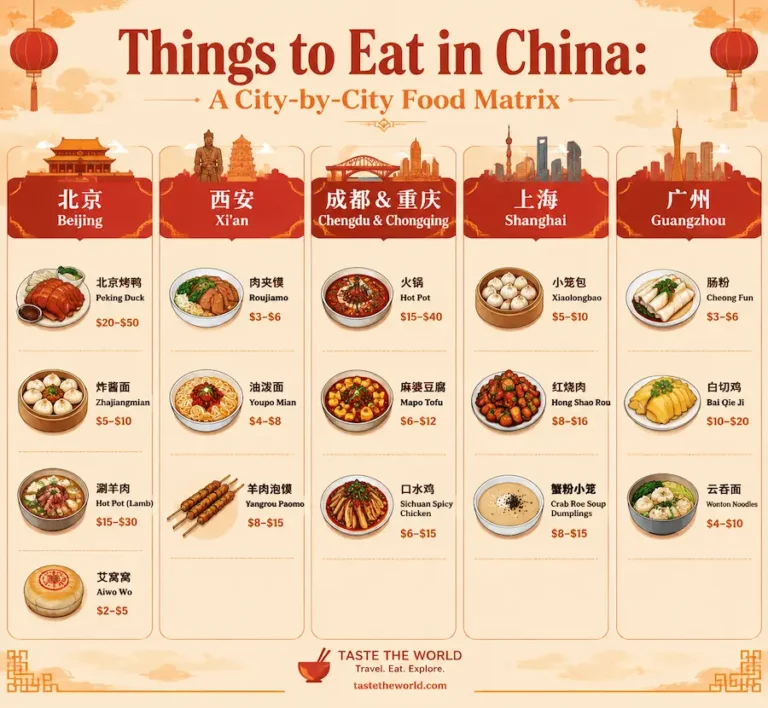
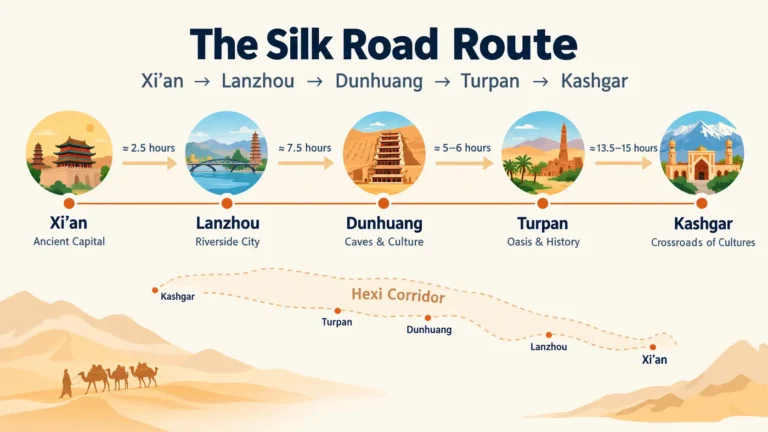
Day 5 — Bullet train to Xi’an. Beijing West → Xi’an North, 4.5 hours, second class ¥515–600 / USD 74–86. Check in near the Bell Tower. In the evening, head to the Muslim Quarter — walk past the main drag into the narrower back alleys. The lamb paomo (crumbled flatbread in broth) and red-willow lamb skewers back there taste different. Better.
Day 6 — Terracotta Army. Taxi or Bus 5 from the train station, about 40 minutes. Pit 1 is the big one — two thousand life-size soldiers with distinct faces, arrayed before you in silent formation. You’ll instinctively lower your voice when you step up to the railing. Entry ¥120 / USD 17. Hire an official guide (¥150 / USD 21). Without context, you’re looking at clay.
Day 7 — Bike the city wall, then train to Chengdu. Xi’an’s wall is the best-preserved in China. A full loop is 14 km, roughly 1.5 hours. Bike rental ¥45 / USD 6.5. Ming dynasty stone beneath your wheels, modern traffic humming eight stories below. That abrupt collision of eras — Xi’an in one frame. Afternoon: board the high-speed train to Chengdu.
Week 2: Pandas, Hotpot & Karst Landscapes (Days 8–14)
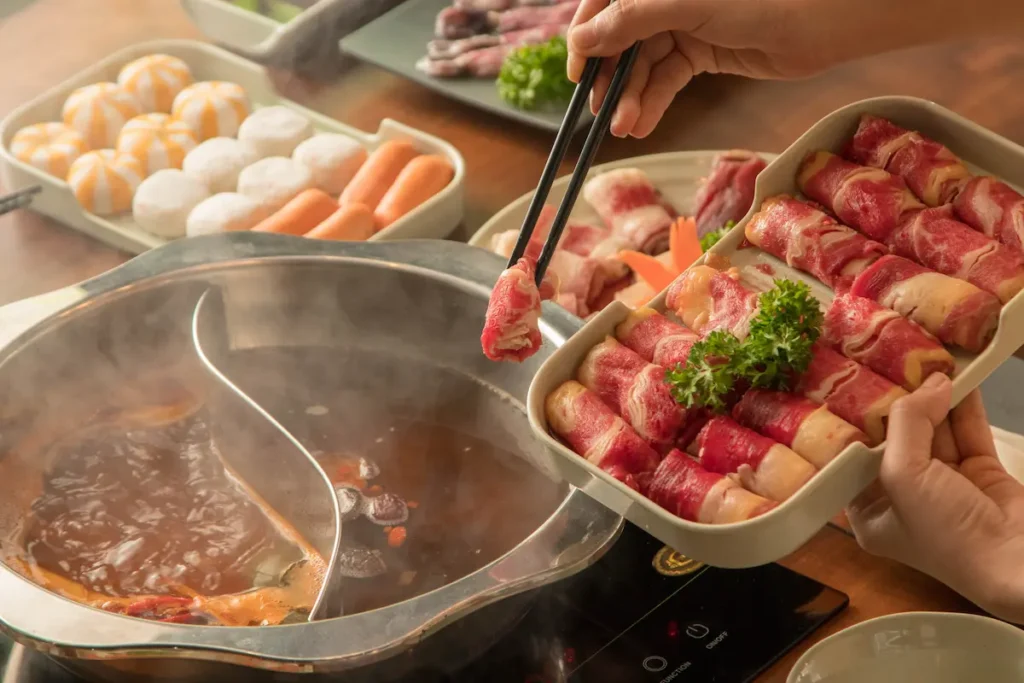
Day 8 — Chengdu hits different. The train from Xi’an takes 3.5 hours, ¥263–300 / USD 38–43. The pace here drops two notches. Tonight: your first Sichuan hotpot. Order the yuanyang pot — half chili oil, half mild broth. If the server gives you the “I knew it” look, take it in stride. Every first-timer gets that look. Across any china itinerary 3 weeks worth its salt, Chengdu is the meal you’ll still be thinking about on the flight home.
Day 9 — Pandas, then tea. Chengdu Research Base of Giant Panda Breeding. Gates open at 7:30 a.m. Be there by 7:00. Pandas are most active during the 8:00–9:30 feeding window. By 10 a.m., they’ve entered “loaf mode” — motionless on a wooden platform. Entry ¥55 / USD 8. Afternoon: Heming Tea House in People’s Park. Bamboo chair, a cup of jasmine tea (¥15–30 / USD 2–4), ear-cleaning if you’re adventurous. Sitting still and watching the world drift by — this is what Chengdu people consider a productive afternoon.
Day 10 — Leshan Giant Buddha day trip, or a free day in Chengdu. High-speed train to Leshan, 50 minutes. The 71-meter Buddha looms over the confluence of three rivers — you walk the cliffside path from head to foot, each step recalibrating your sense of scale. If this sounds like too much moving around, skip it. Spend the day at Wenshu Temple, wander Kuanzhai Alley, or just eat hotpot again. (Nobody’s judging.)
Day 11 — Toward the karst peaks. Chengdu to Guilin by train: 6.5 hours, ¥380–480 / USD 54–69. Transfer to Yangshuo (about 1 hour). Stay near West Street or by the Yulong River.
Day 12 — Li River bamboo raft. Take the raft from Yangdi Pier to Xingping, about 1.5 hours. Karst peaks rise straight from the water like green fangs. You drift between them. This is the moment you understand why every classical Chinese landscape painting looks the way it does — the mountains actually do that here.
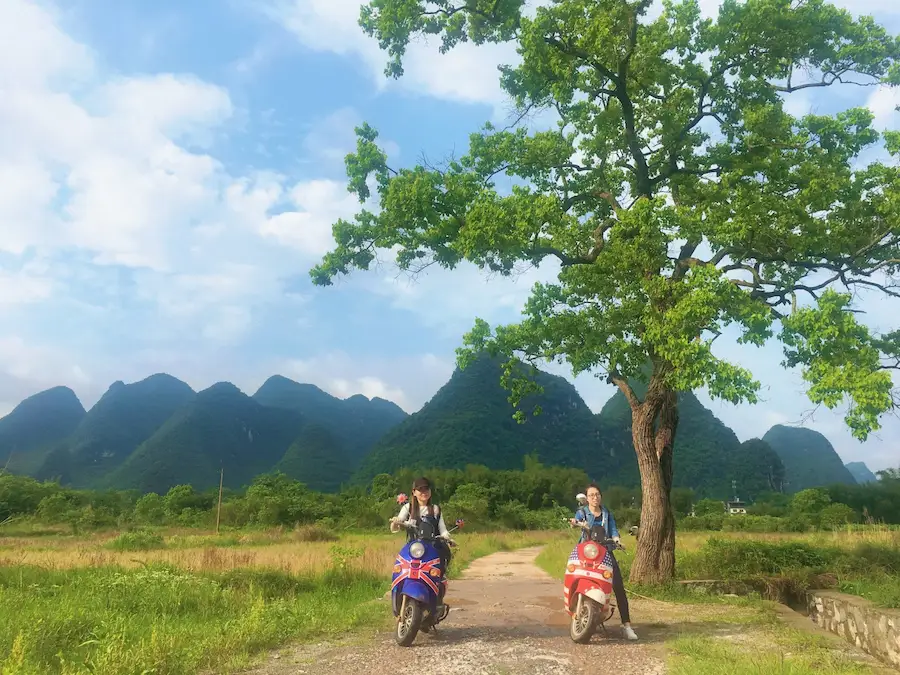
Day 13 — E-bike day. (The highlight of this entire china itinerary 3 weeks, if you ask me.) Rent an e-bike for ¥50–80 / USD 7–11. Head toward the Yulong River. No fixed route. If a narrow path between rice paddies looks promising, take it. You’ll cross a stone bridge blocked by ducks. You’ll pass villages where nobody speaks English and an elderly woman will gesture at you with the universal sign for “have you eaten?” I got lost for twenty minutes on an unmarked road — ended up being navigated out by a farmer with a hoe and a series of increasingly enthusiastic hand signals. Best twenty minutes of the trip.
Day 14 — Xianggong Hill sunrise. Fifteen minutes of stairs to the top. Entry ¥60 / USD 8.5. Watch the first light hit the Li River’s great bend, layers of karst peaks receding into fog. Your phone camera won’t do this justice. You won’t regret the 5 a.m. alarm.
Week 3: Avatar Mountains & Neon Skylines (Days 15–21)
Day 15 — To Zhangjiajie. Guilin to Zhangjiajie by train via Changsha, about 5 hours, ¥280–380 / USD 40–54. Stay in Wulingyuan town, as close to the park’s east gate as possible.
Day 16 — Yuanjiajie + Tianzi Mountain. Zhangjiajie National Forest Park. Enter through the east gate (Wulingyuan), shuttle bus to the Bailong Elevator — a 335-meter glass lift bolted to a cliff face. Yuanjiajie is where the “floating mountains” in Avatar got their inspiration. Then shuttle to Tianzi Mountain for the panoramic view. Pro tip: the east gate queue between 7:30 and 9:30 a.m. can hit 1–2 hours. Solutions: arrive by 7:00, or enter through the Tianzishan ticket gate instead (fewer tourists, under 20-minute queue, direct shuttle uphill).
Day 17 — Tianmen Mountain. This is a different scenic area from yesterday’s park. Book 1–3 days in advance via the official platform, real-name registration. Choose Route A (cable car up → express cable car down). Below Heaven’s Gate, there are 999 steps. You can climb them or take the escalator. I climbed. My calves sent me hate mail for three days.
Day 18 — Fly to Shanghai. Zhangjiajie Hehua Airport → Shanghai Pudong, about 2 hours, ¥600–900 / USD 86–129. Check in near the Bund or East Nanjing Road. Tonight: walk the Bund promenade and watch the Pudong skyline light up. Three hours ago you were on a mist-shrouded sandstone pillar. Now you’re staring at a cyberpunk skyline. This transition — from ancient mountain to neon metropolis — is the most dramatic moment of spending 3 weeks in China.
Day 19 — The Bund → Nanjing Road → Yu Garden. The Bund stretches about 1.5 km. Look across the Huangpu River at the Oriental Pearl Tower and the “Bottle Opener” (Shanghai World Financial Center). Then walk through Nanjing Road to Yu Garden — a Ming dynasty private garden shoehorned between skyscrapers, easy to miss the entrance, worth finding. Entry ¥30 / USD 4.3.
Day 20 — French Concession + Tianzifang. The “no-plan plan.” Walk under plane trees in the former French Concession. Stop at a café. Tianzifang is a lane-house art maze — good for souvenirs. Dinner: find a Shanghainese restaurant. Red-braised pork. Crab roe xiaolongbao. Oil-burst shrimp.
Day 21 — Suzhou water town half-day, or head home. If your flight departs late afternoon or evening: high-speed train to Suzhou, 30 minutes, ¥40 / USD 6. Visit the Humble Administrator’s Garden (¥70 / USD 10), walk along Pingjiang Road canal. Back to Shanghai by noon, straight to the airport. If your flight is in the morning: go straight to the airport. Twenty-one days. Six cities. One china itinerary 3 weeks — done.
3 Route Options for Different Travel Styles
The route above is a multi-city China itinerary designed for first-timers who want the full sweep. But it’s not your only option. Here are three ways to shape a China travel route for 3 weeks in China — or shorter, depending on your pace and priorities:
| Route | Best For | Duration | Budget (excl. flights) |
|---|---|---|---|
| Classic First-Timer Beijing → Xi’an → Chengdu → Yangshuo → Zhangjiajie → Shanghai | First visit, want the best of everything | 21 days | ¥23,000–33,000 / USD 3,300–4,700 |
| Golden Triangle Plus Beijing → Xi’an → Shanghai (+ Suzhou/Hangzhou) | Shorter on time, prefer cities & culture over nature treks | 10–14 days | ¥12,000–18,000 / USD 1,700–2,600 |
| Nature & Heritage Beijing → Xi’an → Chengdu → Yangshuo → Shanghai | Want a relaxed pace, 2–3 fewer stops | 15–18 days | ¥18,000–25,000 / USD 2,600–3,600 |
The China Golden Triangle tour — Beijing, Xi’an, Shanghai — is a classic travel-agency concept. Think of this china itinerary 3 weeks as a China golden triangle itinerary with nature bolted on: three cultural heavyweights plus pandas, karst peaks, and floating mountains. Only have 15 days? Drop Zhangjiajie — you’ll still hit the five core stops without feeling rushed.
Already booked a tighter trip? Check out our 2-week China itinerary for a condensed version, or the 7-day China itinerary if you’re really squeezed. Have a full month? Add Yunnan (Dali, Lijiang, Tiger Leaping Gorge) after Chengdu and skip Zhangjiajie, creating a very different 1 month in China itinerary biased toward the southwest. If you’re looking at an even longer trip, a China itinerary 4 weeks gives you room for both Zhangjiajie and Yunnan — the best of both worlds.
Traveling on a tighter budget? With hostels, hard-sleeper trains, and street food, you can pull off a China backpacking itinerary for around ¥15,000 / USD 2,100 — roughly half the mid-range total. The route stays the same. The bed gets smaller and the noodles get cheaper.
Three Moments I Can’t Shake
These aren’t in any guidebook. They’re the sharpest memories from this china itinerary 3 weeks.
The Great Wall — Without the Crowds
Mutianyu, six in the morning. The cable car dropped us before the staff had fully clocked in. We walked from Watchtower 20 toward 23. One person. A woman sweeping the steps. That was it. At the furthest tower, I sat on the parapet. Layers of the Yanshan Mountains folded into the distance. Wind pushed through the crenellations. Pine trees rustled below. Two hours passed before anyone else appeared. On one of the most famous landmarks on earth, I had two hours of silence. That kind of solitude — I didn’t even dare hope for it before the trip.
Lost in Yangshuo — The Best Twenty Minutes
The e-bike path ended at a pomelo orchard. My phone’s blue dot started drifting. Rice paddies on the left, a half-dry irrigation ditch on the right. A farmer came toward me on the ridge, hoe over his shoulder. I showed him the address on my phone. He studied it for five seconds, then switched the hoe to his left hand and drew a huge arc through the air with his right — roughly meaning “go around.” He did this three times, with increasingly theatrical gestures, then turned around and walked us a hundred meters until the main road came into view. No shared language. All hand signals and facial expressions. Better than Google Maps.
My First Bite of Sichuan Hotpot
Chengdu, 8 p.m. The server brought out the pot — a basin, really — with at least two centimeters of chili oil on the surface. Sichuan peppercorns and dried chilies rolling in slow motion. I stared at it for about thirty seconds, doing mental preparation. Then I grabbed a slice of tripe, performed the sacred “seven up, eight down” dunking ritual, and put it in my mouth. Not spicy. Numbing. My lips felt like they’d been hooked up to a low-voltage battery. The heat came a moment later, creeping up from the back of my tongue. Tears welled up. I was already reaching for another slice.
8 Mistakes I Made So You Don’t Have To
Some of these cost me hours. Some cost me money. All of them are avoidable — especially on a china itinerary 3 weeks where one bad planning decision can ripple across your entire trip.
1. Defaulting to Badaling for the Great Wall. Badaling has roughly five times the crowd density of Mutianyu. If you visit during Golden Week (October 1–7), any section of the wall becomes a slow-moving queue. Pick Mutianyu. Or Jinshanling if you want to hike.
2. Showing up at Zhangjiajie’s east gate at 9 a.m. The queue between 7:30 and 9:30 can stretch to 1–2 hours. Arrive by 7:00 or use the Tianzishan or Zimugang ticket gate instead. For Tianmen Mountain, pick Route A or B — avoid Route C (all-bus, winding mountain roads, motion sickness guaranteed).
3. Confusing Beijing’s train stations. There are multiple: Beijing West, Beijing South, Beijing Station, Beijing North. Your Xi’an train leaves from Beijing West. Triple-check the station name when booking. How to book China train tickets without messing this up — there’s a guide for that.
4. Waiting too long to book train tickets. Tickets go on sale 14 days before departure. Popular routes sell out the same day they open — especially around holidays. Use the official 12306 app or its English website. Third-party platforms may charge extra or delay ticket issuance.
5. Not setting up Alipay or WeChat Pay before arrival. China is a cashless society. Hotels and large malls take international cards. Street food stalls, small restaurants, shared bikes, and many attraction tickets are QR-code only. Setting up Alipay as a foreigner takes about 20 minutes — do it before you fly.
6. Waiting until you land to download a VPN. Once you’re in China, downloading a VPN is nearly impossible. Google, Instagram, WhatsApp, and Google Maps are all blocked. Install your VPN, download offline maps, and save your translation app’s offline language pack before departure.
7. Booking a hotel that can’t host foreigners. Not every hotel in China has a “foreign guest” license. Confirm before booking — especially in smaller cities or with guesthouses. Booking.com and Trip.com clearly label this.
8. Not carrying tissues. Public toilets in China are free and surprisingly widespread, but toilet paper is rarely provided. Squat toilets are still the majority. (One traveler I spoke with noted: “We found Western-style toilets more often than we expected.” So it’s improving. Bring tissues anyway.)
What 3 Weeks in China Costs: A Realistic Budget
Let’s talk numbers. This is the 3 weeks in China cost breakdown — mid-range, one person, 21 days, excluding international flights. If you’re researching a china itinerary 3 weeks and wondering whether the numbers floating around online are realistic, here’s what I actually spent (and where you can trim).
| Category | RMB | USD | Share |
|---|---|---|---|
| Accommodation (3–4 star hotels) | ¥8,400–12,600 | USD 1,200–1,800 | ~35% |
| Food (restaurants + street food) | ¥5,250–7,350 | USD 750–1,050 | ~22% |
| Transport (high-speed trains + taxis) | ¥3,500–4,500 | USD 500–640 | ~15% |
| Attraction tickets | ¥3,000–4,200 | USD 430–600 | ~13% |
| Other (SIM/eSIM, insurance, misc.) | ¥3,000–4,000 | USD 430–570 | ~15% |
| Total | ¥23,000–33,000 | USD 3,300–4,700 | 100% |
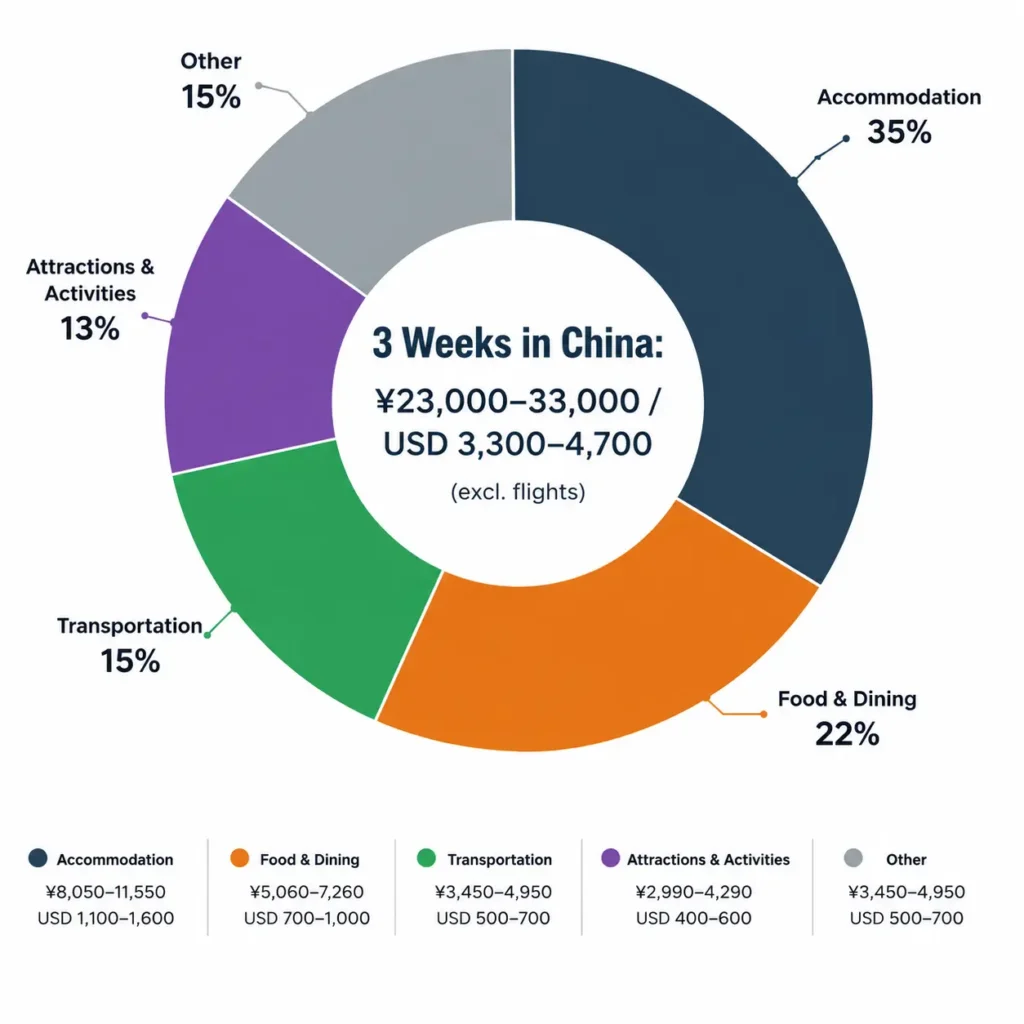
A few context points for your 3 weeks in China cost planning: budget travelers can push this down to around ¥15,000 / USD 2,100 by staying in hostels, taking hard-sleeper trains, and eating street food. At the upper end, you could comfortably spend ¥35,000 / USD 5,000 on nicer hotels and private drivers. For perspective — one European traveler I spoke with mentioned that a 15-day China group tour (Beijing → Xi’an → Guilin → Shanghai → Hong Kong) was priced at €5,670 per person from a European agency. Self-planning a china itinerary 3 weeks at mid-range costs less than a two-week guided tour. That’s the power of going independent.
Getting Around: Trains, Flights & Where to Sleep
China’s high-speed rail network connects every stop on this China train itinerary. Second class is spacious (roomier than many European trains) and runs about ¥1–1.5 per kilometer. In cities, use Didi (the English-language version works fine) or the metro — Beijing, Shanghai, and Chengdu all have English signage and announcements. A single metro ride runs ¥3–9 / USD 0.4–1.3.
For hotels: location beats star rating every time. Stay within a 5-minute walk of a metro station. Beijing: Qianmen or Wangfujing area. Xi’an: near the Bell Tower. Shanghai: the Bund or East Nanjing Road. Budget ¥400–600 / USD 57–86 per night for a solid mid-range room.
Quick Answers Before You Go
Do I need a visa? It depends on your passport. The 144-hour transit visa-free policy covers 54 nationalities (including the US, UK, Canada, Australia, and most of Europe) at major entry ports including Beijing, Shanghai, Chengdu, Xi’an, and Guilin — but you must hold an onward ticket to a third country. If you’re flying “home → China → home,” it won’t apply. Several European countries plus Australia and New Zealand now enjoy 15–30 day unilateral visa exemption. Otherwise, apply for an L tourist visa: 4–5 working days, USD 30–140 depending on nationality. Check our China visa guide for the latest details.
When’s the best time to visit China? April–May and September–October. Pleasant temperatures, manageable crowds. Avoid: Golden Week (October 1–7 — the entire country travels simultaneously), Chinese New Year (late January or February — many businesses close, transport prices spike), and July–August (school holidays + heat, Beijing and Xi’an can hit 38°C / 100°F).
Can I get by without Mandarin? Yes. One traveler I spoke with put it perfectly: “Most signs have English as well as Chinese. Every hotel had staff who communicated easily through electronic translation. There is really no need to learn the language.” Translation apps — especially Google Translate’s live camera feature — work remarkably well in China. Learn “ni hao” (hello), “xie xie” (thank you), and “zhe ge” (this one). That’s enough for 3 weeks in China.
Is China safe for solo travelers? Violent crime rates are extremely low. That same traveler said: “It is a very safe country.” As a foreigner, you might attract curiosity — people asking for photos, staring — but it’s curiosity, not hostility. Walking alone at night doesn’t feel threatening. This is the single biggest surprise for most first-time visitors.
Can I add Hong Kong? Yes, but it’s tight. If you want Hong Kong in your china itinerary 3 weeks: drop Zhangjiajie (saves 3 days), fly Shanghai → Hong Kong (2 hours). Alternative: Beijing → Xi’an → Chengdu → Yangshuo → Hong Kong (Days 19–21) → fly home from Hong Kong. The high-speed train from Hong Kong’s West Kowloon Station reaches Shenzhen in 15 minutes and Guangzhou in an hour.
A china itinerary 3 weeks won’t show you everything. It’ll show you enough — enough to know that China is bigger, stranger, warmer, and more surprising than anything you read before you went. The wall, the rivers, the mountains, the food, the people who navigated you out of a pomelo orchard without a single shared word. You come back with a different map in your head.
And if you’re like me, you’ll come back already planning the next one.
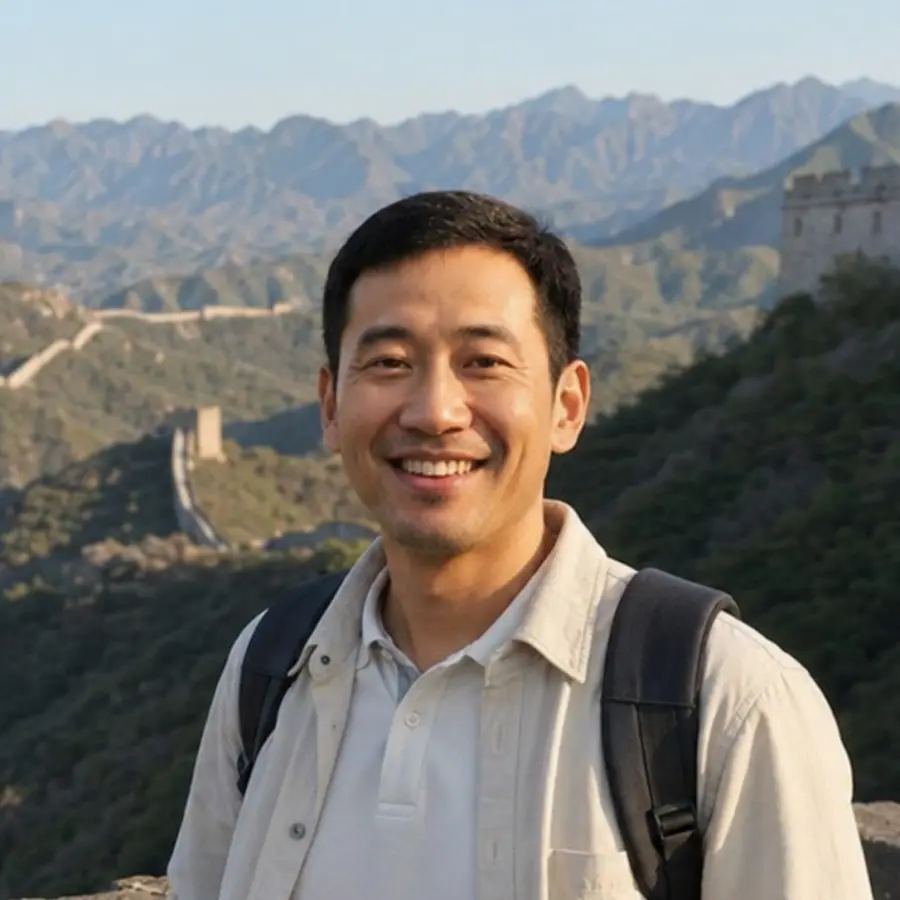
Ke Ping — Founder, InsiderChinaTravel
I personally reply to every email and create free, custom trip frameworks. Already have a plan? I can arrange vetted local guides and private drivers. Over 5,000 travelers from 30+ countries have started their journey this way.
📋 Tell me about your trip ideaReplied within 24 hours. No charge, no obligation.