China High Speed Rail Tickets & Classes: How to Book and What to Expect
China’s high-speed rail network stretches across more than 45,000 kilometers. It connects every major city on the map. For travelers who want to skip the airport and watch the landscape unfold at ground level, china high speed rail tickets are the key that makes it all possible. A trip that eats up an entire day by car shrinks to just a few hours. Beijing to Shanghai? About 4.5 hours. Guangzhou to Shenzhen? Barely 30 minutes.
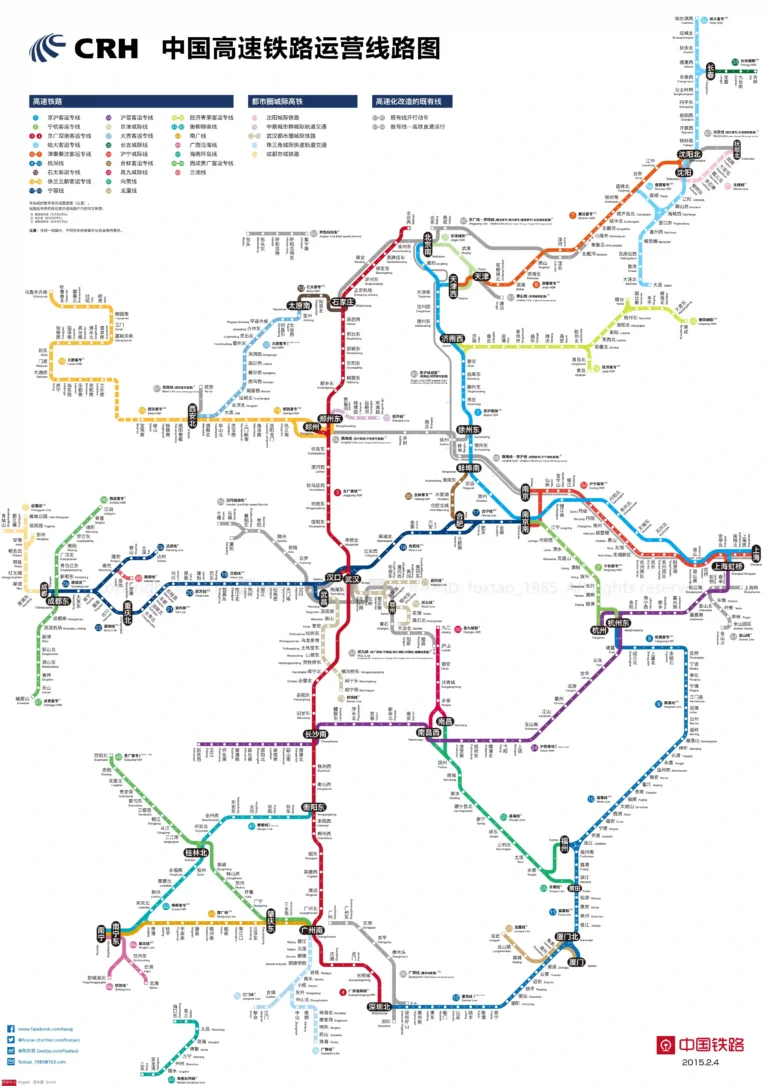
If you’re planning your route, a china high speed rail map can help you visualize the network before you book. Once you know where you’re headed, the next step is figuring out the china high speed rail booking process. This guide walks you through every part of it—buying your china high speed rail tickets, picking the right seat class, handling station logistics, and knowing what to do when things don’t go as planned.
One thing to lock in before we go further: China uses a real-name ticketing system. Every ticket sold is linked to a specific ID document. For foreign travelers, your passport (or Foreign Permanent Resident ID Card, if you hold one) is the golden credential. Hang onto it from the moment you book your china high speed rail tickets until the moment you step off the train.
- Understanding China High Speed Rail Seat Classes
- Second Class: Budget-Friendly and Still Comfortable
- China High Speed Rail First Class: The Sweet Spot for Long-Haul Comfort
- Business Class: The Full Flat-Bed Experience
- How to Book China High Speed Rail Tickets: Your Three Options
- At the Station: Step by Step from Entrance to Platform
- What Life Onboard Feels Like
- Refunds, Changes, and When Things Go Sideways
- Traveling With Kids
- The One Timing Rule That Can Wreck Your Plans
- Help When You Need It
Understanding China High Speed Rail Seat Classes
Trains on China’s high-speed network—labeled G-series (high speed), D-series (conventional speed), and C-series (intercity)—offer distinct seat classes. Space, comfort, and price vary meaningfully between them. Picking the right class can shape how you feel when you step off the train after a long ride. Here’s what each one actually delivers.
Second Class: Budget-Friendly and Still Comfortable
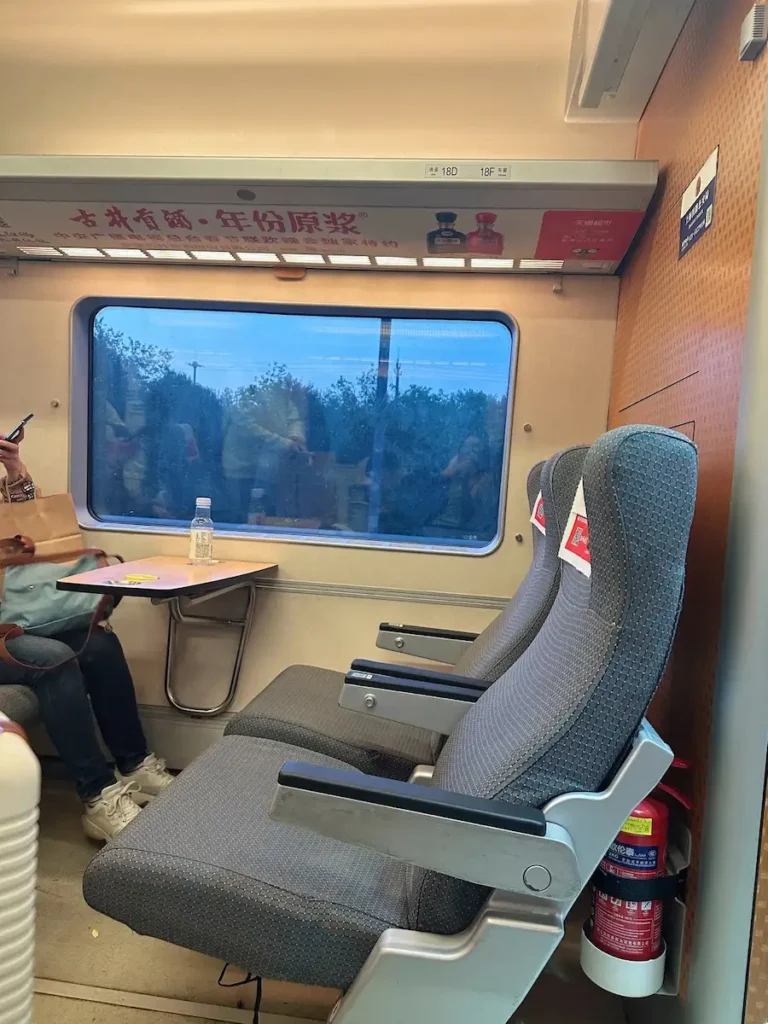
Second class is what most china bullet train tickets are sold for. The layout is 3+2—five seats across each row. It feels similar to economy class on a plane, but the legroom is noticeably better than what you’d get on a budget airline. Every seat comes with a fold-down tray table and a power outlet (Chinese two-prong/three-prong plus a USB port), usually located under the seat or on the seatback in front of you.
For any trip under three hours, second class china high speed rail tickets are the smart money move. Expect to pay around 550 CNY (≈79 USD) for a long-haul route like Beijing to Shanghai. Shorter routes cost proportionally less.
Is it tight? Not by Western standards, but if you’re taller than 185 cm (6’1″) or simply value breathing room, the next class up is worth a look.
China High Speed Rail First Class: The Sweet Spot for Long-Haul Comfort
China high speed rail first class seats follow a 2+2 layout. Losing one seat per row changes the whole feel of the carriage. The seats themselves run about 5–8 cm wider than second class, with thicker cushioning and a shape that actually supports your back. Legroom expands by 15–20 cm. Tall travelers, take note.
Other touches: wider armrests (no silent war over elbow space), an adjustable headrest, and a footrest on most trains. Some routes include a free snack box and a drink. The carriage stays quieter simply because fewer people are packed into it.
You’ll pay roughly 900 CNY (≈129 USD) for Beijing to Shanghai with china high speed rail first class tickets. For anything lasting four to six hours, this upgrade delivers the biggest comfort jump per yuan spent. If you’re buying china high speed rail tickets for a multi-city itinerary, mixing second class for short hops and first class for the long legs is a strategy that works.
Business Class: The Full Flat-Bed Experience
China high speed rail business class sits at the top of the pyramid. Seats are arranged 2+1 or even 1+1 on newer Fuxing “smart” trains. Each one reclines to a full 180° flat position—a real bed, not an angled compromise. Every passenger sits inside a semi-enclosed pod with genuine privacy, and a personal entertainment screen folds out from the armrest.
Business class passengers get access to a dedicated lounge at major stations. Think comfortable sofas, free drinks, snacks, and priority boarding ahead of the crowd. Onboard, a proper meal is served during meal hours (Chinese and Western options are usually available), and drinks flow freely for the entire journey. Blankets, slippers, eye masks, and earplugs are standard issue.
The price tag for china high speed rail tickets in business class: roughly 1,750 CNY (≈250 USD) for Beijing to Shanghai. For a six-plus-hour run, a honeymoon leg of your trip, or just the kind of day where you want to lie flat and watch farmland blur past, it’s hard to beat.
Worth Knowing: Premium First Class and Special Class
Some newer Fuxing intelligent EMU trains feature a Premium First Class (优选一等座). It lands between regular first class and business—wider 2+2 seats with upgraded service. There’s also an ultra-rare Special Class (特等座) tucked at the front of certain trains, more of a sightseeing nook than a mainstream option. Don’t overthink these. They’re niche products with limited availability. The three core classes—second, first, and business—cover virtually every train you’ll board.
Can You Get a Sleeper Instead?
Most G-, D-, and C-series trains are all-seat, no sleepers. If you need a bed, your china bullet train tickets should point you toward D-series “sleeper EMU” (动卧) services offering soft sleeper compartments. Traditional K-, T-, and Z-series trains run hard sleepers (six bunks along an open corridor) and soft sleepers (four bunks behind a lockable door), but those move at a much slower pace—a different world from high-speed travel.
How to Book China High Speed Rail Tickets: Your Three Options
Foreign travelers have three practical paths for china high speed rail booking. Each path trades convenience against cost. Choose the one that fits your tolerance for paperwork and planning time.
Option 1: 12306 — The Official Platform (Cheapest, Most Steps)
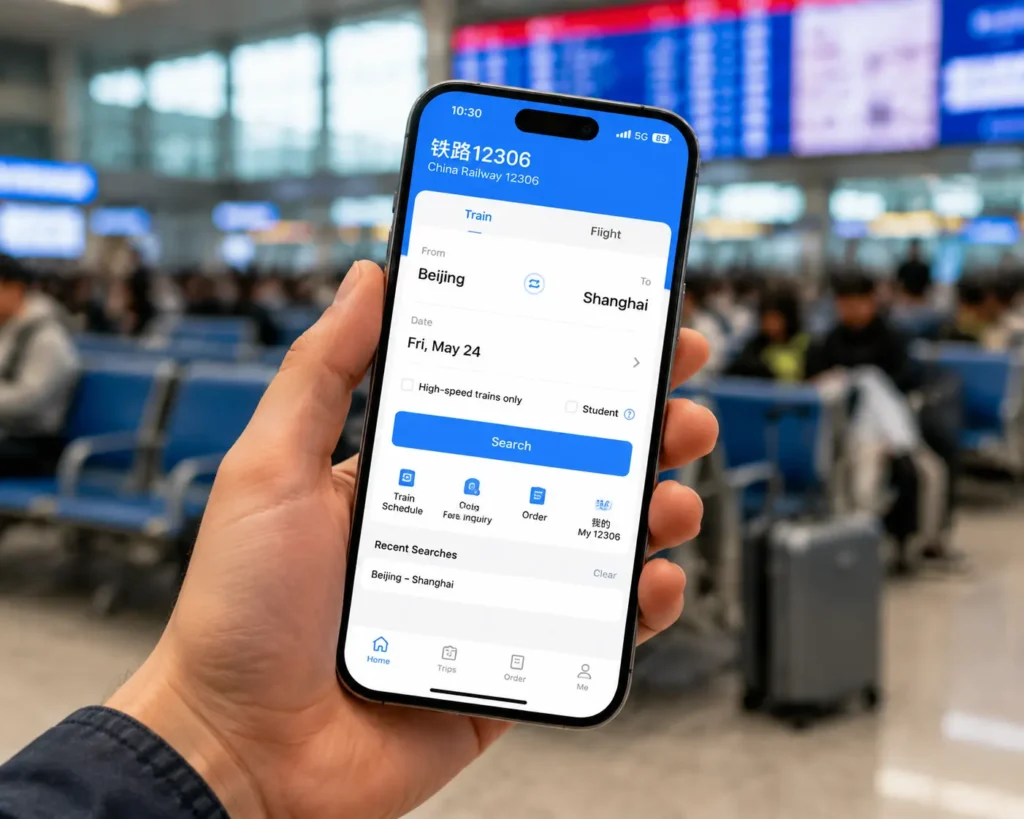
12306 is China Railway’s official ticketing platform—the only one authorized to sell china high speed rail tickets directly. No middleman markup. You pay exactly the official fare. The catch is that you’ll need to clear some setup hurdles before you can buy anything.
Download and switch to English. Grab the “铁路12306” app. Open it, then go to My → the gear icon in the top right corner → Language → English. The interface transforms into something readable.
Register with your email. Tap Register. For ID type, pick “Passport.” Enter your name exactly as it appears on your passport—same order, same spacing, same capitalization. Use a space between your given name and surname. Keep the total under 30 characters. Skip the phone number field (the English version doesn’t require it). Use your email address. After submitting, check your inbox and your spam folder for the activation link.
Verify your identity. This step trips up the most people. Go to My → Passengers → Add, and enter your passport details. The system runs an automatic check. If it clears (usually within minutes), you’re ready to buy china high speed rail tickets. If automatic verification fails, you’ll upload a photo of your passport information page plus a photo of yourself holding your passport. Manual review takes 3–5 business days. If that still doesn’t work, bring your physical passport to any train station ticket window—in-person verification happens on the spot.
Buy your ticket. Search for your departure station, arrival station, and travel date. Select your train and seat class. Add the passenger (must be verified). Pay before the time limit expires.
Payment methods: Visa, MasterCard, JCB, Diners Club, Alipay, WeChat Pay, and UnionPay all work. International cards are processed through Bank of China in CNY.
Know these limits before you book:
- Online booking hours: 6:00 to 23:30 Beijing time. Outside that window, the system is view-only.
- Complete your purchase at least 25 minutes before departure.
- The English version does not let you pick a specific seat. The system assigns one automatically. Seat selection requires switching to the Chinese interface—which demands a Chinese phone number to log in.
- Single order max: 9 tickets. Per-account passenger max: 15 people.
For a broader look at getting around the country, see our china high speed rail overview and china transportation guide.
Option 2: Trip.com — Fast, Friendly, Small Fee
If the 12306 registration-and-verification gauntlet sounds like more than you signed up for, Trip.com is the escape hatch. It plugs into China Railway’s system but hides all the complexity behind a clean English interface. No passport verification. No activation emails. Search, click, pay with your regular credit card, and your china high speed rail tickets are booked.
The trade-off: Trip.com adds a service fee (usually 20–40 CNY per ticket, roughly 3–6 USD), and list prices can run slightly above official rates. During peak seasons, china bullet train tickets may sell out faster here than on 12306. Seat selection isn’t guaranteed either. For most first-time visitors, though, Trip.com remains the path of least resistance. Download it before you leave home.
Option 3: Buy at the Station Counter
Walk into any train station in China, find the ticket hall, and slide your passport across the counter. State your destination, date, and preferred class. Pay with cash (CNY), Alipay, WeChat, or a bank card.
Prepare for a language gap. Most ticket clerks speak little to no English. Write your trip details on paper or save them as a phone note—ideally in Chinese. A simple format does the job:
上海 → 北京 | June 25 | G12 | Second Class | 1 ticket
The clerk will understand. You’ll walk away with your china high speed rail tickets in under five minutes.
One important limitation: self-service ticket machines do not accept foreign passports. If you hold a Foreign Permanent Resident ID Card, the machines work fine for you. Everyone else: stick to the staffed counter or book your china bullet train tickets online.
At the Station: Step by Step from Entrance to Platform
You have your china high speed rail tickets. Now you need to navigate the station.
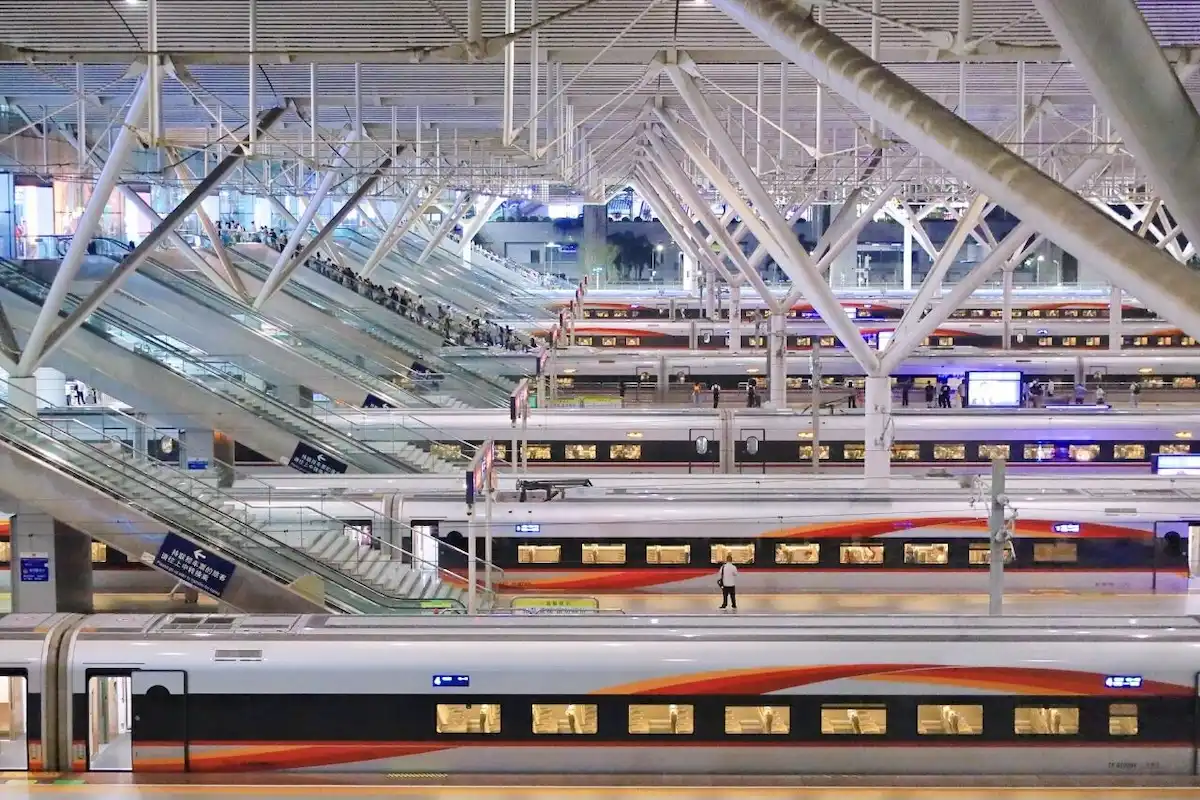
Arrive with buffer time. Give yourself 30–60 minutes. For mega-stations like Shanghai Hongqiao or Beijing South, push that to 90 minutes. One classic mistake: showing up at the wrong station. Beijing alone has Beijing South, Beijing West, and Beijing Station. Look at your booking and confirm the exact station name.
Clear security. Bags go through the X-ray scanner, you walk through the metal detector. Sprays like sunscreen and hairspray face volume restrictions. Knives and anything flammable are prohibited. The line tends to move quickly.
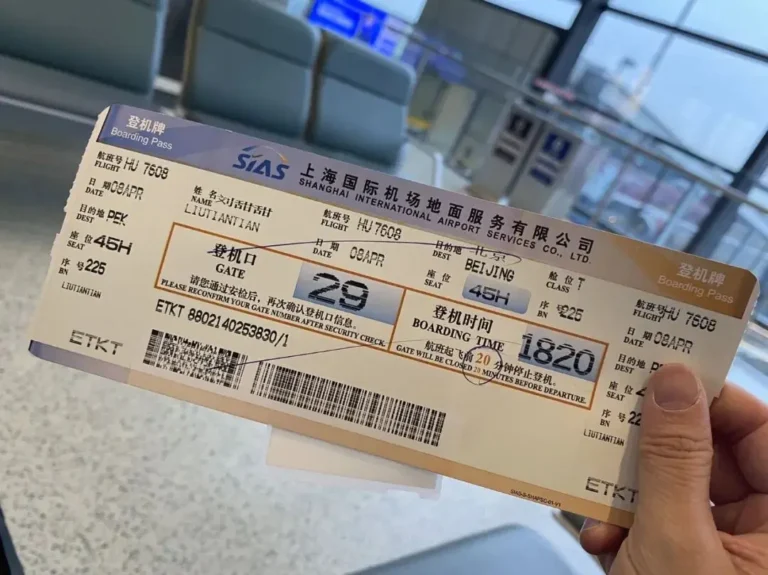
ID check at the gate. If you hold a Foreign Permanent Resident ID Card, use the self-service gates. With a standard foreign passport, head to the manual verification lane. A staff member scans your passport and matches it against the booking database. No paper ticket is needed—your passport is your ticket. China’s high-speed rail system has moved to fully electronic ticketing.
Find your platform. After clearing ID check, look up at the departure boards. Platform numbers typically appear 10–15 minutes before departure. Follow the signs.
Board fast. Train doors close 1–2 minutes before the scheduled departure time. At intermediate stops, the train may only pause for 2–5 minutes. Know your carriage number—it’s marked on the outside of each car—and stand at the corresponding spot painted on the platform floor. Find your seat, stow your luggage, settle in.
What Life Onboard Feels Like
It’s quiet. Chinese high-speed trains are surprisingly calm. Phones stay on silent. Conversations stay low. Smoking is banned outright—e-cigarettes included. Smoke detectors are sensitive. Setting one off will slow the train and earn you a fine.
Food and drinks. On shorter routes, a snack cart rolls through the aisles with drinks, chips, and boxed meals. Longer routes have a dining car, usually mid-train. You can also bring your own food without any restrictions. Instant noodles are a beloved train tradition in China—and every carriage has a free hot water dispenser near the end of the car, so you can make your own.
WiFi. Most Fuxing-series trains offer free WiFi. Connect, sign in with a phone number or 12306 account, and you’re online. It handles messaging and light browsing fine. Streaming video is inconsistent.
Toilets. Each carriage has at least one bathroom—usually a mix of Western-style toilet and squat toilet. Toilet paper and hand soap are provided, and they’re cleaned regularly throughout the journey.
Arrival announcements. Both Mandarin and English announcements play before every stop. Electronic displays above the doors show the next station. Start gathering your belongings about five minutes before your stop—the dwell time is short.
And because people always ask about speed: most G-series trains cruise at 300–350 km/h (186–217 mph). China bullet train speed records have topped 400 km/h in testing, but commercial service settles comfortably in that 300–350 band. The ride is smooth enough that you won’t feel the velocity unless you fix your eyes on the power poles racing past the window.
Refunds, Changes, and When Things Go Sideways
Your Verification Keeps Failing
Double-check three things: Is your name spelled exactly as it reads on your passport? Did you put a space between your given name and surname? Did any full-width characters sneak in? If all three check out and verification still won’t clear, take your passport to a station ticket window. In-person verification takes five minutes and solves the problem permanently.
Your Passport Goes Missing
Find the railway public security office inside the station (铁路公安制证口). They’ll issue a temporary travel document good for that one trip. Never use someone else’s ID to buy china high speed rail tickets or to board—you’ll be denied entry at best, and flagged in the system at worst.
You Missed Your Train
Trains depart on schedule. They don’t wait. If you miss yours, go to the ticket counter and ask to switch to a later departure. Expect to pay a change fee or lose part of your fare, depending on how close to the original departure time you are.
Refund Rules at a Glance
Refund fees for china high speed rail tickets are based on timing:
- 8+ days before departure: free
- 48 hours to 8 days: 5% fee
- 24–48 hours: 10% fee
- Under 24 hours: 20% fee
Destination changes can be made up to 48 hours before departure. Inside the 25-minute window before departure, all changes and refunds must be processed at a station ticket window—online channels close at that point.
You Need a Receipt
Within 180 days of your trip, bring your passport to any station ticket window or self-service machine to print a reimbursement voucher. You get one shot at this—the system allows a single print. Lose the slip and it’s gone. One more reminder: this receipt is not a boarding pass. Only your passport gets you through the gate.
Traveling With Kids
- Under 6 and not occupying their own seat: free. Declare the child when you book your china high speed rail tickets.
- Ages 6–13: child discount ticket. Bring the child’s passport.
- 14 and older: full-price ticket.
Each adult can bring one free child. Extra children need their own discounted tickets. Every child needs their passport for the ID check at the station.
The One Timing Rule That Can Wreck Your Plans
Certain times of year turn china high speed rail tickets into one of the most fiercely contested products on the planet. The entire country is on the move, and the railway handles over a billion passenger trips during these windows. If your travel dates fall into any of these periods:
- Chinese New Year (late January to mid-February, roughly a 15-day window)
- National Day Golden Week (October 1–7)
- Labor Day Holiday (May 1–5)
You need to book the moment china bullet train tickets go on sale. They vanish in minutes. If you’re flexible on dates, consult our best time to visit china guide to find a window that dodges the crowds entirely. If your dates are locked in, be ready at your screen the instant the 15-day advance booking window opens.
Help When You Need It
- 12306 customer service: dial 12306 from within China
- English-language hotline: +86 21 12306
- Lost something onboard? Tell a crew member immediately, or call 12306 with your train number, carriage number, and a description of the missing item.
For more practical advice before your trip, browse our china travel tips collection. And if you’re still building your route, our china itinerary guides can help you piece together a journey worth the train ride.
Your passport is in your pocket. The departure board just flipped to show a platform number. Somewhere past the gate, a train is waiting—quiet, clean, and fast enough to turn the countryside into a blur. Go find your seat.

Ke Ping — Founder, InsiderChinaTravel
I personally reply to every email and create free, custom trip frameworks. Already have a plan? I can arrange vetted local guides and private drivers. Over 5,000 travelers from 30+ countries have started their journey this way.
📋 Tell me about your trip ideaReplied within 24 hours. No charge, no obligation.