Shanghai Metro Guide: How to Use the Subway as a Foreigner (2026)
It was 1 AM at Pudong International Airport. I stood in front of a blue-lit ticket machine, passport in hand, staring at the “Single Journey Ticket” button. One question looped through my jet-lagged brain: will my Visa card actually work?
A guy with a suitcase breezed past, tapped his phone against the turnstile, and vanished toward the platform. Another traveler slapped a bank card against the gate—beep, gone. Five seconds flat. I’d been to China before. I still froze.
I didn’t need to. The Shanghai Metro is shockingly foreigner-friendly—bilingual signs everywhere, English ticket machines, international bank card support, and Alipay QR code access. You just need to know the moves. This guide covers exactly that: how to pay, how to ride, and how not to look like a lost tourist at the turnstile. The Shanghai Metro spans 21 lines, 524 stations, and 906 kilometers (564 miles), moving over 10 million people a day. It’s one of the world’s largest subway systems—and hands down the best way to get around Shanghai.
- Shanghai Metro at a Glance: What Every Foreign Visitor Needs to Know
- How to Use the Shanghai Metro: Step by Step for Foreigners
- Shanghai Metro Tickets & Passes: Which One Is Best for You?
- 7 Mistakes Foreigners Make on the Shanghai Metro (And How to Avoid Them)
- Mistake 1: Assuming the Metro Runs 24 Hours
- Mistake 2: Riding During Peak Rush Hour
- Mistake 3: Ignoring Exit Numbers
- Mistake 4: Assuming Every Turnstile Takes Foreign Cards
- Mistake 5: Looking for a Bathroom Inside the Station
- Mistake 6: Trying to Use Apple Pay as a Transit Card
- Mistake 7: Treating the Maglev Like a Regular Metro Line
- Shanghai Metro FAQ: Quick Answers for Foreign Tourists
Shanghai Metro at a Glance: What Every Foreign Visitor Needs to Know
Let’s nail the essentials before we get into step-by-step stuff.
What Is the Shanghai Metro?
The Shanghai Metro opened in 1993 and now runs 21 lines across 524 stations. By the end of 2026, with Line 22 (Chongming Line) expected to open, the network will push close to 1,000 kilometers. For visitors, here’s the fact that matters most: the entire system is bilingual—Chinese and English. Station names, line maps, directional signs, onboard announcements. All of them. You don’t need to read a single Chinese character to get around.
(I’ve ridden subway systems in Tokyo, Paris, and New York where I spent half the trip squinting at foreign scripts. Shanghai is easier. Much easier.)
Shanghai Metro Operating Hours
Most lines start around 5:30 AM. Last trains run between 10:30 PM and 11:30 PM, depending on the line and direction. Shanghai Metro closing time varies—and here’s the hard rule: the Shanghai Metro is not 24 hours. Miss that last train and you’re hailing a taxi or firing up a ride-hailing app.
Key last-train times heading toward the city center:
- Line 2 (Pudong Airport → downtown): last train around 10:00–10:30 PM
- Line 10 (Hongqiao Railway Station → downtown): last train around 10:30–11:00 PM
- Maglev (Pudong Airport → Longyang Road): last train around 9:40 PM
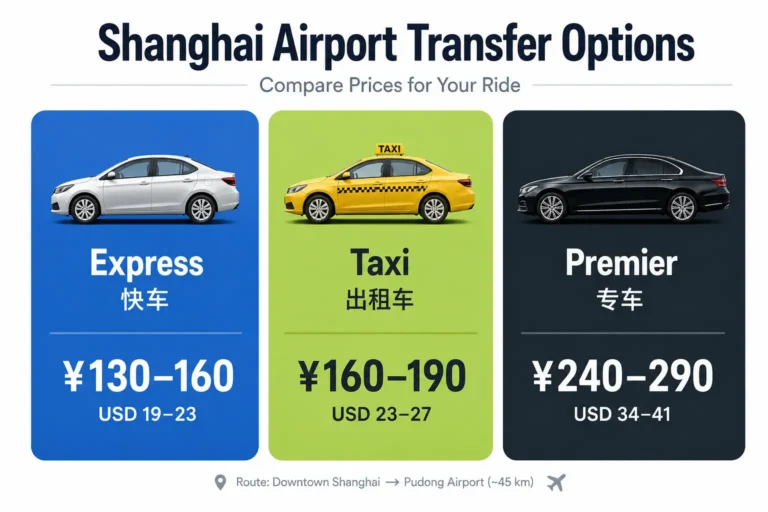
If your flight lands late, have a backup plan. The metro won’t wait. Need alternatives? Our guide to ride-hailing in China covers Didi, taxis, and what to do when public transit shuts down for the night.
Shanghai Metro Price & Fares
The Shanghai Metro uses a distance-based fare system. Rides start at ¥3 (USD 0.43) for trips under 6 km, then ¥1 per additional 10 km. Most trips within the city center cost ¥3–¥6 (USD 0.43–0.86).
Day passes:
- 1-Day Pass: ¥18 (USD 2.57) — unlimited rides for 24 hours from first tap (Maglev not included)
- 3-Day Pass: ¥45 (USD 6.43) — unlimited rides for 72 hours (Maglev not included)
When does a Shanghai Metro pass make sense? Ride more than 6 times in a day, or average 5+ rides daily over three days—the pass pays for itself and saves you the hassle of buying tickets each trip. For most tourists hitting multiple attractions in one day, the 1-Day Pass is an easy win. We’ll break down all your options in detail below.
Key Shanghai Metro Lines for Tourists
| Line | You’ll Use It For… | Key Stations |
|---|---|---|
| Line 2 (Green) | Airport → downtown artery | Lujiazui (Oriental Pearl Tower), Nanjing Road East (the Bund), Jing’an Temple |
| Line 10 (Lilac) | Old city & culture | Yuyuan Garden (City God Temple), Xintiandi, Shanghai Library |
| Line 11 (Brown) | Disneyland | Disney Resort (terminus) |
| Maglev | Fastest Pudong Airport link | Longyang Road — 7 minutes, ¥50 (USD 7.14); ¥40 (USD 5.71) with same-day flight ticket |
| Airport Link Line | Hongqiao ↔ Pudong cross-airport | Faster than Line 2 for airport transfers |
A quick note: if you’d rather navigate Shanghai with ride-hailing instead, our guide to getting around China covers taxis, Didi, and other transportation options. The Shanghai Metro isn’t your only move—but it’s usually the fastest and cheapest one.
How to Use the Shanghai Metro: Step by Step for Foreigners
You’re standing at the station entrance. Here’s exactly what to do, in order.
Step 1: Pick a Payment Method
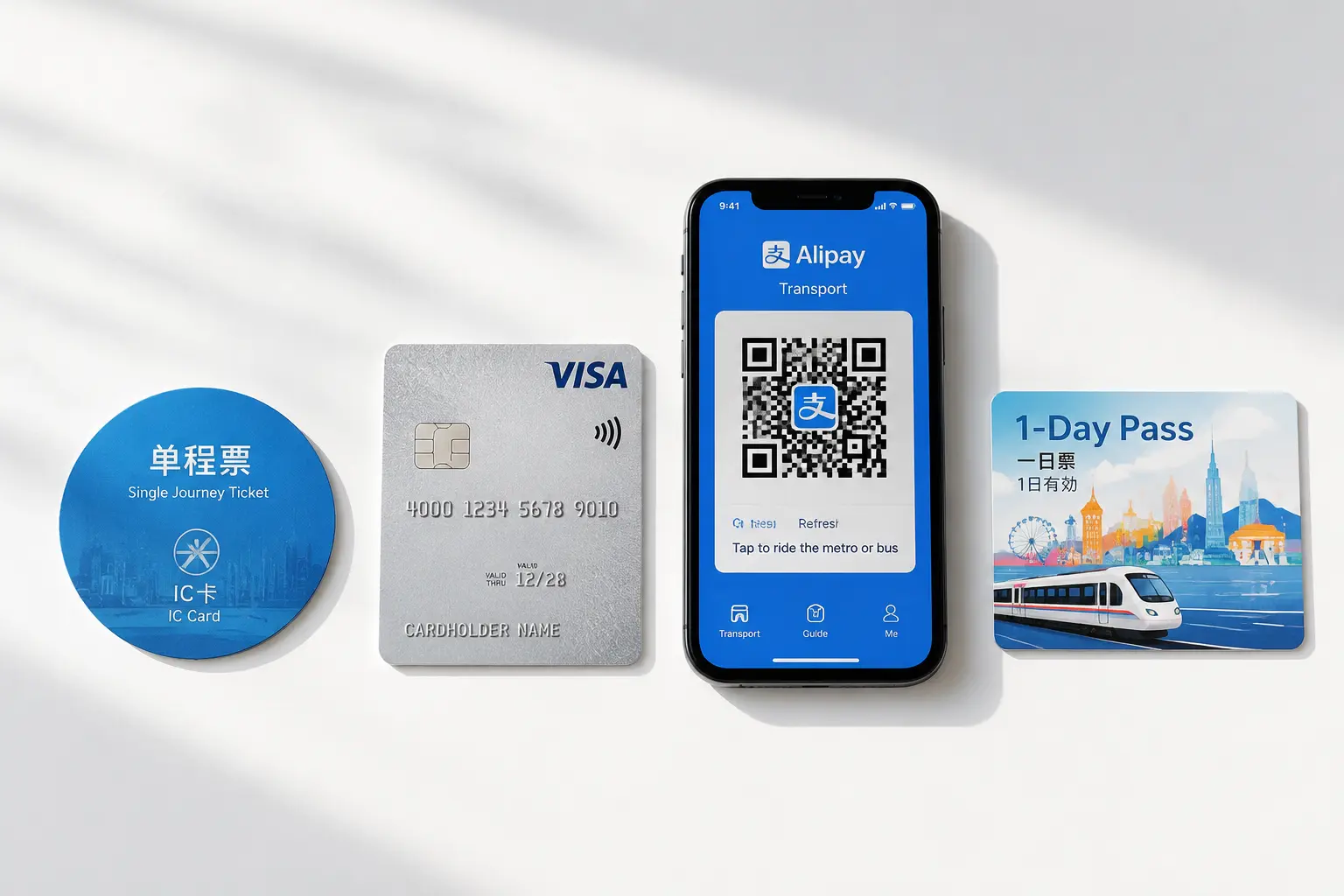
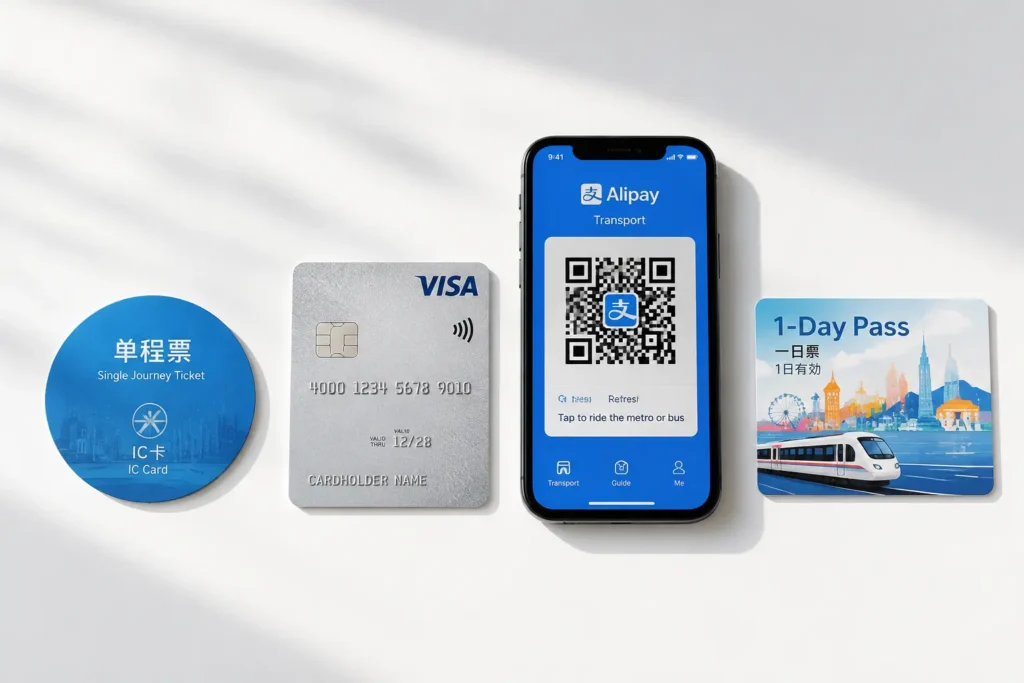
You’ve got five ways to pay. Ranked from most to least convenient—all tested in June 2026.
① Alipay Transit QR Code (Best Option)
If you’ve already set up Alipay, this is the smoothest way to ride. No ticket. No line. Just scan and walk.
How to activate the Shanghai Metro Alipay QR code:
- Open Alipay, switch your city to “Shanghai” (tap the city name top-left)
- Tap “Transport” on the home screen
- The app will ask for real-name verification — upload a photo of your passport’s personal information page, enter your passport number, name, and nationality
- Approval is usually instant (occasionally takes 1–2 hours)
- Accept the terms, tap “Agreed and Obtain QR Code”
- You’ll see a blue QR code labeled “上海公共交通乘车码” — that’s your ticket
At the turnstile, hold this QR code over the square scanner on top of the gate. One beep. Done.
(Don’t have Alipay yet? Read our full guide on setting up Alipay as a foreigner — you’ll want to sort this out before your trip, since passport verification can occasionally hit a snag. You’ll also need mobile data at the station, so check out our China SIM card guide if you haven’t sorted that yet.)
② Bank Card Tap-to-Ride (The Pleasant Surprise)
Yes. You can tap your international bank card directly on the turnstile.
Accepted cards: contactless-enabled VISA, MasterCard, JCB, and American Express. Apple Pay and Google Pay linked to these cards work too—though compatibility varies by card issuer and phone model.
(Carry a physical card as backup. Seriously.)
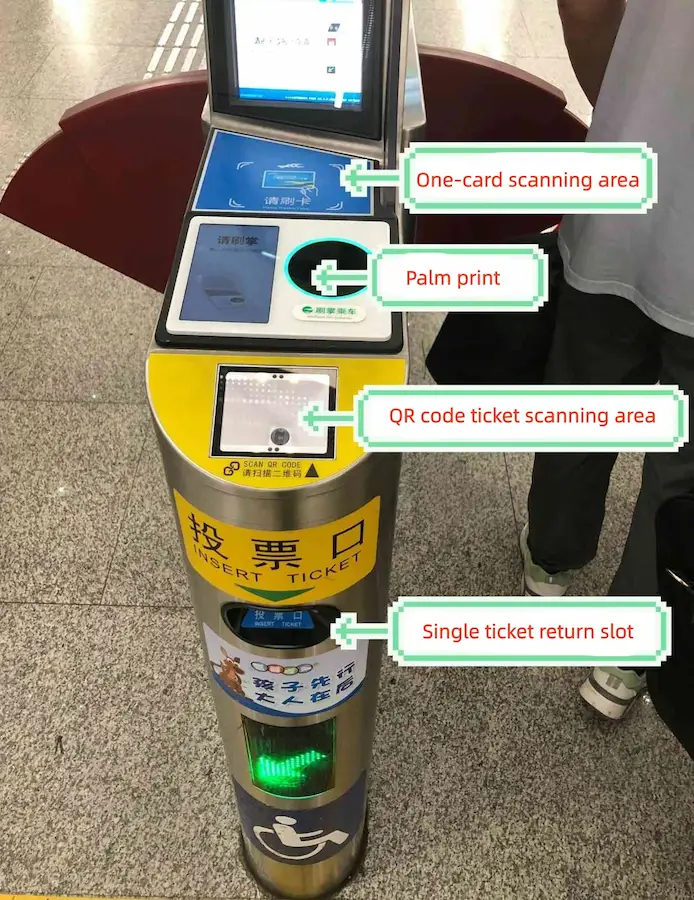
One catch: not every turnstile supports foreign cards. Look for machines marked with a VISA or MasterCard logo — usually at either end of the gate row. If the first gate doesn’t respond, try the one with the logo. This contactless payment option on the Shanghai Metro works more often than travelers expect, and it’s growing fast.
③ Metro Daduhui App (Official Option)
Download the “Metro 大都会” (Daduhui) app, register with your passport, link an international card, and you’ll get a transit QR code similar to Alipay’s. The Shanghai Metro Daduhui app is the official solution — stable, reliable — but it does mean downloading one more app. If you’ve got the storage space and prefer an official channel, it’s a solid pick. For most visitors, the Alipay option above is quicker to set up.
④ Single-Journey Ticket (Cash or Card)
Every station has self-service ticket machines with a full English interface. Pick your destination → pay with cash (RMB) or an international card (VISA, MasterCard, AmEx, JCB) → collect your ticket.
You’ll get a blue round IC card. Tap it on the gate sensor to enter. Hold onto it — you’ll need it to exit.
⑤ Shanghai Public Transport Card
Available at station service counters. ¥20 (USD 2.86) deposit, top up as needed. Worth considering if you’re staying over a week and riding the metro daily. For short-term visitors, skip it — Alipay or tap-to-ride is easier. This is also where you’ll find the Shanghai Metro card that regular commuters use, though it’s less practical for tourists who already have contactless bank cards.
Step 2: Go Through Security
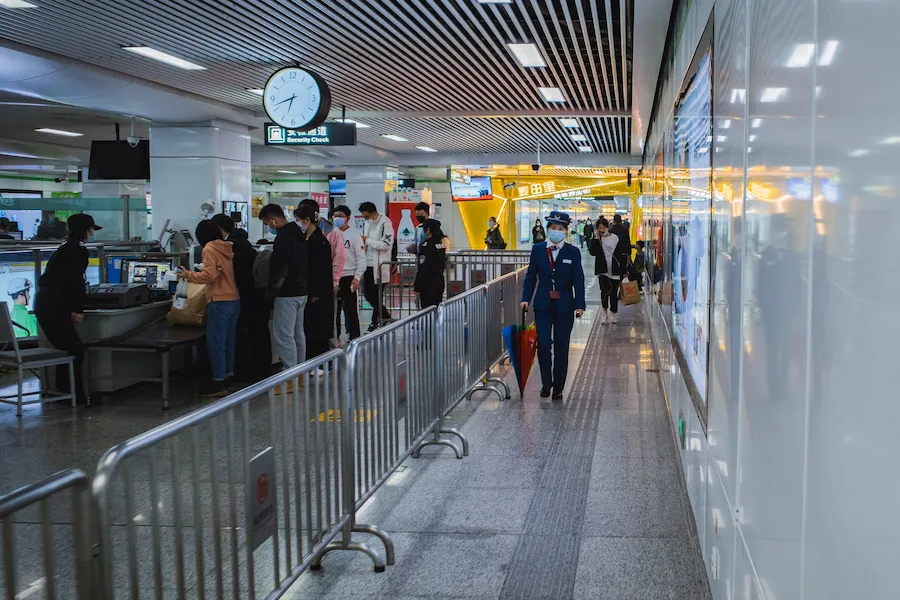
Every Shanghai Metro entrance has a security checkpoint. Place your bags on the X-ray conveyor belt, walk through the metal detector. That’s it.
No passport check. No taking off your shoes. No removing electronics. (It’s not airport security.) If you’re carrying bottled water, the officer might ask you to take a sip — standard procedure, don’t overthink it.
Give yourself an extra 5 minutes during rush hour. One Reddit user nailed it: “Why do I have to put my tiny tote bag through a massive X-ray machine just to take a 2-stop subway ride? Always leave an extra 5 minutes for security queues during peak hours!” The Shanghai Metro security check is fast, but the line builds up.
Step 3: Tap Through the Turnstile
- Alipay or Daduhui app: hold your phone screen over the square scanner on top of the gate. Beep. Go.
- Bank card tap-to-ride: press your card against the contactless reader. Wait one second for the green light.
- Single-journey ticket: tap the blue card on the sensor pad. Pocket it.
If the gate doesn’t open, check the screen — it’ll usually say “insufficient balance” or “card not recognized.” Move to the next gate. Don’t hold up the line.
Step 4: Find Your Platform and Direction
This is where first-timers get tripped up.
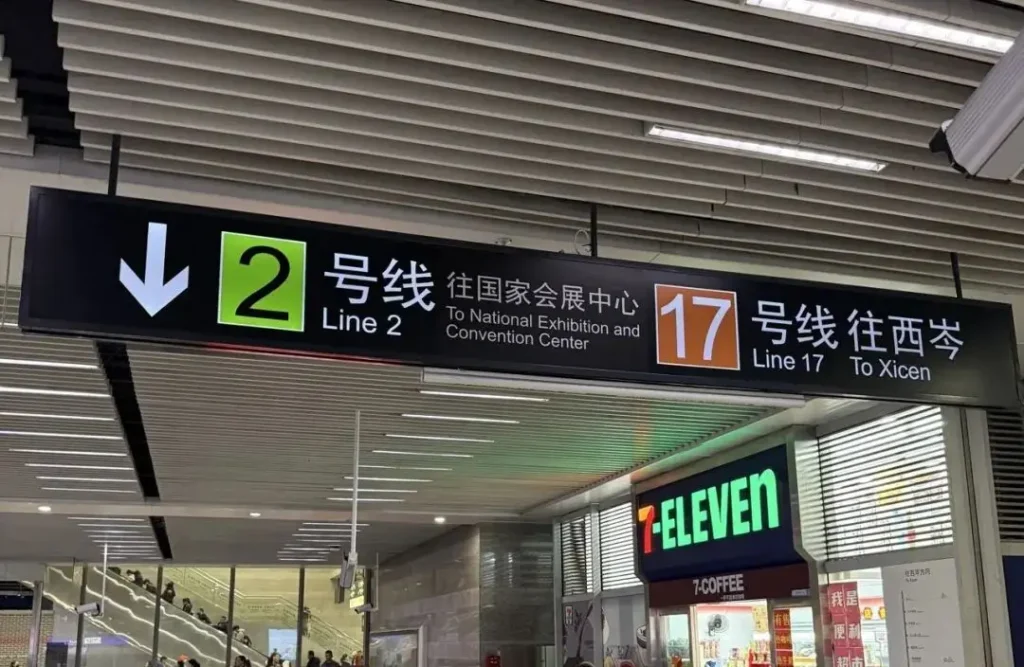
After the turnstile, look up. Overhead signs show each line by color and number — Line 2 is green, Line 10 is lilac. Find your line number, then check the direction. The signs display the terminus station name, not your current station. Shanghai Metro English signs make this straightforward: you’ll see both Chinese and English text, so “People’s Square (人民广场)” is instantly recognizable.
Example: you’re at Nanjing Road East, catching Line 2. The signs show:
- Toward “National Exhibition and Convention Center” (westbound)
- Toward “Pudong Airport Terminal 1&2” (eastbound)
Going to Lujiazui? One stop east. Jing’an Temple? Two stops west.
Above every platform door, an LCD screen shows the line map with your current station highlighted and the next stop blinking. Shanghai Metro lines are color-coded consistently — once you know your color, you can’t get lost.
Step 5: Transfer Between Lines
Transfers happen inside the paid area. No extra ticket. No re-entering.
Follow the “Transfer” signs — they show the target line number inside a colored block. Major hubs like People’s Square (Lines 1/2/8) or Century Avenue (Lines 2/4/6/9) have transfer corridors that can take 5–8 minutes to walk. Everything’s underground. Escalators and clear signage the entire way.
Step 6: Pick the Right Exit
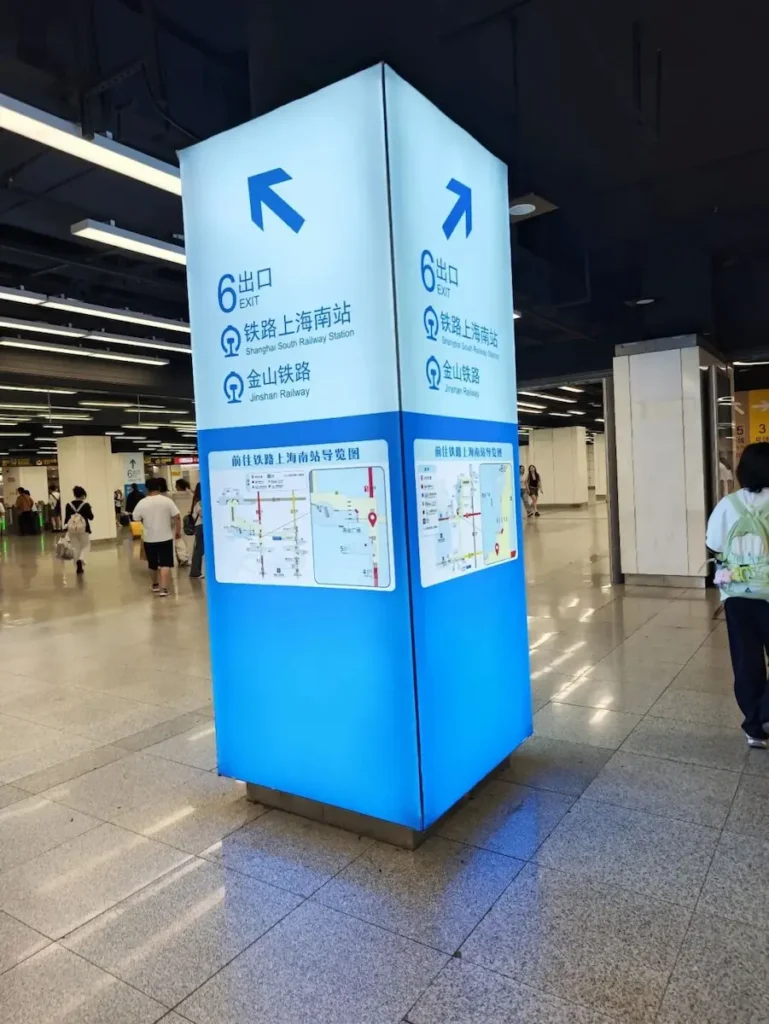
Here’s where things go wrong. Big Shanghai Metro stations have 8 to 12 exits, numbered from 1 upward. Shanghai Metro exit numbers matter more than you’d think.
Exit 1 and Exit 8 can be a 10-minute underground walk apart. Take the wrong one, and you’ll surface on the opposite side of an eight-lane road from where you wanted to be.
Before you tap out, check the neighborhood map on the wall near the exit gates. It shows which exit leads to which street and landmark. Another Reddit traveler put it perfectly: “Subway stations in Shanghai are underground labyrinths. Exit 1 and Exit 8 could be a 10-minute walk apart underground. Always check the neighborhood map before tapping out!”
Exit signs above each gate list the street names and major buildings served. Nanjing Road East’s exits point to “Nanjing Road Pedestrian Street.” Yuyuan Garden’s exits point to “Yuyuan Garden.” Obvious once you look — easy to miss if you don’t.
Exiting the gate:
- QR code users: scan again to exit. Fare auto-deducted.
- Bank card tappers: tap again.
- Single-journey ticket holders: insert the blue card into the slot on the gate. The machine keeps it.
- 1-Day or 3-Day Pass holders: tap to exit. No charge.
Shanghai Metro Tickets & Passes: Which One Is Best for You?
If you’re still deciding, this section breaks down Shanghai Metro tickets and passes side by side.
Payment Methods Compared
| Method | How to Get It | Cost | Best For |
|---|---|---|---|
| Alipay Transit QR Code | Activate in-app (passport verification required) | Distance-based fare | Anyone already using Alipay — most convenient |
| Bank Card Tap-to-Ride | No setup — just tap | Distance-based fare | Short-term visitors who want zero app downloads |
| Metro Daduhui App | Download & register (passport required) | Distance-based fare | Travelers who prefer the official app |
| Single-Journey Ticket | Buy at ticket machine | ¥3–¥9 (USD 0.43–1.29) per trip | 1–2 rides only |
| 1-Day Pass | Buy at service counter | ¥18 (USD 2.57) | 3+ attractions in one day |
| 3-Day Pass | Buy at service counter | ¥45 (USD 6.43) | 3-day deep-dive trip |
Which Shanghai Metro Pass Should You Choose?
Scenario 1: One day — the Bund, Yuyuan Garden, Lujiazui.
Get the 1-Day Pass (¥18 / USD 2.57). These three attractions are spread across both sides of the Huangpu River. You’ll ride at least 4–6 times. The pass saves you money and skips the ticket-machine line every time.
Scenario 2: Three days — plus Disneyland.
Get the 3-Day Pass (¥45 / USD 6.43). The round trip to Disneyland on Line 11 alone costs ¥12–¥14. Add your other daily rides and you’ll easily hit 8–10 trips over three days. The 3-Day Shanghai Metro pass pays for itself fast.
Scenario 3: Mostly walking the French Concession, occasional metro hop.
Skip the pass. Use bank card tap-to-ride or buy single-journey tickets. One or two rides a day don’t justify a pass — pay as you go and keep it simple.
7 Mistakes Foreigners Make on the Shanghai Metro (And How to Avoid Them)
These are the traps I’ve fallen into — and watched other travelers stumble into — on the Shanghai Metro. Dodge them and your ride gets ten times smoother.
Mistake 1: Assuming the Metro Runs 24 Hours
It doesn’t. Most lines stop between 10:30 PM and 11:30 PM. Land at Pudong Airport at midnight? The metro is done. Check your line’s last-train time before you count on it. When the Shanghai Metro closing time hits, your options narrow to taxis or ride-hailing — so have a backup. See our guide to ride-hailing in China for exactly what to do when public transit shuts down for the night.
Mistake 2: Riding During Peak Rush Hour
Weekdays, 8:00–9:00 AM and 6:00–7:00 PM. The carriages get packed to the point of body contact. Not an exaggeration — you might find your face pressed against the door glass. If your schedule is flexible, avoid these windows. If you can’t: take your backpack off and hold it at your side. That’s the unspoken local rule. One person wearing a backpack takes up the space of two. If you’re visiting during summer, check our guide to the best time to visit China for tips on avoiding the worst crowds across the country.
Mistake 3: Ignoring Exit Numbers
I covered this above, but it bears repeating. Check the neighborhood map before you tap out. Thirty seconds of staring at a wall map saves you a 15-minute street-level detour across an eight-lane road.
Mistake 4: Assuming Every Turnstile Takes Foreign Cards
Only the ones marked with a VISA or MasterCard logo do. Walk to the ends of the gate row — that’s usually where they are. Tap. No response? Try the next one over.
Mistake 5: Looking for a Bathroom Inside the Station
They exist. They’re just absurdly hard to find. Reddit’s verdict: “Finding a bathroom inside the metro station is like a treasure hunt. Half of them are outside the turnstiles, and the other half require you to walk to the far end of the platform.” Go before you enter the station. If it’s urgent, head to the extreme ends of the platform — some larger stations have restrooms inside the paid area. Many don’t.
Mistake 6: Trying to Use Apple Pay as a Transit Card
Apple Pay does work — but only as a bank card NFC payment, not as a transit card. You can’t add a Shanghai Metro transit card to your Apple Wallet the way you’d add a Suica card in Japan. Tap your iPhone at the gate like you’re making a purchase, with a linked VISA or MasterCard. The “Transit Card” mode won’t do anything.
Mistake 7: Treating the Maglev Like a Regular Metro Line
The Maglev train is a separate system with its own pricing — ¥50 (USD 7.14) one-way, or ¥40 (USD 5.71) with a same-day flight ticket. Day passes don’t cover it. It gets you from Pudong Airport to Longyang Road in 7 minutes flat (versus about an hour on Line 2). Worth it if you’re in a hurry. Skip it if you’re not.
Bonus survival tip: the air conditioning. Shanghai Metro carriages run cold — especially Line 10, which locals have nicknamed the “Arctic expedition line.” The AC is designed for packed rush-hour trains, so when the carriage is half-empty, the cold air has nowhere to go. Most lines have weak-cooling cars at the front and back of the train (the first and last carriages). Head there if you run cold. Or toss a light jacket in your bag — locals do it year-round.
Shanghai Metro FAQ: Quick Answers for Foreign Tourists
Is the Shanghai Metro 24 hours?
No. Most lines close between 10:30 PM and 11:30 PM. Plan accordingly.
When does the Shanghai Metro close?
It depends on the line and direction. Line 2 from Pudong Airport closes earliest (around 10:00 PM). Check your specific route before heading out.
How many metro lines are in Shanghai?
21 lines as of 2026, covering 524 stations and 906 kilometers. Line 22 (Chongming Line) is expected to open by the end of 2026.
How do I get to Shanghai Disneyland by metro?
Take Line 11 to the terminus — Disney Resort station. From Nanjing Road East it’s about 50 minutes. From Xujiahui, roughly 45 minutes.
Can I use Apple Pay on the Shanghai Metro?
Yes, but only as an NFC bank card payment on turnstiles marked with VISA/MasterCard logos. You cannot add a Shanghai Metro transit card to Apple Wallet.
Where can I download a Shanghai Metro map PDF?
The official map is available on the Shanghai Metro website (service.shmetro.com). For an interactive version, download the MetroMan China app. A quick Google search for “Shanghai Metro map PDF” will also pull up printable third-party versions.
How do I get from Pudong Airport to downtown fastest?
Maglev to Longyang Road (7 minutes), then transfer to Line 2 or Line 7. Total cost: ¥50 (USD 7.14). The Airport Link Line is another fast option connecting Pudong and Hongqiao airports.
How do I pay for the Shanghai Metro?
Five ways: Alipay QR code (easiest), contactless bank card tap-to-ride (no setup), Metro Daduhui app (official), single-journey ticket from machines (cash or card), or a Shanghai Public Transport Card from the service counter. Pick whichever fits your setup.
Nine hundred and six kilometers of track. Five hundred and twenty-four stations. Twenty-one lines woven under one city. Once you know how to scan, which direction to follow, and which exit to take — the rest is just a beep and a step forward. Shanghai moves fast. Now you can keep up.

Ke Ping — Founder, InsiderChinaTravel
I personally reply to every email and create free, custom trip frameworks. Already have a plan? I can arrange vetted local guides and private drivers. Over 5,000 travelers from 30+ countries have started their journey this way.
📋 Tell me about your trip ideaReplied within 24 hours. No charge, no obligation.