Beijing Subway Guide 2026: How to Use the Metro, Pay with Foreign Cards & Avoid Mistakes
This March, I picked up a friend from London at Beijing Capital Airport. James was in town for four days. I told him we’d take the subway into the city.
Standing in front of a ticket machine at Dongzhimen Station, James slid in his Visa card. Nothing. He tried Mastercard. Still nothing. Behind us, the line was growing. A kid in a school uniform walked up to the gate, tapped his phone against the reader, and breezed through in under two seconds. James turned to me with a look that said everything: What am I supposed to do with this system?
That moment stuck with me. I’ve lived in China my whole life. The Beijing subway is second nature to me — which is exactly why I’d forgotten how many invisible hurdles it throws at a foreign visitor. Which ticket machines actually take foreign cards? What happens at security? Why does Exit A lead to a completely different street than Exit D? I never had to think about any of this. James did. And watching him struggle through it, I started paying attention to every foreign traveler I saw in the stations. The problems they ran into were surprisingly predictable — and surprisingly absent from most English-language guides online.
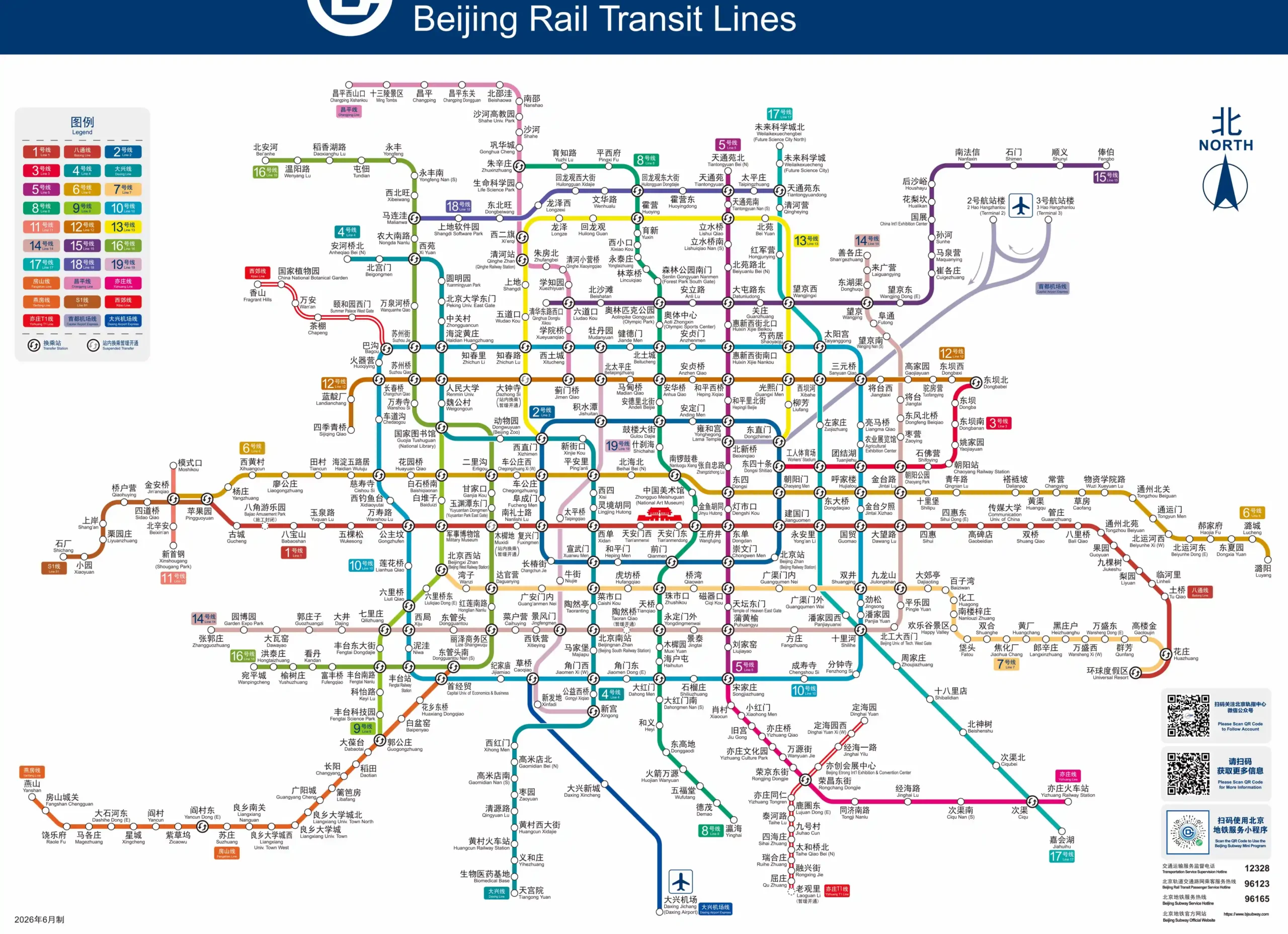
This article is what I wish James had on Day 1. No history lessons (Wikipedia has that covered). No maze-like system maps with no explanation. Just the answers that matter: how to pay, how to get in, how to get where you’re going, and how to avoid the mistakes that drive foreign travelers up the wall.
Beijing Subway at a Glance
A few things you should know before diving into the steps. They’ll shape whether the subway becomes your go-to — or something you avoid.
The scale is staggering. As of 2026, the Beijing subway runs 30 lines across roughly 909 kilometers of track, serving 540 stations (source: Beijing Municipal Transport Commission annual report). On an average day, it moves 9.8 to 9.9 million people. On workdays, that number crosses 11 million. The single-day record? 13.75 million. It’s one of the largest and busiest subway systems in China — and the world.
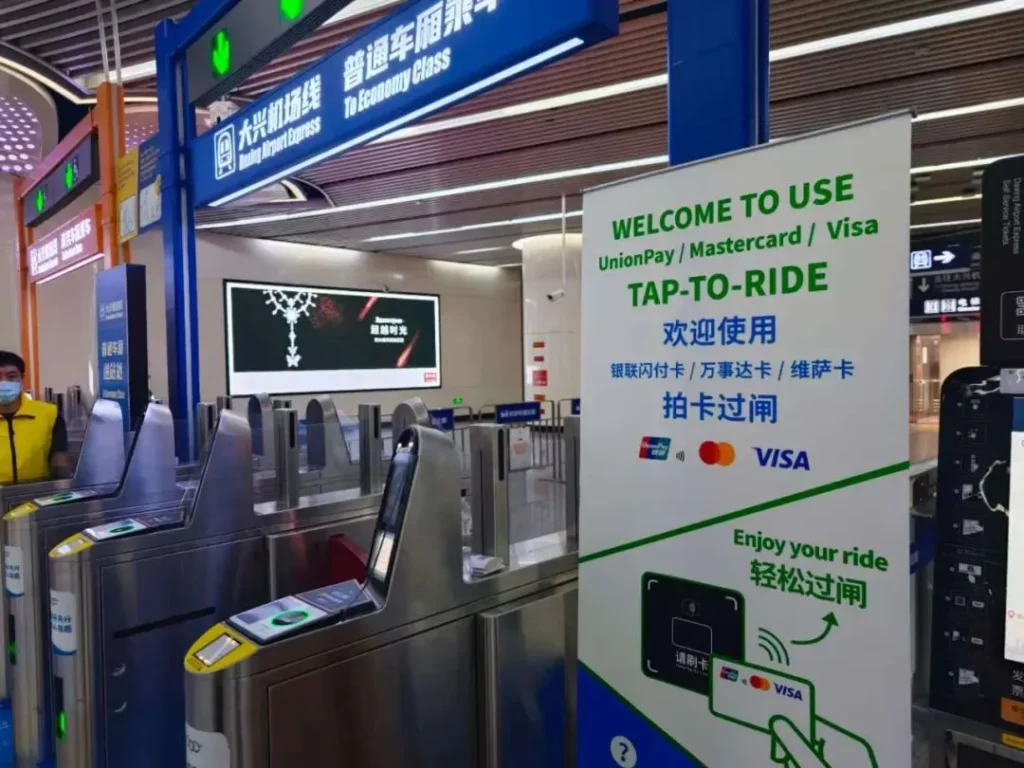
It’s far more foreigner-friendly than you’d expect. Every station name, sign, ticket machine interface, and onboard announcement comes in English. Since 2024, every single gate across the entire Beijing subway network accepts foreign-issued Visa, Mastercard, JCB, and American Express chip cards for Tap to Pay. No ticket. No app. No setup. Just tap your card and walk through — the same way you’d pay for groceries back home. This rollout happened faster than contactless adoption in most Western cities.
The price is absurdly low. Fares start at ¥3 (about 0.40 USD). Most trips between tourist destinations cost ¥3–7 (0.40–1.00 USD). For context: a single ride on the New York City Subway costs $2.90. The London Underground starts at £2.80. You could ride the Beijing subway for an entire week and still spend less than a single day pass in most European cities.
📎 A quick footnote: you might notice Beijing calls it the “Subway” while Shanghai uses “Metro.” This isn’t random — Beijing adopted the North American “Subway” branding after winning the 2008 Olympic bid in 2002, while Shanghai has used the international “Metro” since Line 1 opened in 1993. Same thing. Different name.
Bottom line: the Beijing subway is the last thing you should be nervous about. It’s cheap. It’s safe. It reaches every major attraction. All the signs are in English. And your foreign bank card works at every gate. Let’s walk through it.
How to Use the Beijing Subway: Step by Step
This is the backbone of the whole guide. Every step below targets one specific moment where foreign travelers get stuck. If you’re arriving in Beijing for the first time, read this section in order. If you’re already here and just need to figure out payment, jump to Step 1.
Step 1: Choose Your Payment Method
Get this right and everything else falls into place. Pick wrong and you’ll be fighting the system before you’ve even boarded a train.
🥇 Best option: Tap your foreign card directly at the gate
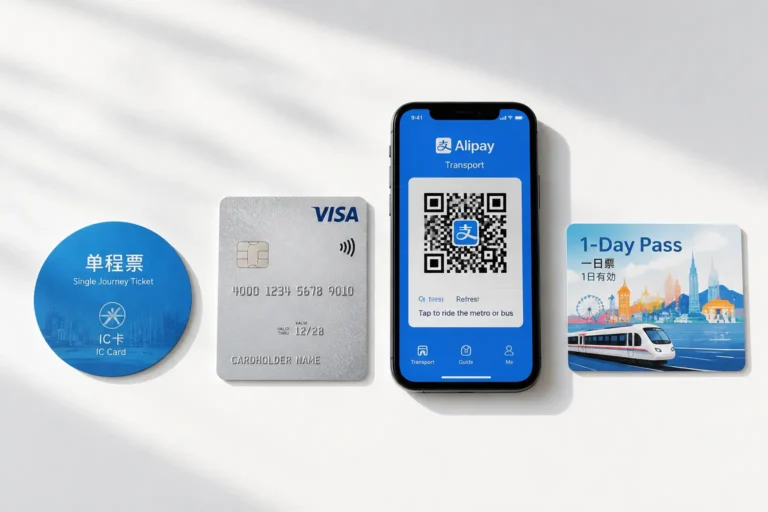
If you have a Visa, Mastercard, JCB, or American Express chip card — contactless or insert — just hold it against the circular reader on the gate. Same motion as paying for coffee. Every gate across the Beijing subway network supports this as of 2026. Tap when you enter. Tap when you exit. The system calculates the fare and charges your card automatically. Zero setup. Zero fees. This is, hands down, the most foreigner-friendly option available right now.
🥈 Runner-up: Alipay or WeChat ride code
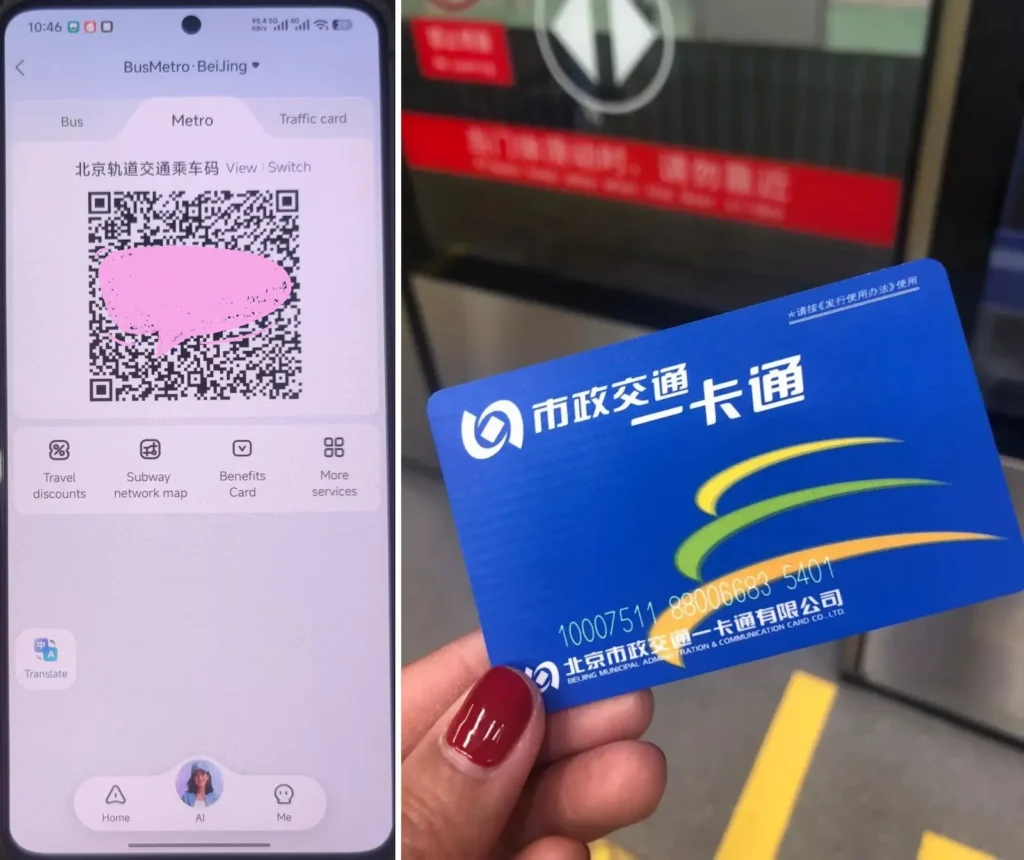
Download Alipay (the international version) or WeChat. Register with your overseas phone number. Add your Visa or Mastercard. Upload a photo of your passport for identity verification — approval usually takes a few minutes to a couple of hours. Once set up, activate the “Beijing Metro Ride Code” inside the app. Scan the QR code to enter, scan to exit. Individual rides cost ¥3–10, well under the ¥200 threshold that triggers the 3% transaction fee, so your subway trips are effectively fee-free.
This is ideal if you’re staying 3+ days and want to handle all your payments — not just the subway — through one app. For a full walkthrough of the setup process, see our step-by-step Alipay setup guide for foreigners.
🥉 Backup: Yikatong transportation card
Available at any station’s service counter or self-service kiosk. ¥20 deposit (about 2.90 USD), with a minimum top-up of ¥20. Works on the subway, buses, taxis, and even some convenience stores. Best for stays of 5 days or longer when you don’t want to mess with apps. Deposit and remaining balance are refundable at select stations.
⚠️ Last resort: Single-ride ticket from a machine or counter
Every station has staffed ticket counters and self-service machines — most now accepting foreign cards. If you’re paying with cash, bring small bills (¥10 or ¥20 notes). The machines sometimes don’t give change.
Step 2: Get Your Ticket or QR Code
What you do here depends on Step 1:
- Foreign card Tap to Pay → Skip this step entirely. Head straight to security.
- Alipay / WeChat ride code → Open the app to your QR code. Double-check the top of the screen says “Beijing Metro Ride Code.” The bus code and subway code are separate — use the wrong one and the gate will not open.
- Yikatong card → Top up at any ticket machine or service counter beforehand. Most machines have an English interface and accept foreign cards.
- Single-ride ticket → Select your destination on the machine, pay, and collect the small plastic card it spits out. Important: you need to insert this card into the gate’s return slot when you exit. It is not a souvenir. Every trip, somewhere on the Beijing subway, a foreign traveler stands frozen at the exit gate trying to tap a single-ride card that needs to be fed into a slot instead.
Step 3: Pass the Security Check
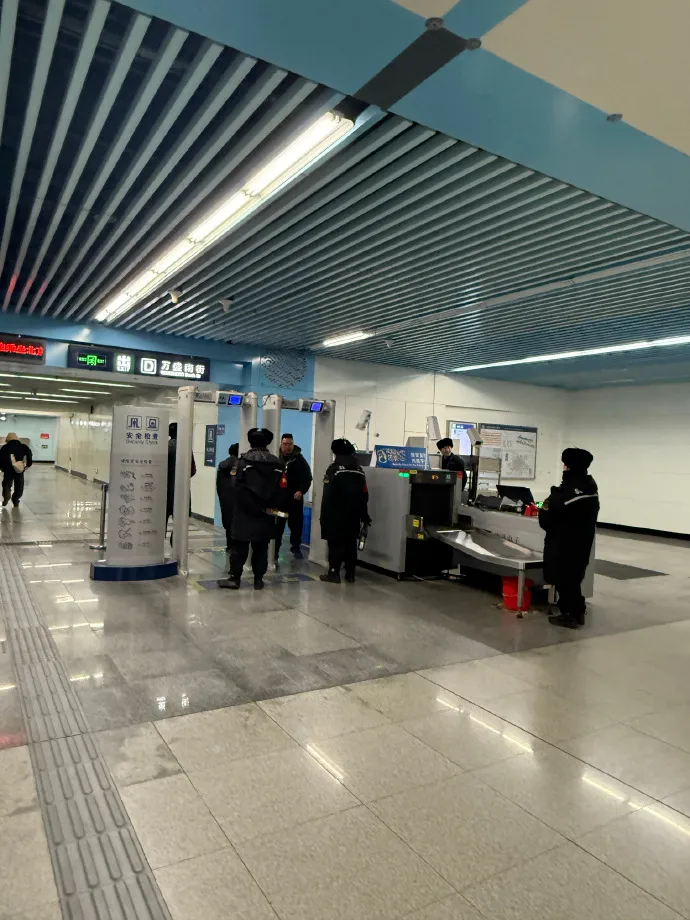
Every station entrance has a security checkpoint. Put your bag and luggage on the conveyor belt. Take out any bottles of water or drinks — the officer will either ask you to take a sip or scan them with a handheld liquid detector.
Items that routinely get confiscated:
- Aerosol sprays — sunscreen, hairspray, deodorant, dry shampoo. Any pressurized can with a labeled capacity over 120ml is banned. Labeled capacity. Not how much is left inside. I once watched a French traveler at Gulou Dajie Station spend five minutes arguing with security over a 150ml sunscreen bottle. She lost.
- Knives — pocket knives, scissors, box cutters with blades longer than 6cm.
- Alcohol, loose white spirits, large lithium batteries — all prohibited.
The whole process takes under ten seconds on a normal day. During rush hour, the line for security can stretch outside the station entrance — another reason to avoid peak times.
Step 4: Tap In at the Gate
Find a row of gates. For foreign cards or Yikatong: hold your card against the circular reader. For ride codes: point your phone screen at the QR scanner. For single-ride tickets: tap the plastic card on the sensor area.
Green light. Gate opens. Walk through.
If nothing happens, check: ① Are you holding your card to the right spot? It’s the circular reader zone, not the screen. ② Has your QR code been sitting on the screen for more than 30 seconds? Refresh it. ③ Are you standing too close to the gate? Step back half a pace and try again. If three attempts fail, walk over to the service counter. Hold up your card, point at the gate, and shrug. They’ll know exactly what’s happening — no Chinese required.
Step 5: Find Your Platform
Follow the overhead signs. Every line is marked by color and number: Line 1 is red, Line 2 is dark blue, Line 10 is sky blue. Signs point to “Line X → Destination” in both English and Chinese.
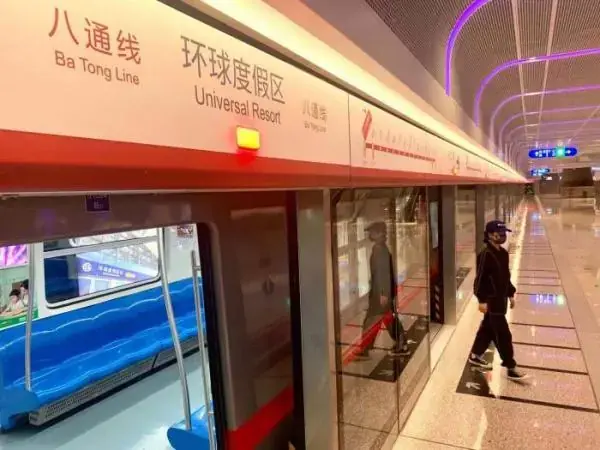
The single most common rookie mistake: getting on the right line but heading the wrong direction. Before you step onto the escalator down to the platform, check the direction sign. If you’re heading to Tiananmen East, the sign should read “→ Universal Resort” — not “→ Gucheng.” Once you’re on the wrong train, fixing it costs you at least ten minutes.
Platform floors have marked queue lines and door-position indicators. Line up behind the markings and you’ll be fine.
A note on navigation apps: Don’t rely on Google Maps alone. In Beijing, Amap (高德地图) and Baidu Maps offer far more precise transit directions, including exact exit letters — which you’ll care about deeply by Step 7. If you’d rather not download Chinese apps, MetroMan and ExploreBeijing are two solid English-language subway map apps with offline support. Having mobile data helps enormously here — if you haven’t sorted that out yet, see our guide on picking up a China SIM card.
Step 6: On the Train & Transfers
Every carriage has an electronic display showing the current and next station in both English and Chinese. Announcements are bilingual too.
Seats are bench-style, first-come-first-served. Offering your seat to elderly passengers or people with small children is widely practiced. No one will glare at you if you don’t — but it’s appreciated.
If you need to transfer, follow the “Transfer Line X” signs. Mental preparation: some transfer stations in Beijing are enormous. The walk between lines at Xizhimen or Jianguomen can take five to eight minutes. You haven’t taken a wrong turn. The station really is that big. (The first time I took James through Jianguomen, he asked three separate times if we were lost. We were not.)
Step 7: Exit at the Right Gate
This is the most underestimated step in the entire Beijing subway experience — and the one no local will ever warn you about, because they don’t have to think about it.
Beijing subway stations have multiple exits labeled with letters: Exit A, Exit B, Exit C, Exit D. Some larger stations go all the way to Exit H. Different exits can dump you onto completely different streets, on opposite sides of massive intersections. Choose wrong and you could be adding 15–20 minutes of walking, sometimes requiring another security check just to cross back to the side you actually wanted.
Real example: Tiananmen East Station. Exit A puts you on the north side of Chang’an Avenue, right in front of Tiananmen Gate (this is the one you want for the Forbidden City). Exit D puts you on the south side, in front of the National Museum. The two exits face each other across a ten-lane boulevard you cannot cross on foot — you’ll need the underpass, which adds ten minutes and another security screening.
What to do: before you arrive, check your map app for the recommended exit letter. Amap and Baidu Maps both specify this in their transit directions. Inside the station, exit information boards on the walls list which street and landmark each letter leads to. Take five seconds to confirm. It’s the cheapest investment you’ll make all day.
When tapping out: foreign cards, ride codes, and Yikatong all work the same way as entering — tap or scan. Single-ride ticket users: feed the plastic card into the return slot on the gate. Not tap. Not swipe. Insert. The gate will not open until that card disappears into the machine.
Beijing Subway Tickets & Payment: Which One Is Best for You?
With so many ways to pay and multiple ticket types floating around, here’s how they stack up side by side.
Payment Methods Compared
| Method | Best for | Setup difficulty | Needs Chinese phone/bank? | Rating |
|---|---|---|---|---|
| Foreign card Tap to Pay (Visa/MC/JCB/Amex) | Short stays, zero-app travelers | None | No | ⭐⭐⭐⭐⭐ |
| Alipay / WeChat ride code | 3+ day stays, all-in-one payment | Low | No (overseas number + passport) | ⭐⭐⭐⭐ |
| Yikatong card | 5+ day stays, frequent transit | None | No | ⭐⭐⭐⭐ |
| Single-ride ticket (machine) | 1–2 rides only | None | No | ⭐⭐⭐ |
| Cash at service counter | Absolute backup | None | No | ⭐⭐ |
Our recommendation: if you have a Visa or Mastercard chip card, use Tap to Pay. That’s it. That’s the whole strategy. No apps, no registration, no cash. If you’re staying more than three days and want mobile payment for everything — not just the subway — spend ten minutes setting up Alipay with your foreign card. It’s a one-time task that pays off across your entire trip.
Ticket Types Compared
| Ticket | Price | Best for | How to buy |
|---|---|---|---|
| Single ride | ¥3–10 (0.40–1.40 USD) | 1–2 rides | Self-service machine / service counter |
| Yikatong card | ¥20 deposit + top-up (2.90 USD) | 3+ day stays | Service counter / self-service kiosk / phone app |
| 1-day pass | ¥20 (2.90 USD) | 5+ rides in 24 hours | Yitongxing App only (e-ticket, no physical card) |
| 3-day pass | ¥40 (5.70 USD) | Heavy use over 72 hours | Yitongxing App only (e-ticket, no physical card) |
| Capital Airport Express | ¥25 (3.60 USD) | To/from PEK airport | Airport line ticket machine / Tap to Pay at gate |
| Daxing Airport Express | ¥35+ (5.00 USD+) | To/from PKX airport | Airport line ticket machine / Tap to Pay at gate |
Two things to watch:
① The 1-day and 3-day passes are digital-only. You cannot buy them at a ticket window or machine — they exist exclusively inside the Yitongxing (亿通行) App, where you purchase and activate them to generate a ride QR code. (Yes, this is different from the Yikatong card. Different app. Different system. Welcome to China.) If you prefer a physical card, you can also get a digital Yikatong card through the Beijing Yikatong app on your phone. Both passes also do not cover the Airport Express lines.
② The Airport Express is a separate fare system. Your day pass, 3-day pass, or Yikatong discount won’t work on it. You’ll need to either buy a dedicated Airport Express ticket or tap your foreign card directly at the airport line gate — which will charge the airport fare separately.
6 Mistakes to Avoid on the Beijing Subway
Every one of these comes from watching real travelers — including James — run into them headfirst.
Mistake #1: Squeezing into Rush Hour with Big Luggage
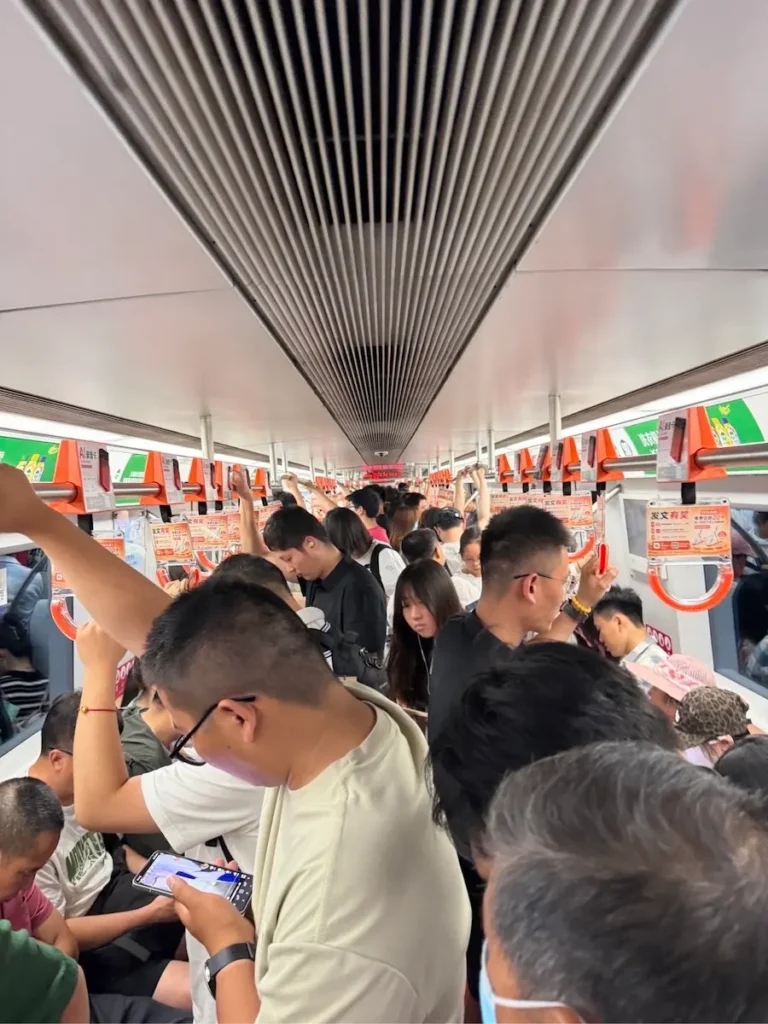
Beijing rush hour (roughly 7:30–9:00 AM and 5:30–7:00 PM on weekdays) is something you need to see to believe. Trains arrive with faces pressed against the glass. Platform queues stretch out of sight.
I brought James into the city right at the peak of evening rush. He stared at the packed carriage for a solid ten seconds. Then: “Are we really getting in there?” We sat in an airport lounge for an hour instead.
One Reddit user on r/travelchina put it bluntly: “We travelled into Beijing in rush hour on the train with large luggage, let me tell you, we didn’t make any friends lol. Hustle is considered normal here.”
How to avoid it: if your flight lands during rush hour and you have a big suitcase, you’ve got two choices. Wait it out at the airport — grab a coffee, sit for an hour. Or skip the subway entirely for that first trip: Didi (China’s ride-hailing app) accepts foreign cards and will get you to your hotel without the wrestling match. Our guide to ride-hailing in China covers how to set this up. If you must take the subway during peak times without luggage, just brace yourself. Physical contact is not a violation of personal space here. It’s just Tuesday.
Mistake #2: Relying Only on Google Maps
Google Maps has two problems in Beijing: transit data sometimes lags behind (the Beijing metro adds new lines almost every year), and it doesn’t tell you which exit letter to use. You’ll know when to get off the train. You won’t know which of the four possible exits actually gets you where you’re going.
How to avoid it: have a backup. Amap and Baidu Maps have basic English interfaces and give exit-precise transit directions. If you want to stay entirely within English-language apps, MetroMan and ExploreBeijing are both excellent — they cover the full Beijing subway map and work offline.
Mistake #3: Picking the Wrong Exit
I covered exit navigation in detail back in Step 7, but this mistake is so common it deserves its own warning. Nearly every first-time foreign rider on the Beijing subway gets burned by this at least once — a station’s Exit A and Exit D can put you on opposite sides of a ten-lane boulevard with no pedestrian crossing in sight. The fix costs you an underpass detour and sometimes a second security check. Before you surface, glance at the exit board. Five seconds. Every time.
Mistake #4: Getting Your Spray Confiscated at Security
Aerosol cans with a labeled capacity over 120ml are banned. Period. It doesn’t matter if the can is nearly empty — the rule goes by labeled capacity, not actual contents. Sunscreen, deodorant, dry shampoo, hairspray. All of it.
How to avoid it: buy travel-size bottles (under 120ml) before you leave, or just buy what you need after you land. Convenience stores and drugstores in Beijing are everywhere and well-stocked. You won’t struggle to find sunscreen. For more on what to bring (and what to leave out), see our China packing list.
Mistake #5: The Airport Express Trap
Two traps, actually.
First: the Airport Express is its own thing. Your day pass won’t cover it. Your 3-day pass won’t cover it. Even your Yikatong card charges a separate, higher fare on these lines. Capital Airport Express: ¥25 (3.60 USD). Daxing Airport Express: ¥35 and up (5.00 USD+).
Second: the last train leaves earlier than you think. The Capital Airport Express’s final departure from Dongzhimen is around 10:30 PM. Regular Beijing subway lines run until about 11:00 PM. If your flight lands late and you dawdle, you can absolutely miss the last airport train — and this happens to foreign travelers constantly.
How to avoid it: check the first and last train times on bjsubway.com or the ExploreBeijing app before you travel. If your flight lands close to the last departure, have a ride-hail backup plan ready to go.
Mistake #6: Transfer Tunnels That Never End
Xizhimen. Dongzhimen. Jianguomen. Guomao. These mega interchange stations can swallow five to ten minutes of your life just in walking between lines. You haven’t made a wrong turn. The station is simply enormous.
A Reddit user on r/travelchina described it perfectly: “A big ‘Metro This Way’ sign pointed to three possible branch directions. When I finally asked someone for directions I had already walked a considerable distance and backtracked. Not funny, but I felt the wariness of distance.”
How to avoid it: when you see your first transfer sign at a major interchange, don’t charge toward it. Stop. Read the full sign. It should list the specific line number and direction — not just “Metro This Way.” If you’re unsure, open a map app to confirm your route. GPS usually works well enough even on the concourse level.
Beijing Subway FAQ: Quick Answers for Travelers
Q: What time does the Beijing subway open and close?
Most lines run from 5:00 AM to 11:00 PM. Exact first and last train times vary slightly by line. If you need to get around after 11:00 PM, the subway is not your option — use a ride-hailing app instead.
Q: Is there a 1-day or 3-day pass?
Yes. A 1-day pass costs ¥20 (2.90 USD), valid for 24 hours from activation. A 3-day pass costs ¥40 (5.70 USD), valid for 72 hours. Both are digital-only — you buy and activate them inside the Yitongxing (亿通行) App. No physical card exists for either pass, and neither covers the Airport Express.
Q: Can I use my Mastercard or Visa to pay for the Beijing subway?
Yes — and it’s the method I recommend most. As of 2026, every gate across the entire Beijing subway network accepts foreign-issued Visa, Mastercard, JCB, and American Express chip cards via Tap to Pay. No advance setup. No app download. Just tap and go.
Q: Where can I get an English Beijing subway map?
Three good options: ① the ExploreBeijing app (iOS/Android, works offline); ② MetroMan (high-res Beijing subway map with route planning); ③ bjsubway.com, which offers downloadable English PDF maps. Most station service counters also carry free printed English maps — just ask.
Q: How do I get from the airport to the city center by subway?
Capital Airport (PEK): take the Airport Express to Dongzhimen Station, then transfer to Line 2 or Line 13. Daxing Airport (PKX): take the Daxing Airport Express to Caoqiao Station, then transfer to Line 10 or Line 19. For fare details and last-train warnings, see Mistake #5 above — the Airport Express has its own pricing and an earlier closing time than regular lines.
Q: Do I need to download a Chinese app to use the subway?
No. If you have a foreign chip card, Tap to Pay works at every gate — zero apps required. Downloading Alipay or a map app is nice to have, not need to have.
Q: Is the Beijing subway safe?
Extremely. Every entrance has a security checkpoint. Stations and carriages are under full video surveillance. Pickpocketing rates are far lower than on most European metro systems. If you’re traveling late at night, stick to the front or rear carriages where an attendant is on duty.
Q: What’s the difference between “Beijing Subway” and “Beijing Metro”?
Nothing — same system, different branding. (We unpack the backstory in the footnote at the top of this guide.) If you’re also visiting Shanghai, check out our Shanghai Metro guide for that city’s system.
One Last Thing
James spent four days in Beijing. Every morning, he took the subway to a different corner of the city. Day 1, I led the way — showed him where to tap his card, which exit to take, when to pull his water bottle out before security. Day 2, he started doing it himself. By Day 3, he didn’t need me at all. Visa card on the reader. Gate opens. Walk through like he’d been doing it his whole life.
Before he flew out, he said something that stuck: “Your subway system is actually really good. I just needed something like this —” he pointed at the notes I’d been scribbling “— on Day 1.”
This is that thing. If you’re about to step into a Beijing subway station for the first time, take ten minutes to read through this guide. Then walk up to the gate, pull out your card, and tap it. It’ll open.
Last updated: August 2026. Fares and policies may change — check bjsubway.com or station notices for the latest information.

Ke Ping — Founder, InsiderChinaTravel
I personally reply to every email and create free, custom trip frameworks. Already have a plan? I can arrange vetted local guides and private drivers. Over 5,000 travelers from 30+ countries have started their journey this way.
📋 Tell me about your trip ideaReplied within 24 hours. No charge, no obligation.