China Packing List 2026: What to Pack for China (& 8 Things to Leave Behind)
I landed at Shenzhen Bao’an International Airport in August 2019 with three oversized suitcases and a backpack so stuffed the zipper was begging for mercy.
Half of what I brought? Never touched it. The leather dress shoes I packed “just in case” — worn zero times in two years. That thick wool scarf — absurd in subtropical Shenzhen, where even looking at it made me sweat. A full pack of toilet paper I’d hauled from London — sold in every corner store across China, for pennies.
The things I actually needed? Nowhere in those three suitcases. No universal adapter. No stomach medicine. No shoes that could survive a full day of rain.
I ended up living in China for six years. Moved through three cities — south to north, coast to inland. Every relocation, every short trip, every friend who visited and asked me to come unpack their overstuffed suitcase in a hotel lobby — it all sharpened what I now think of as my personal china packing list.
This article is the note I wish someone had handed me at departures. While you still have time to take things out.
For broader pre-trip advice — visas, payments, SIM cards — I’ve covered those in our China travel tips guide. This page focuses purely on what to pack for a trip to china. Your suitcase. Nothing else.
- What to Pack for China: The 5-Category Travel Essentials
- Seasonal Add/Remove Cheat Sheet
- North vs. South: Beijing and Guangzhou Suitcases Look Nothing Alike
- 8 Things You'll Regret Packing for China
- 4 China-Specific Packing Hacks
- Your Screenshot-Ready China Travel Checklist
- China Packing FAQ: Quick Answers
What to Pack for China: The 5-Category Travel Essentials
This isn’t a “bring everything” list. It’s a decision filter. When you’re standing over an open suitcase debating whether something earns its weight — this is your answer. Consider it your packing list for china, built from years of getting it wrong so you don’t have to. That’s the point of a china packing list — it earns its weight before your suitcase does.
① Documents & Money
This is the category where mistakes get expensive. Fast.
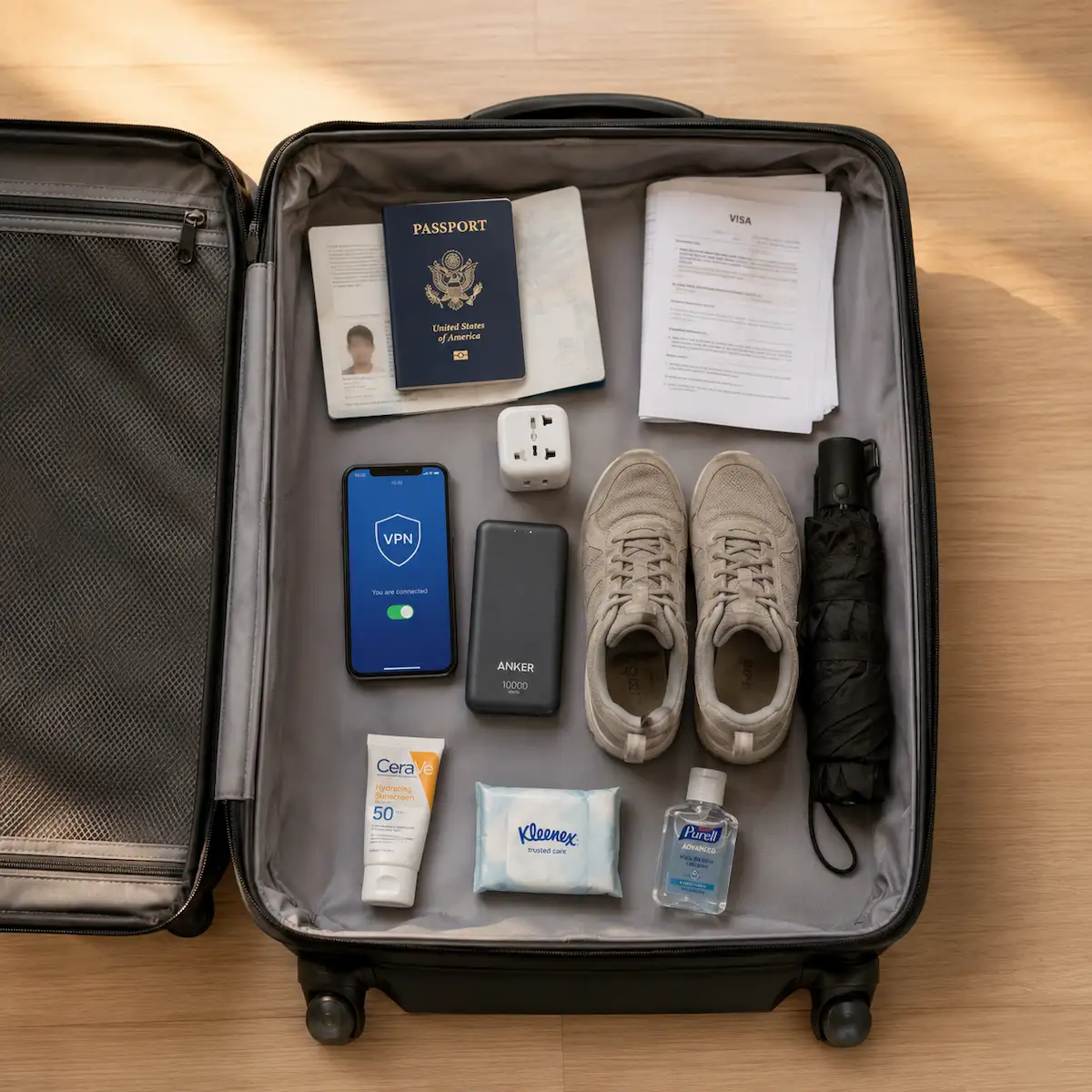
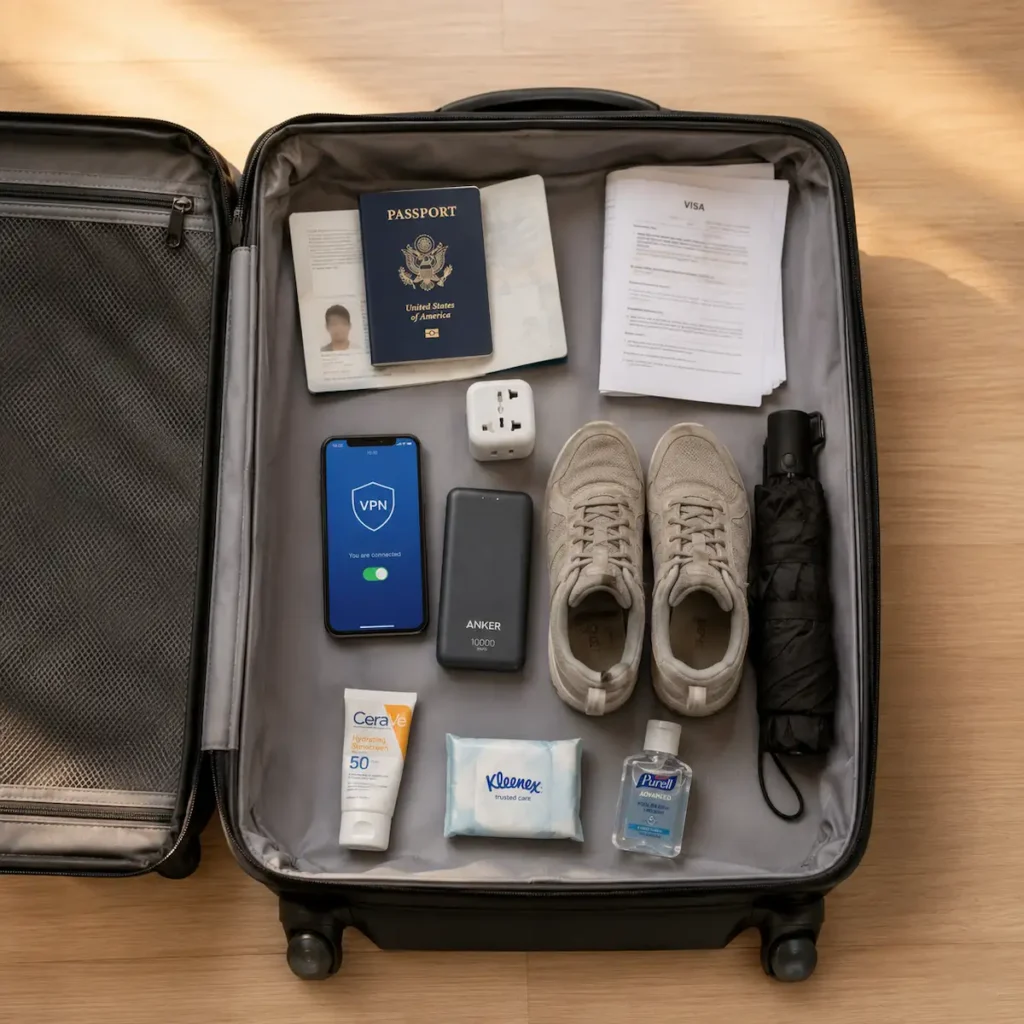
- Passport — valid for at least six months beyond your entry date. Airlines will deny boarding for anything less. No negotiation.
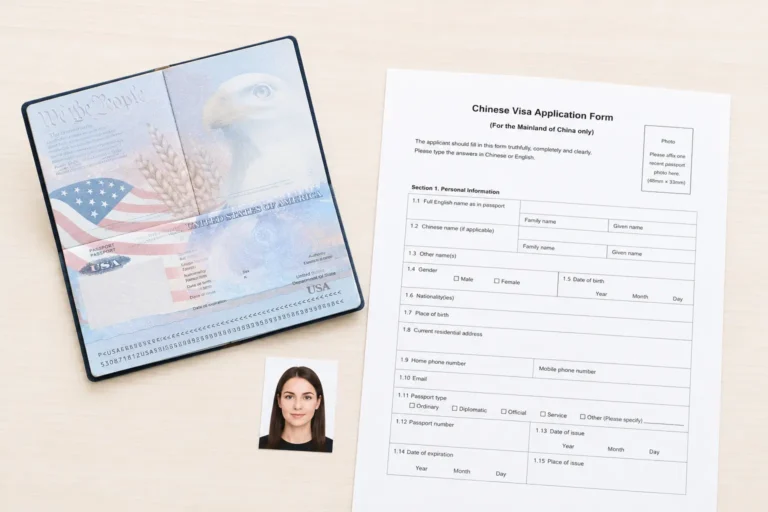
- Visa (printed copy) — a phone screenshot isn’t enough. You’ll want paper when you’re tired, jetlagged, and standing in front of a customs officer. For the full application walkthrough, see our China visa application guide.
- Photocopies of passport + visa — stored separately from the originals. Originals in your day pack or hotel safe. Copies buried in your suitcase.
- Two passport-sized photos — lose your passport and you’ll skip the panic of hunting for a photo booth in an unfamiliar city.
- International credit card + ¥1,000–2,000 RMB cash (about USD 140–280) — mobile payment runs China, but those first few hours before you get a local SIM and bank account sorted? Cash and card are your safety net. Once you’re set up, read our guide to setting up Alipay and you’ll barely touch cash again.
- Travel insurance documents + emergency contacts — printed. Not just on your phone.
② Electronics & Connectivity
Your phone is your wallet, map, translator, menu decoder, and ride-hailer in China. Electronics fail = your trip gets genuinely harder. These are china travel essentials you don’t skip. If you forget these china travel essentials, everything else on your china packing list suddenly matters a lot less.
- Phone + charger — obvious. Less obvious: confirm your phone supports Chinese 4G/5G bands. Most iPhones and flagship Androids do. Some budget and niche models don’t.
- Power bank (10,000–20,000 mAh) — your second battery. Chinese aviation rules require power banks carried onboard to have the CCC (3C) certification mark. Buy a reputable brand with clear labeling.
- Universal adapter — Chinese wall sockets are combination units: two flat prongs on top (compatible with US-style two-prong plugs like iPhone chargers) and three angled flat prongs below (Type I, Chinese standard with grounding). Coming from Europe (Type C/F) or the UK (Type G)? You need an adapter. American two-prong plugs work directly — but if your laptop charger has a third round grounding pin, that needs adapting.
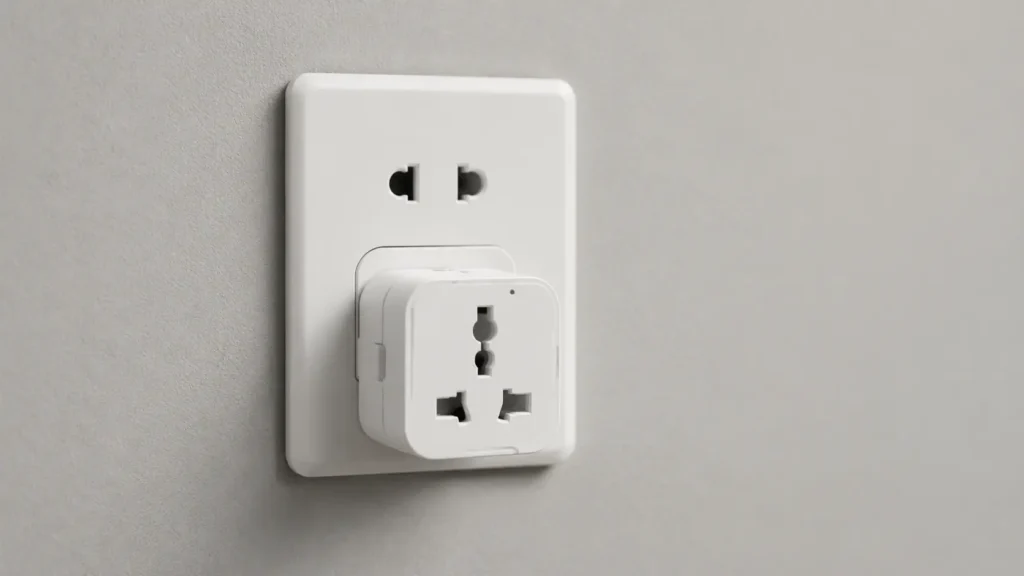
- VPN — install it and test it before you fly. Once you land in China without one, Google, Gmail, Instagram, and WhatsApp disappear. Don’t wait until you need it. You’ll be too late.
- Headphones — your fellow passengers on the high-speed train will silently thank you.
③ Clothing & Footwear
This is where overpacking lives. Here’s the rule: you can buy clothes in any Chinese city for less than back home. Unless you’re very tall (over 190 cm / 6’3″) or have large feet (above US 13 / EU 47), don’t treat your suitcase like a mobile wardrobe. When traveling to china what to pack in clothing comes down to a few versatile pieces, not a full closet.
- Waterproof walking shoes — the single most important item on this entire china packing list. A typical tourist day in Xi’an — Muslim Quarter, City Wall, Terracotta Warriors — clocks 20,000+ steps. Bring shoes you trust. Breaking in new ones after arrival is a gamble you’ll lose.
- A light jacket or cardigan — regardless of season. In summer, malls and trains blast air conditioning to near-arctic levels. In winter, northern buildings overheat to tropical. A layer that goes on and off easily solves both problems.
- Underwear + socks × 3–4 days — laundry is easy (hotels offer it, convenience stores sell replacements).
- Sleepwear — a hotel bathrobe is not pajamas.
- Swimsuit — if your itinerary includes hot springs, water parks, or coastal cities.
Seasonal adjustments — use the cheat sheet below to add or strip items:
④ Toiletries & Medications
Toiletries are easy to buy in China — Watsons, convenience stores, supermarkets cover the basics everywhere. Medications are where things get trickier. Some Western staples don’t exist on Chinese shelves, or come in different formulations and dosages. This section covers what to pack when traveling to china for health and hygiene.
Toiletries — pack small, buy the rest locally:
- Travel-size toothpaste + toothbrush
- Mini shampoo and body wash (2–3 days’ worth)
- Deodorant — selection in China is surprisingly limited. If you’re loyal to a specific brand or formula, bring your own.
- Sunscreen — Chinese sunscreens lean heavily toward whitening and cosmetic formulas. If you want straight-up outdoor SPF protection, bring it.
Medications — this part matters:
- Personal prescriptions — keep them in original packaging with a copy of your English-language prescription. Under China Customs’ “reasonable personal consumption” rule, 30 days’ supply stays in the safe zone.
- Stomach medicine — even with an iron gut at home, the shift in water, oil, spices, and gut bacteria can hit hard. Bring anti-diarrheal and digestive aids.
- Pain/fever relievers + cold medicine — keep in original packaging.
- ⚠️ Strictly prohibited — medications containing compound licorice tablets (opiate derivatives), pseudoephedrine, ephedrine, dextromethorphan, or sedatives like triazolam and alprazolam. These are controlled substances in China. Carrying them without a full doctor’s prescription can mean confiscation, fines, or worse. Official source: General Administration of Customs, Order No. 43.
Small but essential:
- Pocket tissues — not a bulk pack. The tiny packet you grab from your pocket in three seconds. Public toilets across China frequently have no toilet paper inside the stall. Airports and high-end malls are usually fine. Metro stations, parks, small restaurants? Assume nothing. A small packet saves you every single time.
- Hand sanitizer — same logic.
- Lip balm + hand cream — especially autumn and winter. Northern China’s dry air can make you wake up with a nosebleed. Not exaggerating.
⑤ Miscellaneous Must-Haves
- Compact umbrella or lightweight rain jacket — southern China’s plum rain season (April–June) plus summer thunderstorms make this non-negotiable.
- Eye mask + earplugs — plane, hostel, budget hotel with paper-thin walls.
- Small luggage lock — hostels and overnight trains.
- A pen — for the arrival card and customs form. You’ll remember this tip the exact moment the flight attendant hands you the form and you instinctively pat your empty pockets.
- Reusable shopping bag — plastic bags now cost money in Chinese supermarkets.
- Water bottle or thermos — hot water dispensers are everywhere (hotels, train stations, airports, restaurants). Carrying a bottle means you refill like a local.
Seasonal Add/Remove Cheat Sheet
Don’t pack for “China.” Pack for the China you’re actually visiting, in the month you’re actually going. A china packing list built for January looks nothing like one for July. Packing for China changes dramatically with the seasons. This table makes the adjustments quick:
| Season | Months | Add to Your Suitcase | Remove From Your Suitcase |
|---|---|---|---|
| Spring | Mar–May | Light jacket, umbrella, allergy meds (pollen season) | Heavy down coat, thermal underwear |
| Summer | Jun–Aug | Sun hat, sunglasses, sunscreen, insect repellent, umbrella, quick-dry clothing | Thick coats, sweaters |
| Autumn | Sep–Nov | Light jacket, lip balm, hand cream | Insect repellent (after October) |
| Winter | Dec–Feb | Down coat, thermal underwear, hat+gloves+scarf, lip balm and hand cream (double up for the north) | Shorts, lightweight summer clothing (unless heading to Hainan or Guangdong) |
Timing your trip right matters as much as packing right — see our guide to the best time to visit China for month-by-month climate breakdowns.
North vs. South: Beijing and Guangzhou Suitcases Look Nothing Alike
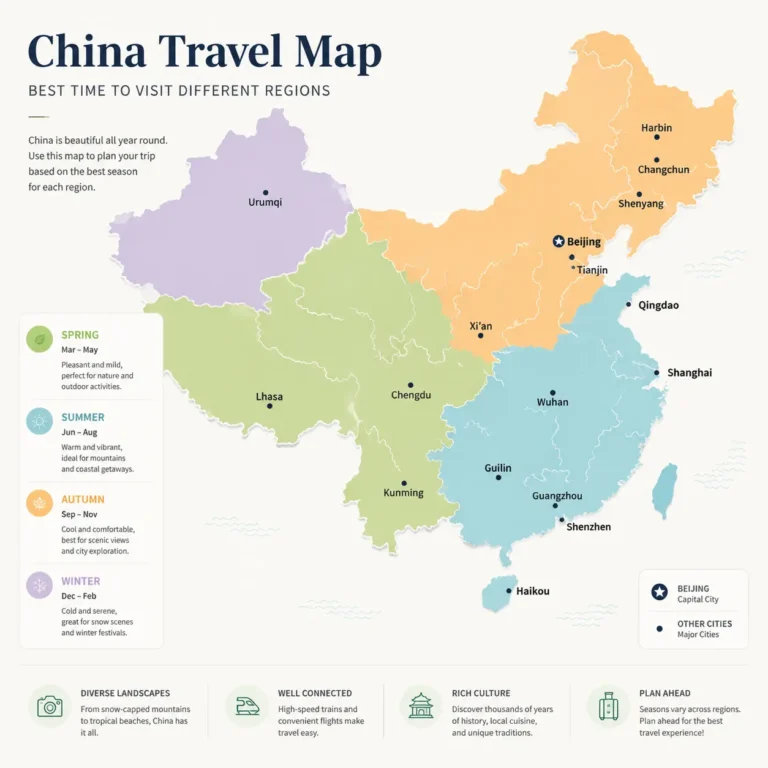
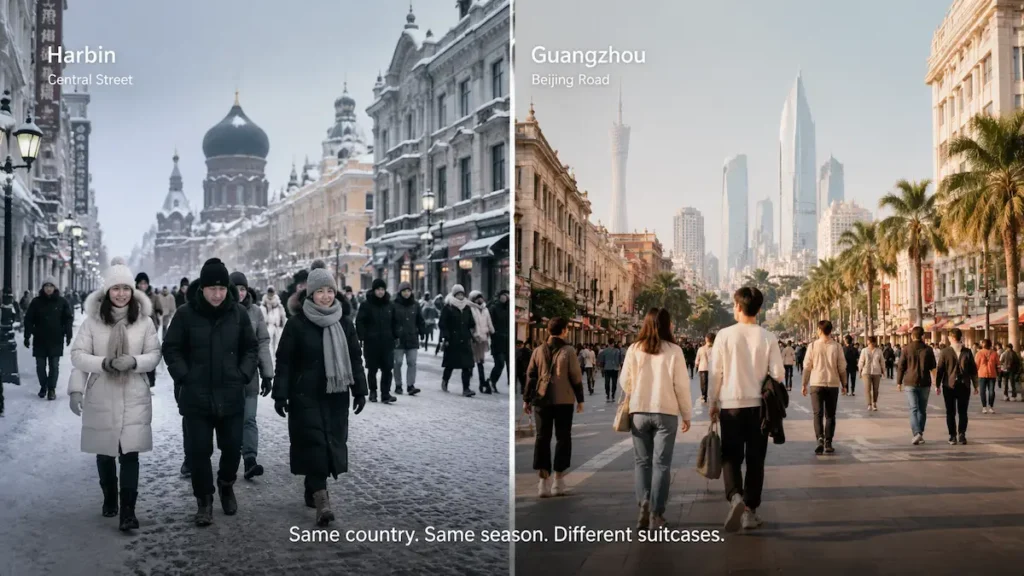
China spans roughly the same latitude range as the continental United States — from Winnipeg-cold to Miami-humid. Your china packing list needs to target your specific destination, not some country-wide average. Packing for a china trip to Harbin shares almost nothing with a trip to Guangzhou.
The North (Beijing, Xi’an, Harbin, Shenyang): Winter here means -15°C (5°F) outside — and 25°C (77°F) inside. The logic is onion-layering: a serious down coat that comes off the second you step indoors, with a presentable t-shirt or thin sweater underneath. Bring lip balm and hand cream. The dryness is biblical. Summer hits 38°C (100°F) but stays arid — a thin long-sleeved shirt for sun protection often beats a t-shirt.
The South (Shanghai, Hangzhou, Guangzhou, Shenzhen, Chengdu): Winter says 5°C (41°F) — sounds mild until you learn there’s no central heating south of the Yangtze River. Indoor and outdoor temperatures are identical, and the humidity drives the cold into your bones. Thermal underwear and a waterproof shell beat a thick down coat here. Summer is 35°C (95°F) with 80% humidity — you’ll sweat through your shirt walking three blocks. Quick-dry fabrics, extra t-shirts, and a foldable umbrella are survival gear.
The Western Highlands (Tibet, Yunnan, western Sichuan): Whatever the season, bring a warm layer. Daytime at 20°C (68°F) under fierce high-altitude sun drops to below freezing after dark. Sunglasses and sunscreen aren’t optional above 4,000 meters — UV intensity here outpaces the Alps.
8 Things You’ll Regret Packing for China
Every seasoned traveler to China has a mental list of things they wish they’d leave behind. Here’s mine — built from personal mistakes and years of watching friends repeat them. When thinking about what to pack for china, knowing what NOT to pack is half the battle.
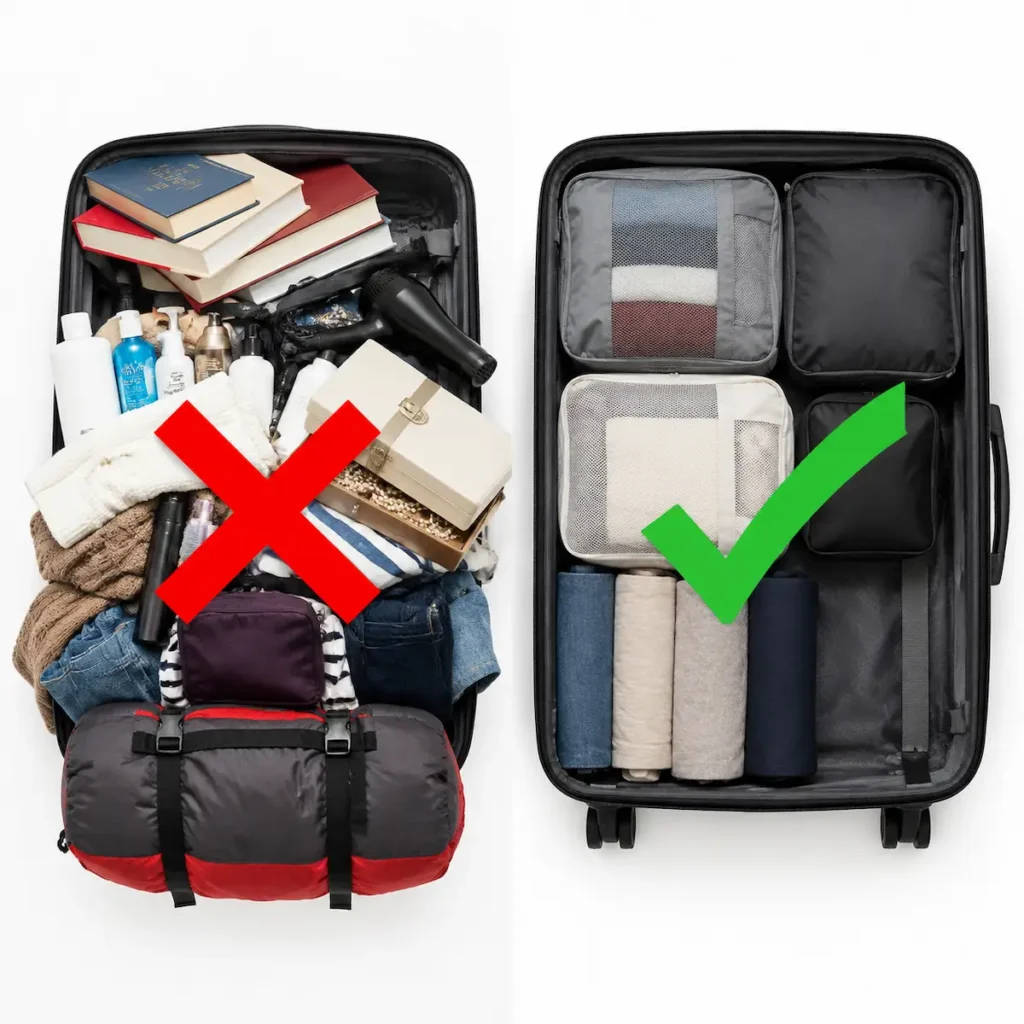
- Too many clothes. Clothing in China is cheap and abundant. Three to four days’ worth of outfit changes is plenty — unless you have hard-to-fit proportions, buy what you’re missing after arrival. It’ll probably cost less.
- Expensive jewelry and watches. No tourist attraction requires a Rolex. Flashy luxury makes you a target in crowded areas, and nobody’s looking at your wrist — they’re looking at the view.
- A stack of books or paper guidebooks. You don’t need a single one. Translation apps, offline maps, and mobile guides replace them all. If you must have something for the flight, bring one paperback — leave it when you finish it.
- Full-size toiletries. Unless you have a medical-grade shampoo situation, travel sizes get you through the first few days. Watsons and supermarkets cover the rest.
- Too many snacks. China’s snack aisle is a country-spanning adventure in itself. Unless you have strict dietary restrictions (gluten-free, for example), save suitcase space for the souvenirs coming back.
- A bulk pack of toilet paper. Don’t hoard it. Carry a pocket tissue packet for bathroom emergencies — buy more locally as needed.
- A sleeping bag. Unless you’re trekking or staying in extremely remote village guesthouses, every hotel and hostel provides bedding. A sleeping bag is the single bulkiest “what if” item you’ll drag across the country.
- A heavy suitcase itself. A hard-shell suitcase weighing 4.5 kg (10 lbs) empty eats nearly 20% of a standard 23 kg checked baggage allowance — before you’ve packed a single sock. Go lightweight. Many older metro stations in China still have no elevators. Every excess kilogram announces itself on the stairs.
4 China-Specific Packing Hacks
Once your china packing list is trimmed of unnecessary weight, these four hacks make the actual packing smoother.
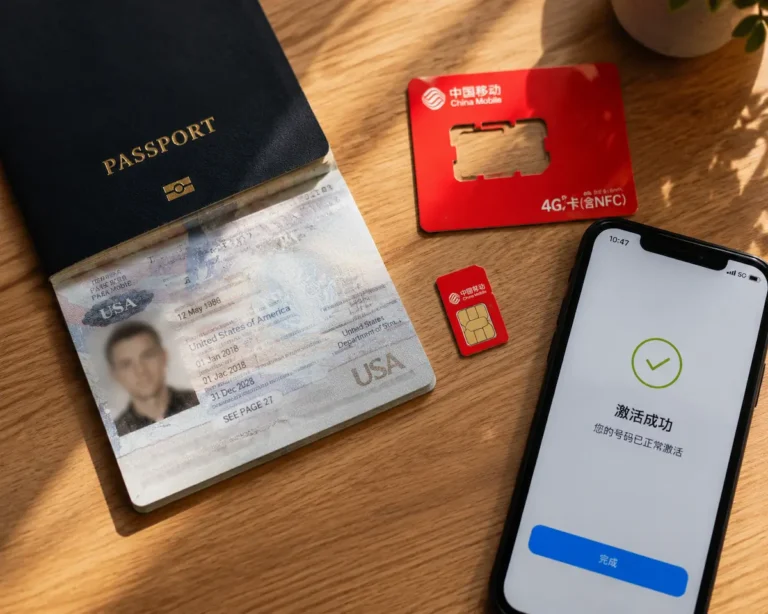
Hack 1: Install and test your VPN before you pack a single shirt. This is the one thing you cannot fix after landing. Download it, install it, connect successfully. Do not wait. Without a VPN on arrival, Google stops existing. Before your trip, also read our guide on getting a China SIM card — connectivity is step one.
Hack 2: Pack a “first-night” bag separately. After a 12-hour flight, you don’t have the energy to dig through three suitcases for a charger and toothbrush. One small bag holds: power bank, charging cable, universal adapter, toothbrush, a clean t-shirt, passport copies. Open that bag. Ignore everything else until morning.
Hack 3: Stuff a foldable duffel bag into a corner of your suitcase. It lies flat, weighs almost nothing. On the return trip? Unfold it and fill it with souvenirs, snacks, and random beautiful things from street markets. Beats paying ¥200 (USD 29) for a woven bag at the airport. This is the “leave room for souvenirs” philosophy applied — literally.
Hack 4: Download offline maps and translation apps at home. Google Maps is unreliable inside China. Download Amap (Gaode Maps) — it supports multiple languages and covers every corner of the country with navigation accurate to the meter. For translation, Baidu Translate or Youdao Translate’s camera feature lets you point your phone at a menu and read it instantly. Download offline language packs before you go. When you’re ready to move between cities, our China transportation guide shows you how high-speed rail works — and packing light suddenly feels even smarter when you’re navigating crowded station platforms.
Your Screenshot-Ready China Travel Checklist
The china travel checklist below — distilled from this china packing list — is designed to be screenshotted on your phone or printed on a single sheet of A4. Tick items off as you go. (Yes, you can screenshot it right now.)
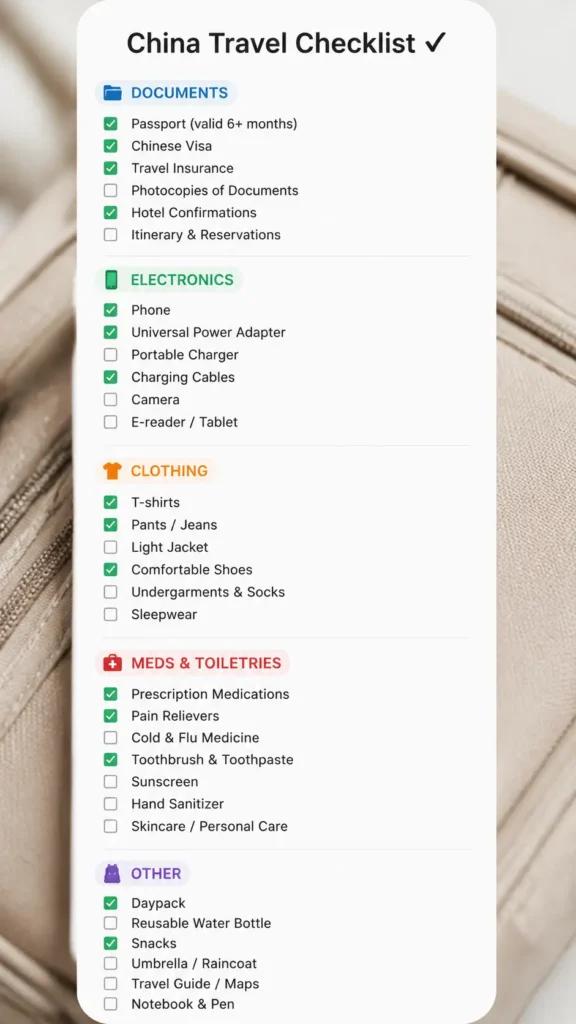
📁 Documents
- ☐ Passport (valid 6+ months beyond entry)
- ☐ Visa (paper copy)
- ☐ Passport + visa photocopies (stored separately)
- ☐ 2 passport-sized photos
- ☐ International credit card
- ☐ ¥1,000–2,000 RMB cash
- ☐ Travel insurance documents
📱 Electronics
- ☐ Phone + charger
- ☐ Power bank (CCC-certified)
- ☐ Universal adapter
- ☐ VPN (installed + tested before departure)
- ☐ Headphones
👕 Clothing
- ☐ Waterproof walking shoes
- ☐ Light jacket or cardigan (all seasons)
- ☐ Underwear + socks × 3–4 days
- ☐ Sleepwear
- ☐ Seasonal items (use cheat sheet above)
💊 Meds & Toiletries
- ☐ Prescription meds (original packaging + prescription copy)
- ☐ Stomach medicine
- ☐ Travel-size toiletries (2–3 days)
- ☐ Deodorant
- ☐ Sunscreen
- ☐ Pocket tissues + hand sanitizer
- ☐ Lip balm + hand cream
🎒 Other
- ☐ Compact umbrella
- ☐ Eye mask + earplugs
- ☐ Small luggage lock
- ☐ A pen
- ☐ Reusable shopping bag
- ☐ Water bottle
- ☐ Foldable duffel bag (empty)
China Packing FAQ: Quick Answers
Still fine-tuning your china packing list? Quick answers to the questions travelers ask most.
Can I buy my usual medications in China?
Some, yes — ibuprofen and paracetamol are available at pharmacies — but brands and dosages differ. Specific allergy meds and particular prescription formulations are harder to find. Bring your own. Keep everything in original packaging with a copy of your prescription.
What adapter do I need for Chinese power outlets?
From the US: two-prong flat plugs (phone chargers) work directly — three-prong grounded plugs need an adapter. From Europe or the UK: everything needs an adapter. Simplest fix: one universal adapter plus a compact USB hub. Charge all your devices from a single socket.
How much cash should I bring?
¥1,000–2,000 RMB (USD 140–280) gets you through the first few days with room to spare. Once WeChat Pay or Alipay is set up, cash usage drops to near zero. Keep a few hundred RMB tucked away for the rare cash-only market stall.
Can I buy clothes in my size in China?
Height under 175 cm (5’9″) and shoe size under US 12 / EU 46: you’re fine. Above those thresholds, selection narrows significantly. Plus-size underwear and extra-large shoes are the two hardest categories to find — pack enough of both.
Do hotels provide toiletries and towels?
Most do. Mid-range and above: reliable. Budget hotels and hostels: bring your own travel-size backup. Hair dryers are usually in the room or available at the front desk.
Is it safe to drink tap water in China?
No. Tap water is not potable anywhere in China. Hotels provide bottled water or a kettle for boiling. Bring a reusable water bottle — refill it from large bottled water dispensers found in hotels, train stations, and airports.

Ke Ping — Founder, InsiderChinaTravel
I personally reply to every email and create free, custom trip frameworks. Already have a plan? I can arrange vetted local guides and private drivers. Over 5,000 travelers from 30+ countries have started their journey this way.
📋 Tell me about your trip ideaReplied within 24 hours. No charge, no obligation.