
Guilin Rice Noodles: How to Order, Eat & Find the Best Shops in Guilin
It’s 6:30 in the morning in Guilin, and the street-side rice noodle shops are already queuing.
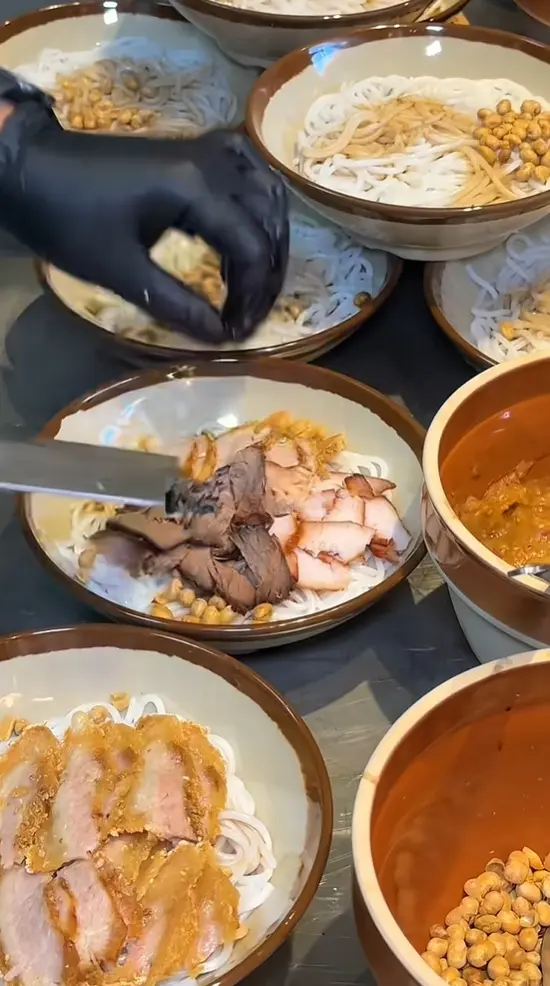
Steam pours off the big pot of boiling water. A knife thuds against the cutting board. Noodles get scooped into bowls, a few golden slices of crispy pork belly go on top, then a ladle of dark brown braised sauce. Bowl after bowl, like a production line.
Inside the shop and squatting by the door are locals — a worker in uniform rushing to a shift, an old man with his shopping basket, and a grandpa slurping loudly by the curb.
This bowl of Guilin noodles has fed locals for over 2,000 years, and the cheapest version costs only five or six yuan. But a first-time visitor standing at the counter often freezes. No English menu. The boss looks up and asks, “二两还是三两?” — and the question lands like a wall.
This guide breaks down Guilin rice noodles from top to bottom: what they are, how to order them, how to eat them, and which shops won’t rip you off. After this, you won’t freeze at the counter again.
- What's Actually in a Bowl of Guilin Rice Noodles?
- Dry-Mixed or Soup? Pick Dry-Mixed Your First Time
- Beyond Lǔcài Fěn — What Else to Order
- How to Order Guilin Rice Noodles in Four Steps
- Traps to Avoid
- Tourist Shop or Local Shop — How to Tell in One Glance
- Local Shops Worth Finding (With Locations and Signatures)
- Dietary Restrictions and Vegetarians
- Common Questions
- A One-Line Order Card (Screenshot This)
What’s Actually in a Bowl of Guilin Rice Noodles?
Let’s clear one thing up first: real Guilin rice noodles are not quite the soupy noodles you might expect.
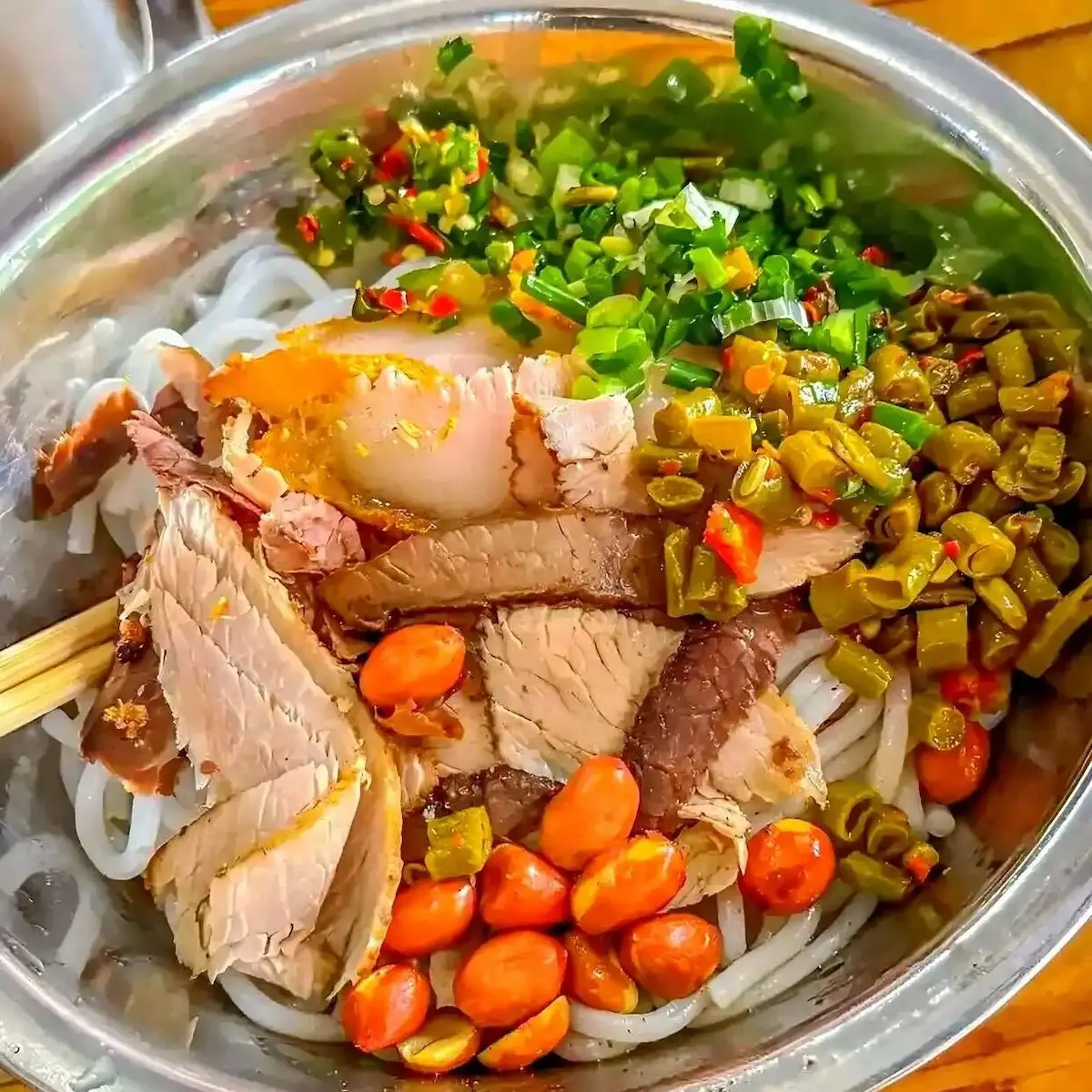
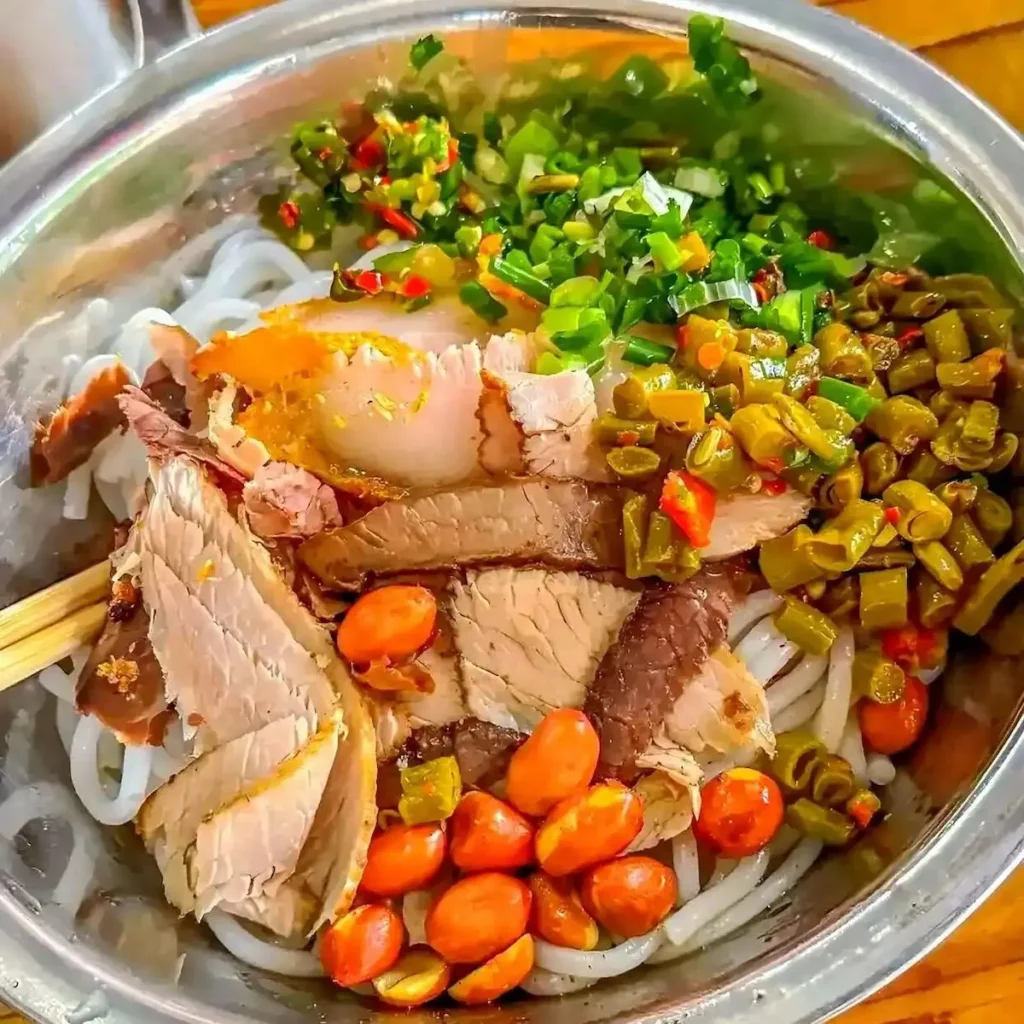
Guilin rice noodles (called mǐfěn locally, sometimes written mifen noodles or mi fen noodles) come in several styles, but the one locals eat every day is “lǔcài fěn” — dry-mixed rice noodles. What lands in front of you is usually a dry bowl, layered like this:
- The noodles: two shapes. Round mi fen noodles are smooth, springy, and chewy — a bit like spaghetti. Flat noodles (qiefen) are wide, thinner, and soak up sauce better. Old Guilin locals prefer the flat ones.
- The lǔshuǐ (卤水): the soul of the bowl. Dark brown and sticky, simmered from pork and beef bones plus twenty-some spices and herbs like star anise, cinnamon, tangerine peel, and monk fruit. No two shops make Guilin noodles the same way — the recipe is the owner’s secret.
- The meat: thin slices of braised pork or beef, plus “guoshao” (锅烧) — crispy deep-fried pork belly with a golden, blistered skin. It crackles when you bite it.
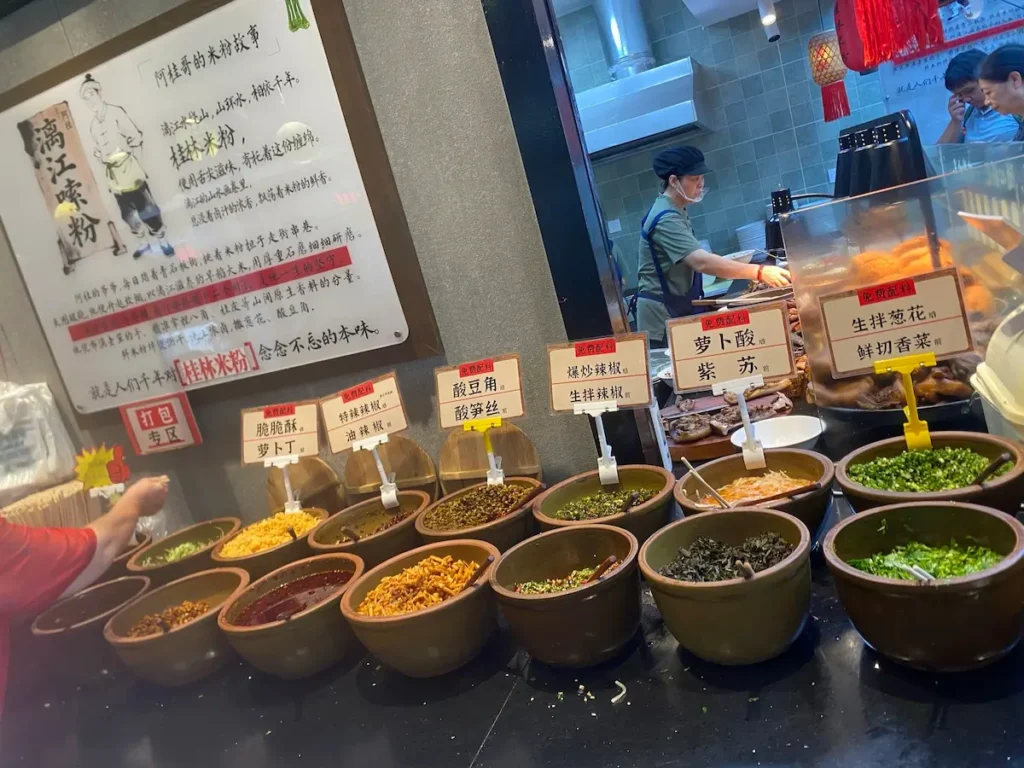
- The self-serve toppings: pickled cowpeas, pickled bamboo shoots, fried peanuts, scallions, and chili sauce. You add these yourself.
Don’t grab the bowl and leave just yet. The most special thing about Guilin rice noodles is how you eat them.
Dry-Mixed or Soup? Pick Dry-Mixed Your First Time
The most common question from outsiders: why is there no soup?
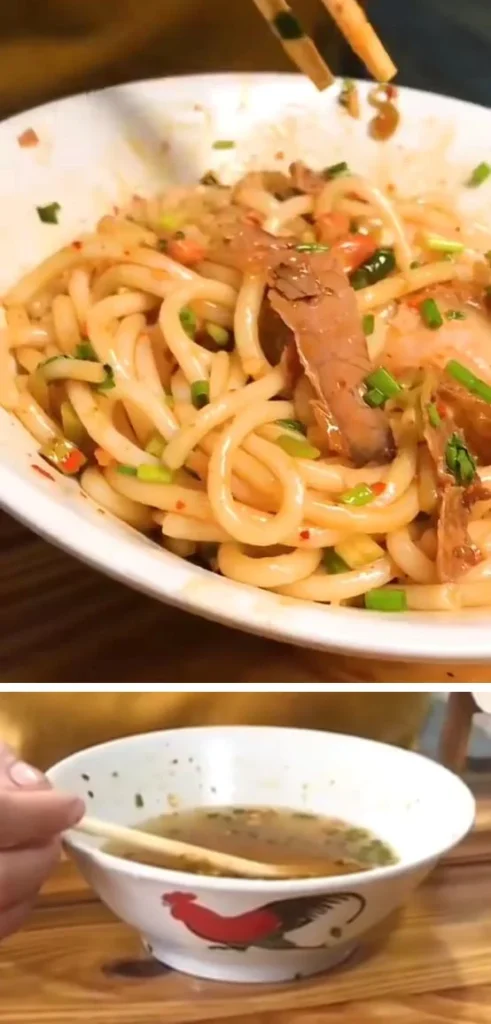
The standard way to eat Guilin rice noodles is “dry-mixed” (gānbàn). The noodles come out, the meat goes on, a spoonful of concentrated lǔshuǐ gets poured over, and you mix it and eat it straight. The sauce clings to every strand — salty and rich. That’s the bowl at its fullest flavor. It’s a traditional Guilin-style rice noodles breakfast, not the soup you get abroad.
As for the soup, that’s a separate thing. Most shops keep a massive, steaming pot of free bone broth on stove heat, and you ladle it yourself.
You’ll also see soupy versions. Guilin rice noodle soup (or guilin noodle soup) is made by pouring bone broth straight into the bowl to soak the noodles — clearer, lighter, warming. Younger locals usually go dry-mixed; older people, or anyone in deep winter, like a hot bowl of guilin noodle soup. Abroad, most Guilin-style noodles are served as soup — which is why the real dry-mixed version surprises people.
First time? My advice is simple: order the dry-mixed lǔcài fěn. Eat half of it dry, then pour broth over the last third and drink it. Two ways, one bowl. That’s the standard local play.
Beyond Lǔcài Fěn — What Else to Order
Lǔcài fěn is the default answer, but Guilin rice noodles go beyond it. A quick map before you stare at the menu:
- Original soup noodles (yuántāng fěn): served in broth, light and clean. Not the same as “add broth after eating.” Pick this if you want soup and want it mild — great for breakfast.
- Beef brisket noodles (niúnán fěn): comes dry-mixed or in soup. Want it heavy, with soft braised brisket? Go dry. Want broth? The radish-and-brisket version makes a hearty Guilin beef rice noodle soup.
- Horse meat noodles (mǎròu fěn): an old Guilin specialty. The meat is firm, and horse bone broth tastes different from beef. Start with a small bowl, and skip the sour toppings first — they’ll bury the flavor. Not into gamey meat? Skip it.
- Soup-topped noodles (tāngcài fěn): only some shops carry this. Mostly soupy, toppings vary by shop. For people who don’t like dry-mixed but want more than plain original soup.
One line to remember: only one bowl? “Two liang of lǔcài fěn, extra guoshao.” Want soup? Original soup. Want meat? Beef brisket. Want a local specialty? Horse meat. Don’t like dry? Soup-topped.
How to Order Guilin Rice Noodles in Four Steps
Memorize this flow, and you won’t panic in any shop selling Guilin noodles.
Step 1: Say the weight, not the bowl size
Guilin rice noodles are sold by weight, not “small” or “large.” When the boss asks “几两” (how many liang), just answer:
- Two liang (èr liǎng): about 100 grams, standard portion. What most people order.
- Three liang (sān liǎng): about 150 grams. Order this only if you’re really hungry.
Locals usually just say “二两” — crisp and done. Do the same.
Step 2: Pick the noodle shape and meat
After the weight, the lady at the window asks what noodles and toppings you want.
The full local order is three words strung together: “二两,卤菜,切粉” — two liang of dry-mixed lǔcài fěn, flat noodles.
Round or flat? For your first time, pick flat (qiefen) — it holds the sauce better.
Meat is braised pork or beef plus guoshao by default. Want extras? Add them now: a marinated egg (1.5 to 2 yuan, about 0.3 USD), or an extra portion of guoshao (3 to 5 yuan, about 0.4 to 0.7 USD). Not sure? Add nothing — the basic bowl is already plenty.
Step 3: Load up at the condiment bar — but don’t touch the soup yet
Grab your bowl and head to the self-serve condiment bar: a long row of stainless-steel trays with pickled cowpeas, pickled bamboo shoots, fried peanuts, scallions, cilantro, and chili sauce.
Here’s the key move — don’t add soup yet. Mix the lǔshuǐ and toppings in thoroughly and eat it dry. Sauce clinging to every strand is the best this bowl will ever taste.
The pickled bamboo shoots are pungent — fermented, with a strong sour funk. First time, give them a sniff before committing.
Step 4: Finish with broth — two ways, one bowl
When a third of the noodles are left, carry your bowl to the big broth pot and ladle in a scoop of free bone broth. The leftover sauce and scraps bloom into a fresh, savory soup. Drink it. Only then is breakfast done.
How to pay: phone first, carry a little cash
Phone payment rules in Guilin noodles shops. Alipay and WeChat Pay cover nearly 100% of them, and foreign visitors can link a Visa or Mastercard and scan to pay with no fee for small amounts (currently under 200 RMB).
But a few very old shops, or ones run by elderly owners, occasionally glitch on foreign cards. Carry 20 to 50 yuan in cash (10s and 5s are best) so old shops can make change easily.
No English menu? Here’s what to say
Guilin noodle shops almost never have English menus, but you only need a few words:
- 二两卤菜粉 (èr liǎng lǔ cài fěn) = 100g dry-mixed rice noodles
- 三两 (sān liǎng) = 150g
- 圆粉 (yuán fěn) / 切粉 (qiē fěn) = round / flat noodles
- 不要辣 (bú yào là) = no spicy
If words fail, open a translation app, or just point at someone’s bowl and hold up two or three fingers.
Traps to Avoid
Guilin rice noodles are cheap, but there are a few traps. Here they are.
Skip anything that says “set meal” or “supreme.” Some shops put up big signs: “25-yuan gold set meal” or “supreme seafood noodles.” That’s a marked-up tourist menu. Locals order the basic “two liang of lǔcài fěn” for five or six yuan. See “set” or “supreme”? Walk to the next shop.
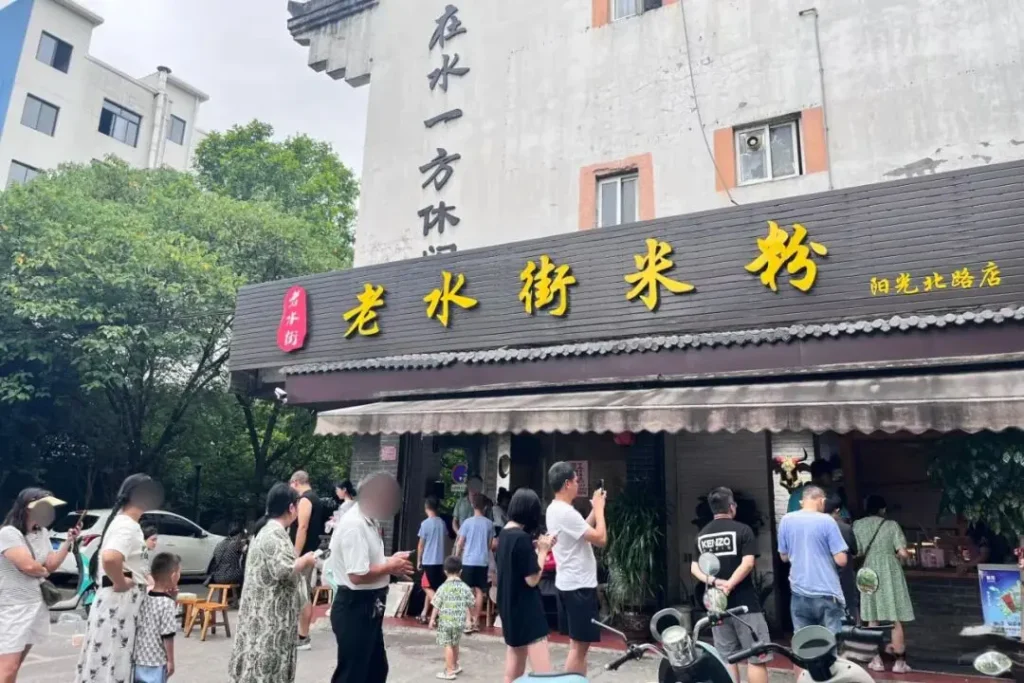
Don’t line up for the famous ones. Take Laodongjiang, the famous flagship — from 8 to 9:30 am the line is huge, and some shops sell out and close. Guilin noodles are so good everywhere that a neighborhood old shop is basically the same quality. Peak time is 7:30 to 9 am, when locals commute to school and work. Famous shops queue 10 to 20 minutes, but the line moves fast — usually under 15. Don’t want to wait? Go when they open at 6:30 am, or pick a neighborhood spot.
Go easy on the lǔshuǐ, and start with half a spoon of chili. The braised sauce is already very salty — don’t ask for extra. The chopped chili on the counter is seriously hot. Start with half a spoon.
The pickled bamboo shoots have a funk. Some people love it, some can’t stand it — Western visitors especially. Sniff at the bar first, and only add what you can handle.
Tourist Shop or Local Shop — How to Tell in One Glance
Three quick checks:
- Look for “set meal,” “seafood noodles,” or “gold” on the sign — that’s a tourist shop.
- Check if “two liang of lǔcài fěn” is the first item on the menu — that means locals eat there.
- See who’s inside — a room full of grandparents and commuters at 7 am is a good sign.
Local Shops Worth Finding (With Locations and Signatures)
Locals judge Guilin rice noodles by age. A shop that’s run for 20 or 30 years, with lǔshuǐ simmered for generations, has a steady taste. These four all have history — and none are the commercial chains you see in every guide:
| Shop | Location | Signature | Vibe |
|---|---|---|---|
| Zhengzong Shiji Laozihao | 5 Yiren Road Pedestrian Street, Xiufeng District | Dry-mixed lǔcài fěn, thin-sliced braised pork or beef | Half tourist, half local; great location, fair price |
| Binbei Road Liji Danzi | Binbei Road, Diecai District (near Beiji Square) | Dry-mixed noodles with ancestral lǔshuǐ, golden crispy guoshao | Pure local favorite, three generations |
| Renli Rice Noodles (Shijiayuan) | 6 Shijiayuan Road, Qixing District | 24-hour lǔcài fěn, lard-fried pickled bamboo shoots | Local late-night staple, fair all day |
| Weidao Zhizao (Qixing) | 30 Qixing Road, Qixing District | Intangible-heritage cured horse meat noodles, horse bone broth | Upscale local spot for the horse-meat variant |
Shiji is right on Yiren Road Pedestrian Street — Guilin’s main food street — about a 10-minute walk (750 m) to Elephant Trunk Hill Park, easy to squeeze in after sightseeing. Liji sits about 1.5 km from Diecai Hill, perfect before a morning visit. “Danzi” refers to the old tradition of selling noodles from shoulder poles — Liji’s name honors that craft. Renli runs 24 hours, so even a late-night arrival gets a hot bowl.
For soup-topped noodles, locals also mention Zhaozhaoxian in the city center (Sanduo Road). Worth a try if you’re nearby. If you’re heading out to the karst country after, see Guilin to Yangshuo for the ride down.
Dietary Restrictions and Vegetarians
Straight answer first: Guilin rice noodles are very unfriendly to strict vegetarians.
Even if you say “no meat,” the soul of the bowl — the lǔshuǐ — is simmered from pork and beef bones and animal fat, and the broth is bone broth too. Halal and vegan eaters need a dedicated vegetarian restaurant. Don’t try to tough it out at a regular noodle shop.
No offal or horse meat? Simple: the standard “lǔcài fěn” comes with braised pork or beef plus pork guoshao. If pork is a problem, ask for it without guoshao — but know the lǔshuǐ and broth are made from pork and beef bones regardless. Guilin has a horse-meat tradition — shops like Youyixuan and Weidao Zhizao specialize in it. If horse isn’t your thing, stick to “lǔcài fěn” or “beef noodles.”
Spice is the opposite problem — none. The noodles and lǔshuǐ come out completely non-spicy. Spice is 100% in your own hands at the condiment bar. Don’t want heat? Add nothing.
Common Questions
Is it healthy?
The noodles are rice, and a two-liang bowl is about one serving of carbs. The lǔshuǐ and guoshao are oily and salty — that’s the flavor, not a health food, but perfectly fine as a travel breakfast. Watching your blood sugar? Walk a bit after — locals joke that you must pair Guilin rice noodles with a stroll.
Is it spicy?
Not by default. Heat is 100% up to you at the condiment bar. Don’t like spice? Add nothing.
Can I take it away?
Yes, but the noodles go soft and clump if they sit. Eat it fresh — it takes a few minutes to finish.
How much does a bowl cost?
At a neighborhood shop, two liang is 5 to 6 yuan (under 1 USD). Tourist-area shops run 8 to 15 yuan (about 1.1 to 2.1 USD). A breakfast for around 1 USD is common in Guilin.
Can I make Guilin rice noodles at home?
There are recipes online, but the real thing needs fresh rice noodles and a long-simmered lǔshuǐ — hard to fake. If you want to try, search for a Guilin rice noodles recipe, but know it won’t match the street bowl.
Why always the same toppings — pickled cowpeas, peanuts, chili?
Guilin’s water is hard, so locals have always balanced it with sour and hot — sour to open the appetite, heat to ward off the damp, peanuts and soybeans grown in every backyard. A few hundred years of habit, matched to this one patch of land.
A One-Line Order Card (Screenshot This)
Walk in and say this one line:
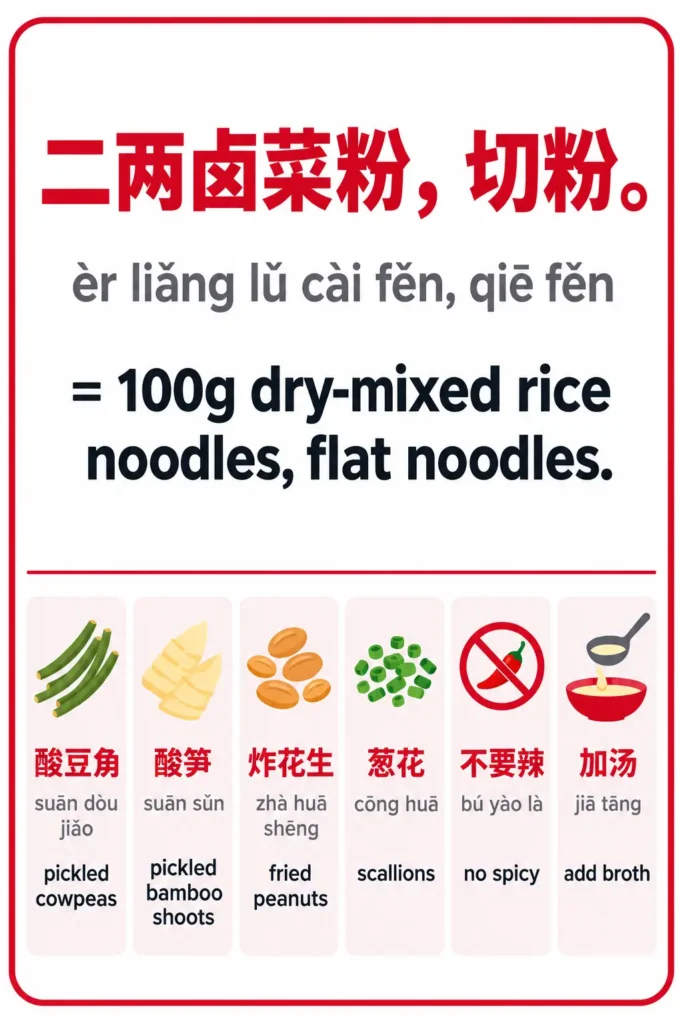
二两卤菜粉,切粉。
(èr liǎng lǔ cài fěn, qiē fěn)
= 100g dry-mixed rice noodles, flat noodles.
Toppings quick reference:
- 酸豆角 suān dòu jiǎo = pickled cowpeas
- 酸笋 suān sǔn = pickled bamboo shoots (pungent — sniff first)
- 炸花生 zhà huā shēng = fried peanuts
- 葱花 cōng huā = scallions
- 不要辣 bú yào là = no spicy
- 加汤 jiā tāng = add broth
A five-yuan bowl of Guilin rice noodles is how Guilin starts its day. Over 2,000 years ago, the soldiers of China’s first emperor ate an early form of these noodles while building the Lingqu Canal; today, commuters slurp them on the corner. Whether the taste has changed is hard to say — the warmth hasn’t.
Want to go deeper? See our Guilin food guide for everything else worth eating, our things to do in Guilin for what’s beyond the bowl, and a Guilin itinerary to slot a rice-noodle breakfast into your day. Planning around the weather? Here’s the best time to visit Guilin. Need to get here? Start with how to get to Guilin. For the bigger picture on Chinese food, see what to eat in China.
So — heading to that corner shop full of locals to order a bowl of “二两卤菜粉” yet?

Ke Ping — Founder, Insider China Travel
Certified China Travel Specialist · Certificate details
I personally reply to every email and create free, custom trip frameworks. Already have a plan? I can arrange vetted local guides and private drivers. Over 5,000 travelers from 30+ countries have started their journey this way.
📋 Tell me about your trip ideaReplied within 24 hours. No charge, no obligation.