China Travel Adapter Guide: Plugs, Outlets & Voltage — What You Actually Need
In October 2025, during China’s Golden Week, I picked up a friend from London at Shanghai Hongqiao Airport. James walked out of arrivals dragging two suitcases, held up his phone, and asked: “My plug won’t fit anywhere. Do you have a power bank?” That single moment is the whole reason this China travel adapter guide exists.
James’s UK Type G plug — three chunky square pins — was useless against his hotel wall sockets. That night his phone limped along on a travel plug adapter for China I lent him. The next morning he fumbled under his train seat, then rode the rest on a shared power bank I unlocked with a QR scan.
I’ve told this story to every friend planning a China trip since. They all ask the same thing: “So what do I actually need to bring?” Here’s the answer — the plugs, the voltage, and which China travel adapter is actually worth your money. For the broader what-to-bring checklist, see our full China packing list.
- China Plug Type, Power Outlet & Voltage: The 3-Second Answer
- What China Travel Adapter Do You Need? (By Country)
- Three Steps to Pick Your Travel Plug Adapter for China
- Adapter, Voltage Converter, or Universal Travel Adapter — What to Buy?
- Five China Power Plug Mistakes to Avoid (From a Local)
- Charging in China Is Easier Than You Think
- China Plug & Voltage: Frequently Asked Questions
China Plug Type, Power Outlet & Voltage: The 3-Second Answer
Mainland China runs on 220V / 50Hz, and its sockets take three plug types — Type A (US-style two flat pins), Type C (two round pins), and Type I (the angled three-pin used across China and Australia). That’s the china plug type answer in one line. The china voltage is fixed by national standard GB/T 156 and identical everywhere, from Beijing to a one-street county town. This is the china power adapter situation in full.
Most wall sockets in China are a “five-hole” hybrid — one china power outlet that handles three plugs. Memorize the china plug socket shape and you’re done:
- Two holes on top — accept Type A (two parallel flat pins, the ungrounded US/Japan plug) and Type C (two round pins, 4.0–4.8 mm, the European plug);
- Three holes below — a standard Type I, with two flat pins angled like a “V” plus a vertical grounding pin above them.
One socket covers flat and round pins at once — which is where people get confused. Under the IEC classification, the top takes Type A and Type C, the bottom Type I (spec GB/T 2099.1).

What China Travel Adapter Do You Need? (By Country)
Lock in one distinction first — it drives everything below. A plug adapter only changes the shape of your plug. A voltage converter (or transformer) changes the voltage. Whether you need that second one depends on what’s printed on your device — and that’s what decides which China travel adapter you actually need, or whether a travel plug adapter for China alone is enough.
This is the most common mix-up: travelers assume “I’m American, so I need a transformer.” Not true.

Which China Travel Plug Adapter Fits Your Home Plug?
Think in two lines. The first line is about the shape of your plug — whether you need a china travel plug adapter at all:
- US, Canada, Japan — two flat pins (Type A). Fits the top holes, so you usually don’t need an adapter;
- Continental Europe — two round pins (Type C). Also fits the top holes, usually no adapter;
- UK, Ireland, Singapore, Malaysia — Type G three-pin. Bring a china travel plug adapter (this is where James got caught);
- Australia, New Zealand — Type I angled three-pin. Same shape as the China standard, so it usually plugs in — but see mistake #3 below.
The second line is about voltage, and it decides whether you need a converter:
- Charger says “Input: 100–240V” (phones, laptops, cameras, most razors) — dual voltage. You only need an adapter, never a converter;
- Charger says “110V” or “120V” with no wide range (typical US single-voltage hair dryers, curling irons, irons) — you need a voltage converter, and a beefy one.
Put the two lines together and you’ve resolved 90% of China travel adapter decisions — and most of the time, the answer is a simple travel plug adapter for China, not a transformer.
Coming from the US or Canada?
Your two-flat-pin Type A plug physically fits a China socket, so in most cases you don’t need a us to china travel adapter at all — the shape already matches, and the China travel adapter question is half-answered. What you do need to check is voltage. Phones and laptops are dual voltage and work with nothing more than the existing plug (or a cheap us to china plug adapter if your device has a grounded third pin). The only real danger is single-voltage gear like hair dryers — and honestly, you’re better off buying one when you land.
Three Steps to Pick Your Travel Plug Adapter for China
Spend three minutes on this before you fly. It’s the entire China travel adapter decision, compressed.
Step one — read the fine print. Grab every china power adapter you’re bringing and look at the “Input” line. If it reads 100–240V, forget about transformers. If it only reads 110V or 120V, tag that device now.
Step two — check your plug shape against the first line above. If it won’t fit a china power outlet, write down “adapter.”
Step three — write the verdict.
- Plug fits + dual voltage → bring nothing;
- Plug doesn’t fit + dual voltage → buy a plug adapter (the few-USD kind is fine);
- Plug fits + single-voltage, high wattage → bring a converter, or skip it and sort it out on arrival.
The packing checklist (screenshot it):
- A china plug adapter ×1 — mandatory for UK/Singapore plugs, a cheap China travel adapter backup for US/EU plugs;
- Converter — skip unless you have single-voltage, high-wattage gear;
- A power strip with USB-C and USB-A ports ×1 — huge for couples and families;
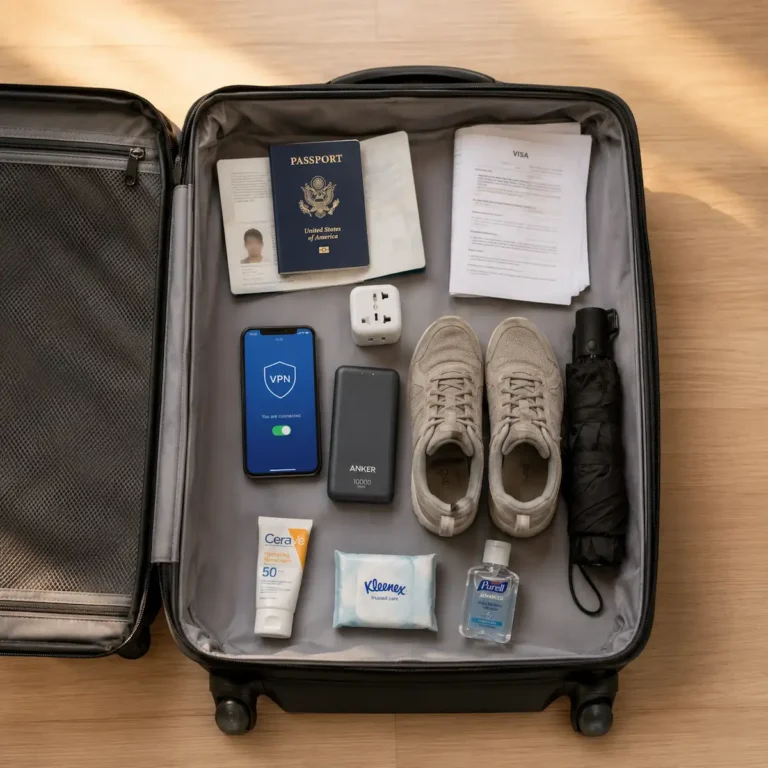
- A power bank ×1 — shared power banks are everywhere, but carrying your own is calmer.
For the rest of the “what do I bring” question, see our China travel tips — this page sticks to power. If your devices are dual voltage, your whole travel plug adapter for China kit — plus your china travel power adapter needs — comes down to one small plastic block.
Adapter, Voltage Converter, or Universal Travel Adapter — What to Buy?
Three product types cover almost everything. Pick by need, not by marketing. Prices are market references from Q1 2026, from Amazon and major Chinese e-commerce platforms. (A universal travel adapter China visitors buy once tends to last for years.)
A universal travel adapter for China turns UK, EU, and US plugs into a China-friendly shape, usually with 2A2C fast-charging ports (two USB-A, two USB-C). It’s the pick if you’re hopping between countries or sharing across a family. Around ¥35–65 in China, USD 12–20 on Amazon. This is the one China travel adapter most travelers buy — the universal travel adapter China-bound visitors rate highest.
A simple one-way adapter is pure mechanical — no voltage change, no fast charging. A UK-to-China block, cheap and light. Around ¥8–15 in China, USD 5–8 on Amazon. For someone like James, visiting China once, a simple china travel plug adapter of this kind — a basic china power adapter — is enough.
A portable step-down transformer turns 110V into 220V, only for single-voltage appliances. Bigger and heavier than the other two. Around ¥80–150 in China, USD 25–40 on Amazon. Reach for a voltage converter for China — or a china power converter — only if you refuse to leave your own hair dryer behind.
My honest take: nine out of ten travelers need a universal travel adapter China shoppers can grab for a few yuan, or a simple one-way adapter — not a transformer. If you want one device that does everything, a universal travel adapter for China and beyond is the smarter spend. Whichever adapter China travel throws at you, check the ground pin before you buy.

Five China Power Plug Mistakes to Avoid (From a Local)
Mistake one: assuming your charger needs a transformer. Phone, laptop, and camera chargers are almost all 100–240V dual voltage — a travel plug adapter for China is all they need. Spending hundreds of yuan on a transformer to charge a phone is the classic waste of money. A plain china power adapter does the job.
Mistake two: insisting on big single-voltage appliances. Many US hair dryers and curling irons are 110V single voltage. Plug one into 220V in China and it’s fried — no China travel adapter will save it. The china voltage difference is real, and it bites. Either bring a high-wattage transformer (heavy and expensive) or buy locally — a basic hair dryer costs a few dozen yuan (roughly USD 10) on Chinese e-commerce, far cheaper than any voltage converter for China.
Mistake three: the Australia live/neutral swap. Australian Type I plugs share the China shape and do plug in, but the live and neutral wires are reversed inside a China socket. Grounded three-pin appliances are mostly fine; “double-insulated” two-pin Australian gear carries real risk. Coming from Australia, put a China travel adapter or a power strip in between — don’t ram the AU plug straight into the wall. A china power converter won’t fix this; the issue is wiring, not voltage.
Mistake four: cheap ungrounded adapters. A cheap china travel plug adapter often has no ground pin (two prongs only). Fine for phones and laptops, risky for high-wattage or metal-cased appliances. Look for a grounded (three-pin) adapter with a safety certification mark — the kind a proper voltage adapter for China guide would insist on.
Mistake five: thinking Hong Kong, Macau, and Taiwan are the same. Hong Kong uses UK Type G, Macau EU Type C/F, and Taiwan US Type A/B at 110V. Cover the mainland plus any of these, and one adapter won’t carry you through all of it.
Charging in China Is Easier Than You Think
Once you land, “will I run out of battery” stops being a worry. High-speed trains (Fuxing and Hexie) have five-hole sockets plus USB-A and Type-C ports at every second-class seat; airport gates have multi-port charging stations. Hotel bedsides mostly offer the same china power plug setup plus USB ports, and some international chains build in universal outlets too. The one china plug adapter you bring covers nearly all of it. To get between cities, book your high-speed rail tickets in advance — the ride won’t leave you short of power.
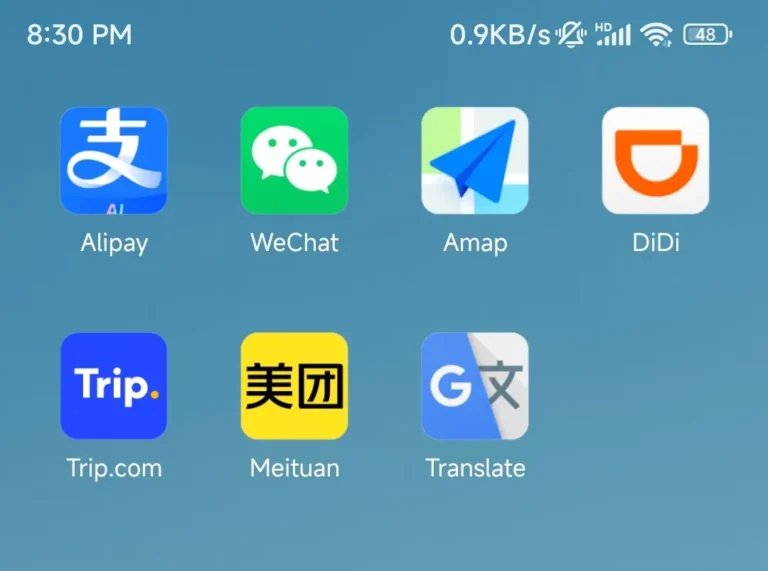
Then there are shared power banks, everywhere to a ridiculous degree — Monster (怪兽), Meituan, Jiedian, and Xiaodian fill malls, convenience stores, and restaurants. Scan the QR on a kiosk with WeChat or Alipay, and one pops out. It’s usually ¥3–4 per hour (about USD 0.5), or ¥5–7 (about USD 1) in tourist hotspots, airports, and clubs, capped at roughly ¥30–40 (USD 4–6) per 24 hours.
Skip the deposit if your WeChat Pay or Alipay credit score is 550 or above; otherwise the deposit is ¥99 (about USD 14). The battery comes with Type-C, Lightning, and Micro-USB cables built in. Return it to any kiosk of the same brand and the system bills you automatically. If you haven’t set up Alipay or WeChat Pay yet, that’s its own quick task — and it’s the one thing a China travel adapter won’t cover.

For staying connected while you charge, grab a China SIM card or eSIM — and if you’re moving between cities, read up on getting around China by public transport too. With the right china travel power adapter and a power bank in your bag, plus a travel plug adapter for China just in case, the only thing left to worry about is running out of time, not battery.
China Plug & Voltage: Frequently Asked Questions
Is China 220V or 240V?
The standard is 220V / 50Hz. Per State Grid supply norms, household china voltage has a small normal-range fluctuation, which modern dual-voltage devices shrug off — so don’t sweat the 220 vs 240 difference.
What plug does China use?
Three types are common: Type A (US-style two flat pins), Type C (EU-style two round pins), and Type I (the angled three-pin standard in China and Australia). The top holes of a China socket take A and C; the bottom takes I — which is why the right China travel adapter (or none at all) depends on your home plug.
What adapter do I need for China?
That depends on two things: your plug shape and your device voltage. If your charger reads 100–240V, a travel plug adapter for China is all you need. If it’s single-voltage 110V, add a voltage converter for China too. In short, a dual-voltage device needs one china power adapter, nothing else.
Does China use the same plugs as the US?
Partly. The two-flat-pin Type A part plugs in directly, but the voltage is different (110V/120V in the US vs 220V in China). Phones and laptops are fine; single-voltage appliances are not. For those, a us to china travel adapter is pointless — you need a transformer, not an adapter.
Can I use my Australian plug in China?
Shape-wise it fits, but the live and neutral wires are reversed, so route it through an adapter or power strip instead of plugging straight in.
Three minutes reading the fine print on your charger beats ten minutes of fumbling under a train seat. So — what’s the one thing you’ll check before you buy your next China travel adapter? Chances are, the right china power adapter is smaller and cheaper than you think.

Ke Ping — Founder, Insider China Travel
Certified China Travel Specialist · Certificate details
I personally reply to every email and create free, custom trip frameworks. Already have a plan? I can arrange vetted local guides and private drivers. Over 5,000 travelers from 30+ countries have started their journey this way.
📋 Tell me about your trip ideaReplied within 24 hours. No charge, no obligation.