Public Transportation in China: The Complete How-to Guide for Foreigners (2026)
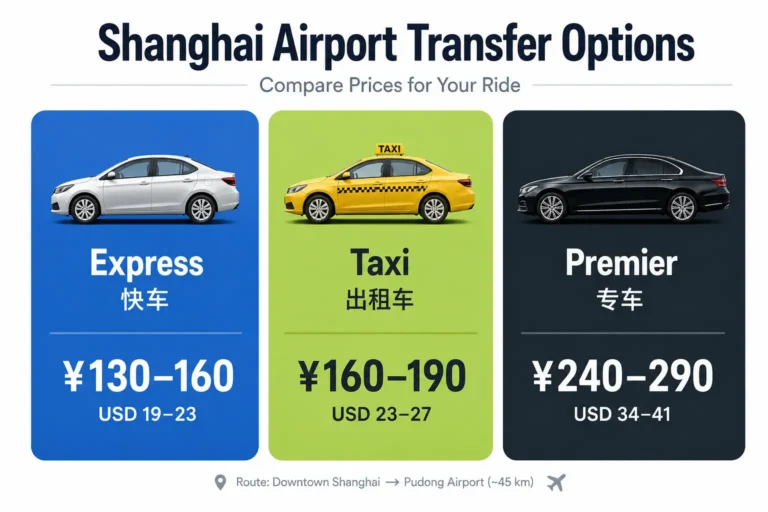
It’s 11 PM at Shanghai Pudong International Airport. A traveler fresh off a long-haul flight stands at the maglev station, phone in hand, staring at an Alipay registration screen. The verification SMS won’t come through to his foreign SIM. He switches to airport Wi-Fi. Restarts the phone. Tries again. Forty minutes later, he drags his suitcase out of the terminal and flags down an unmetered taxi — paying ¥280 for a ride to a hotel that sits seven minutes from a metro station. That metro ride would have cost ¥3.
This is not a one-off story. It shows up on Reddit threads about public transportation in China with painful regularity.
Here’s the thing that makes this frustrating: China’s public transport network is the largest on earth. According to the CPTOND-2025 dataset published in Nature, 350 Chinese cities operate roughly 3.38 million kilometers of bus routes, and 46 cities have metro systems. High-speed trains connect every major urban center at 350 km/h. Fares are absurdly cheap — a Beijing bus ride costs ¥1 (about 0.14 USD), a Shanghai metro trip starts at ¥3 (0.43 USD). The infrastructure is world-class.
The gap isn’t the system. The gap is the first five minutes. The app. The QR code. The moment you realize Google Maps won’t help you here.
I’m Ke Ping. I was born in China, I’ve lived here my entire life, and I’ve helped over 5,000 travelers from more than 30 countries navigate this country — most of them starting with the same question: how do I actually use public transportation in China? I’ve watched friends from Australia, Germany, and the US get stuck at turnstiles, walk the wrong way down eight-lane roads, and pay five times the normal fare because nobody told them how DiDi actually works.
This guide covers every mode of public transport in China that matters to a visitor — metro, DiDi, buses, high-speed rail, shared bikes, intercity buses, and domestic flights — compressed into 15 minutes of reading that will save you hours of confusion, dozens of wasted yuan, and at least one moment of standing in the rain wondering what went wrong.
- Seven Ways to Get Around — Which One Fits Your Situation?
- Public Transportation in China at a Glance
- 5 Ways to Pay for Public Transport in China: The Ultimate Comparison
- The Metro: The Crown Jewel of Public Transportation in China
- DiDi: Your Lifeline at Midnight, in the Rain, or With Heavy Luggage
- City Buses: ¥1 to Cross a City (But You'll Need a Little Courage)
- Shared Bikes: The King of the Last Mile
- Navigation Apps: Which One Will Actually Keep You From Getting Lost?
- Between Cities: High-Speed Trains, Long-Distance Buses & Domestic Flights
- 10 Mistakes Foreigners Keep Making (and What to Do Instead)
- Quick Answers to the Questions Everyone Asks
Seven Ways to Get Around — Which One Fits Your Situation?
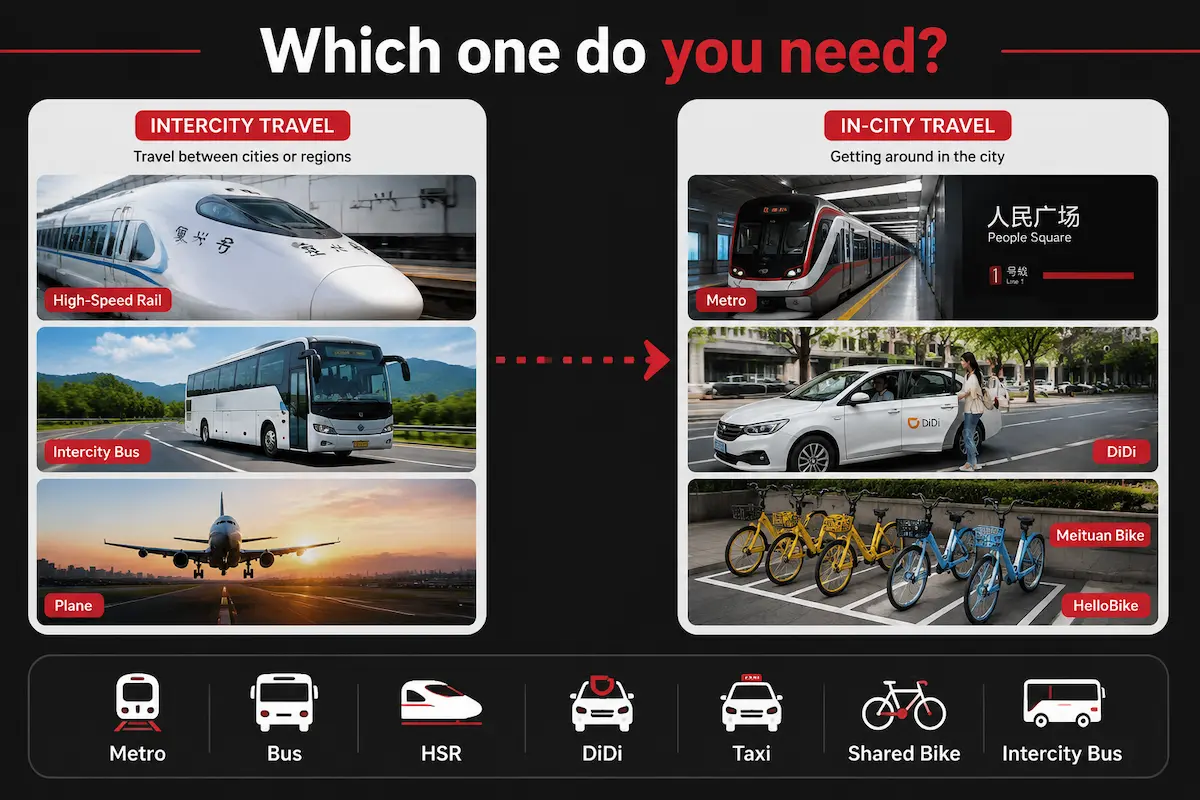
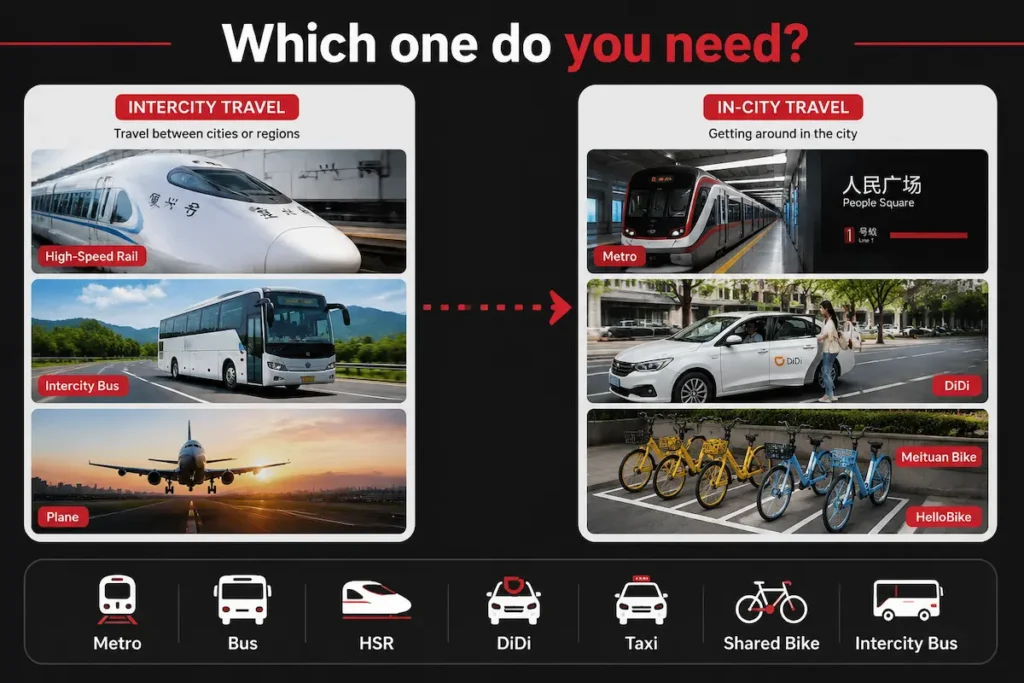
Before you download anything, bind a card, or scan a single QR code, take sixty seconds to answer one question: what kind of trip are you making right now?
Chinese cities don’t run on a single transport mode. They run on a layered, multi-mode network — and picking the wrong one means wasting money, losing time, or wrestling a suitcase through a rush-hour metro car. (I’ve done that. Do not recommend.)
Here’s a quick decision flow:
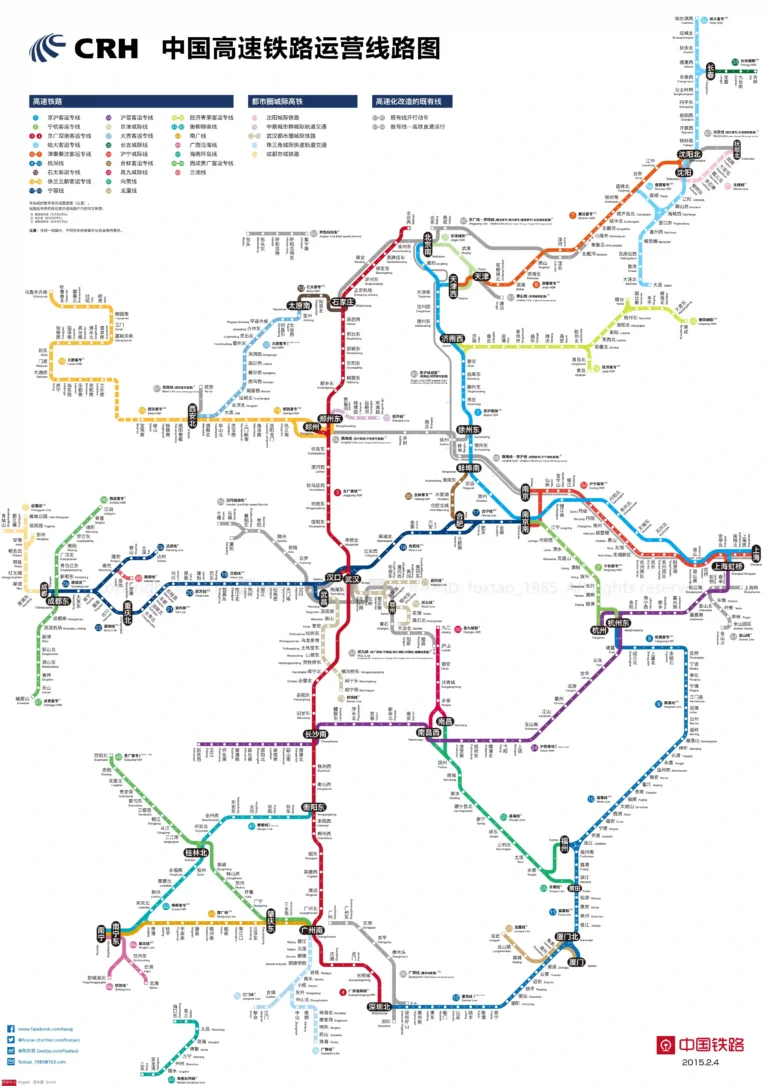
- Traveling between cities? If it’s two major cities (Beijing → Shanghai, Guangzhou → Shenzhen), take the high-speed train. Book through Trip.com or the official 12306 app. If you’re heading to a smaller city with no high-speed rail station, you’ll want a long-distance bus (book via Ctrip or check routes on Baidu Maps) or a domestic flight.
- Moving within a city? Three branches here:
- Budget-conscious, destination near a metro station, not afraid of crowds: Metro. Alipay or WeChat transport QR code, scan in, scan out.
- Heavy luggage, 3–4 people splitting the fare, late at night, pouring rain, or simply too tired to navigate: DiDi ride-hailing. Runs inside WeChat — no separate app download, auto-translated driver messages, upfront pricing.
- Last kilometer or two, nice weather, want to explore at street level: Shared bike. Scan with Meituan or Alipay, ride, park in a designated P-zone.
That’s the decision framework. Now let’s walk through every mode of public transportation in China in detail — starting with the one you’ll use most.
Public Transportation in China at a Glance
If you already know roughly what you need, here’s a one-screen overview of every major mode of public transport in China:
| Mode | How You Pay | Best App | Cost (Reference) | Best For |
|---|---|---|---|---|
| Metro | Alipay/WeChat QR, transport card, international card tap (Beijing & Shanghai) | MetroMan, Apple Maps | ¥3–10 (0.43–1.43 USD) | Fast city travel, no traffic |
| Bus | Alipay/WeChat QR, transport card, cash (no change) | Baidu Maps, Gaode | ¥1–3 (0.14–0.43 USD) | Short trips, areas without metro, street-level views |
| High-Speed Rail | Trip.com, 12306 app, station counter | 12306, Trip.com | ¥50–500+ (7–71+ USD) | Intercity travel (300–1000 km ideal) |
| DiDi | WeChat/Alipay mini program, DiDi app | DiDi, WeChat | ¥10–50+ (1.43–7.14+ USD) | Luggage, late nights, door-to-door |
| Taxi | Cash, WeChat, Alipay | None (street hail) | Flag fall ¥10–14 (1.43–2 USD) | Short spontaneous trips (but DiDi is usually better) |
| Shared Bike | Alipay/WeChat scan-to-ride | Meituan, Hello (哈啰) | ¥1–3 (0.14–0.43 USD) / 30 min | 1–3 km short hops, no rain |
| Intercity Bus | Station counter, Ctrip | Baidu Maps, Ctrip | ¥30–150 (4.29–21.43 USD) | Small cities without high-speed rail |
5 Ways to Pay for Public Transport in China: The Ultimate Comparison
This is where most travelers hit a wall when navigating public transportation in China. Not because payment is hard — but because nobody lays out the options side by side.
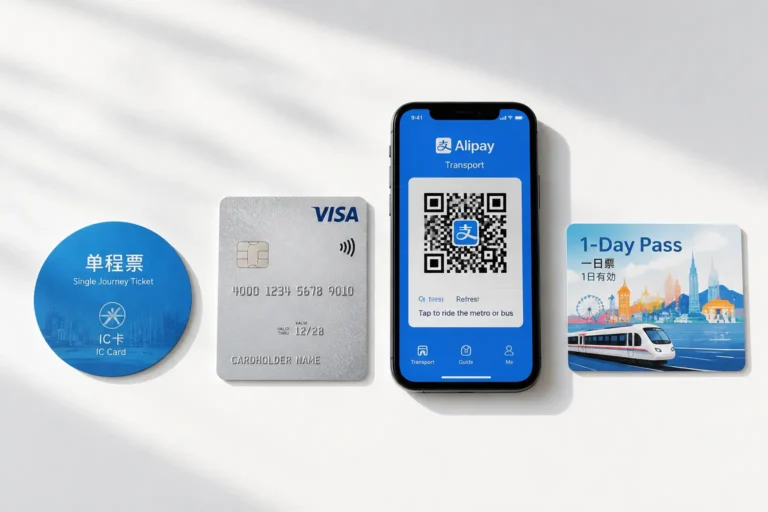
Here’s the honest comparison of every way to pay for public transport in China:
| Payment Method | Coverage | Setup Time | Requirements | Verdict |
|---|---|---|---|---|
| Alipay Transport QR | Nationwide metro + buses + some taxis | ~5 min | Passport verification + linked foreign card | ⭐⭐⭐⭐⭐ Top pick |
| WeChat Transport QR | Same as Alipay | ~5 min | Same requirements | ⭐⭐⭐⭐⭐ Top pick |
| Physical Transport Card (e.g., Shanghai Public Transport Card, Beijing Yikatong) | Local metro + buses | Instant (buy at station) | Cash or mobile top-up | ⭐⭐⭐ Backup option |
| International Card Tap (Visa/Mastercard) | Select gates in Beijing & Shanghai metro only | Zero setup | Contactless-enabled foreign card | ⭐⭐⭐ Emergency use (costs more than Alipay) |
| Cash | Some buses, station ticket machines | Zero setup | Small RMB bills | ⭐ Last resort. You probably won’t need it. |
The short version: before you fly to China, spend 15 minutes setting up at least one of Alipay or WeChat. You’ll cover 99% of payment scenarios across the entire public transportation in China system. If you set up both, you have a backup for the rare moment when one app glitches out. Keep ¥100–200 (14–29 USD) in cash somewhere in your bag as an emergency layer. In six years of helping travelers through China, I’ve yet to meet someone who actually needed that cash — but it costs nothing to carry.
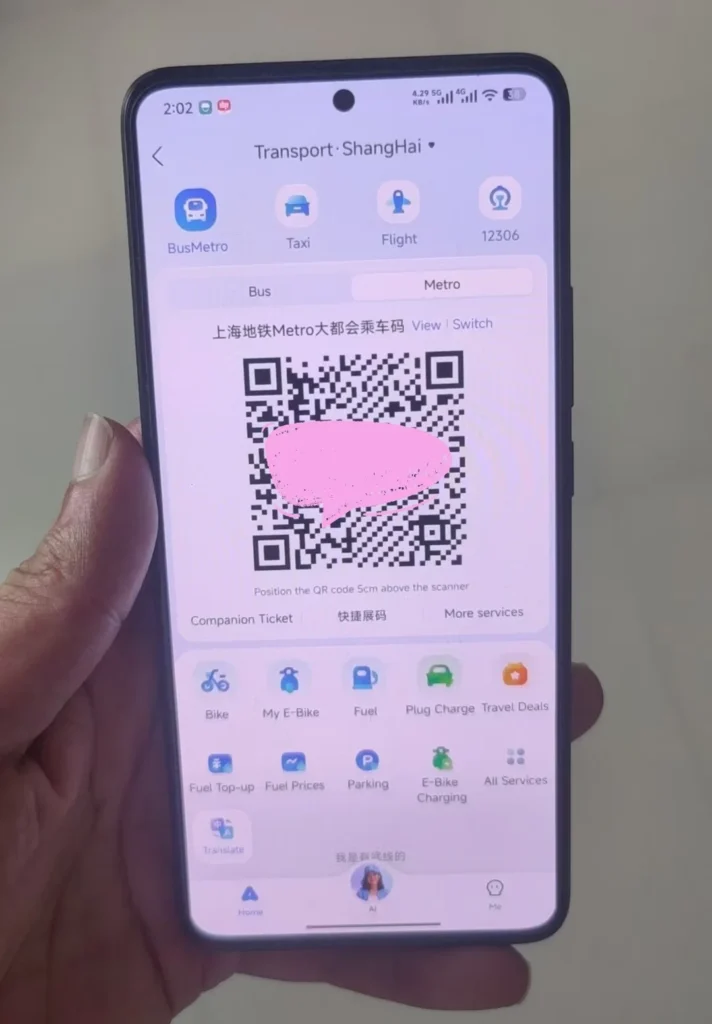
How to Activate Alipay’s Transport QR Code
Assuming you’ve already completed Alipay’s passport verification and linked a foreign Visa or Mastercard (if not, read our step-by-step Alipay setup guide for foreigners first — ten minutes and you’re done), here’s the five-step flow:
- Open Alipay → tap “Transport” (出行) on the top bar.
- Select your city — the app auto-detects your location, or you can manually switch to whichever city you’re in (Shanghai, Beijing, Chengdu, etc.).
- Claim your card — check “Agree to Terms” and tap “Claim Card” (领卡). The system links to your verified passport and foreign card automatically.
- Confirm identity — verify that your linked passport and card info is correct.
- QR code generated — that’s it. This code scans at metro turnstiles and bus card readers the same way locals use it.
You’ll need to repeat this once per city you visit. Metro and bus codes are sometimes unified, sometimes separate — the app will guide you.
WeChat’s path is nearly identical: go to “Me → Wallet → Transport Card,” pick your city, and follow the prompts.
The Metro: The Crown Jewel of Public Transportation in China
If I could only give you one piece of advice about getting around Chinese cities, it would be this: use the metro. It’s the single most reliable mode of public transport in China.
It’s punctual. It never sits in traffic. The air conditioning works. It covers every part of the city you’re likely to visit. The china metro network — 46 cities and counting — is the most English-friendly transit option in the country. Signs, announcements, and ticket machines in every major city are fully bilingual. The china subway system is designed to be navigable even if you can’t read a single Chinese character.
From Station Entrance to Exit: A 6-Step Walkthrough
Step 1: Find the entrance. Look for a red or blue circular sign at street level — usually with a tunnel-like icon and the words “Metro” or “Subway.” Apple Maps navigates you to the nearest station entrance reliably.
Step 2: Security check. Every china subway station entrance has a security checkpoint. This is national policy, not personal. Put your backpack and suitcase on the conveyor belt. Take out your water bottle or thermos — security staff may ask you to take a sip or place it on the liquid scanner. A Korean travel forum I saw recently summed it up: one commenter complained that “Shanghai’s security checks cancel out all the convenience.” It’s a minor ritual. Fifteen seconds. You get used to it. Consider it free baggage screening.
Step 3: Scan your QR code at the turnstile. Open the Alipay or WeChat transport QR code you activated earlier. Hold it up to the scanner. Green light, a beep, the gate opens. Walk through.
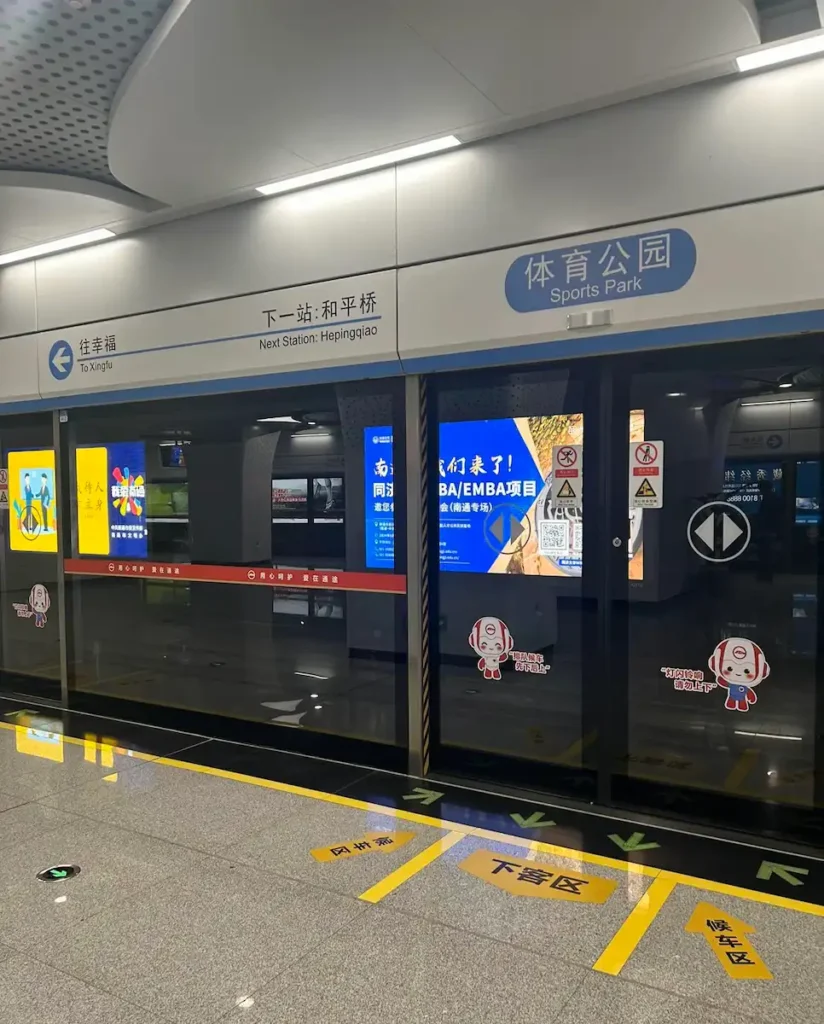
Step 4: Read the platform sign and pick the right direction. This is where tourists most often get it wrong on the china subway. The overhead platform sign shows four things: the line number, your current station, the train’s destination (the terminal station, not the next stop), and which exit to take at your destination.
⚠️ Pay attention to directional words in station names. Many Chinese cities have stations named after the same road with a directional prefix — like Shanghai’s East Nanjing Road and West Nanjing Road. These are not two exits of the same station. They are entirely separate stations, one metro stop apart. A Reddit user once walked twenty minutes in the rain between them before realizing this. Look at the full station name. East (东), West (西), South (南), North (北) — they matter.
Step 5: Ride. Peak hours (7:30–9:00 AM, 5:30–7:30 PM) on the china subway train network can be intense — on Beijing’s Line 1 or Shanghai’s Line 2, you’ll learn what “crowded” actually means. Outside peak times, trains are usually comfortable. No eating on board (drinking water is fine). Use headphones if you’re watching videos.
Step 6: Scan out and pick the right exit. Scan the same QR code to exit. Large stations can have a dozen exits labeled A1, A2, B1, B2, C, D — and picking the wrong one can mean a ten-minute walk or crossing an eight-lane road above ground. Check Apple Maps or MetroMan before you scan out to know which exit you need.
A Few Things Nobody Tells You About the China Subway
- Kids ride free — children under 1.2 meters (about 3 ft 11 in) don’t need a ticket or QR code. They walk through with you.
- Last trains leave early — most china subway train services wrap up between 10:30 and 11:30 PM. If you’re planning a late night, check the last departure time before you head out.
- Transfer stations can be long walks — Shanghai’s People’s Square, Beijing’s National Library — some transfer corridors take several minutes on foot. Budget the time.
- City-specific guides exist for a reason — every metro system has its quirks. If you’re heading to Shanghai, our Shanghai metro guide covers every line and neighborhood. For Beijing, our Beijing subway guide walks you through the world’s most extensive network, including how to reach the Great Wall by public transit.
DiDi: Your Lifeline at Midnight, in the Rain, or With Heavy Luggage
If the metro is the backbone of Chinese cities, DiDi is the circulatory system — it fills every gap that trains don’t reach. Late-night ride after the last china subway train has departed. Door-to-door service when you’re hauling two suitcases. A dry car when the sky opens up.
China DiDi is the country’s dominant ride-hailing platform — think Uber, but far more entrenched in daily Chinese life. And here’s the part most foreigners don’t realize: you don’t need to download the DiDi app. It runs as a mini program inside WeChat. No separate download. No Chinese phone number. Full English interface. A critical piece of the public transport in China puzzle that most guidebooks gloss over.
| DiDi | China Taxi (Street Hail) | |
|---|---|---|
| Pricing | Transparent, shown upfront | Metered (or not — airport taxis sometimes “forget” the meter) |
| Communication | Auto-translated messages | Driver unlikely to speak English |
| Payment | Auto-charged to linked card | Cash, Alipay, WeChat |
| Late-night availability | Any time | Hard to hail; risk of unlicensed cars at stations |
| Safety | Real-time GPS tracking, emergency button | No trip tracking |
How to Use DiDi Without Downloading Another App
- Open WeChat → “Discover” → “Mini Programs.”
- Search “DiDi” or “滴滴出行” — the official mini program appears.
- The interface switches to English (confirm language settings on first use).
- Enter your destination — English works (e.g., “Shanghai Hongqiao Railway Station”).
- Pick a car type, confirm the fare, tap to request.
- A driver accepts. You’ll see their license plate, car color, and ETA immediately.
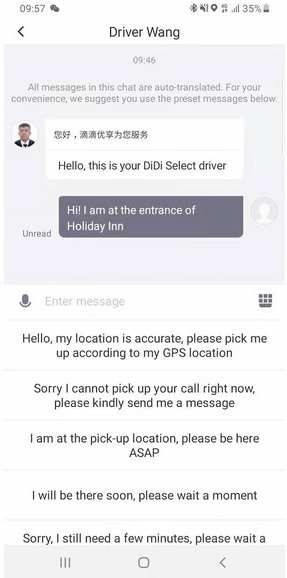
Here’s where it gets genuinely impressive. The China DiDi app (and its WeChat mini-program counterpart) has a built-in auto-translation system for driver messages. Watch how it works in practice:
Driver sends (Chinese): “您好,我在C3出口对面的公交站台等您,车牌号京A88888,穿蓝色衣服。”
System auto-translates (English): “Hello, I am waiting for you at the bus stop opposite Exit C3. License plate: 京A88888, wearing blue clothes.”
You can one-tap these preset English replies:
- “I have arrived at the pickup point.” (我已到达上车点)
- “Please wait a moment, I am looking for you.” (请稍等,我正在找您)
No Chinese required. No phone call. You don’t even need to know precisely where you’re standing — DiDi pulls your GPS location. For advanced features like advance booking and multi-city use, read our in-depth DiDi guide for China.
City Buses: ¥1 to Cross a City (But You’ll Need a Little Courage)
Buses are the unsung workhorses of public transportation in China. ¥1–2 (0.14–0.29 USD) takes you from one end of a route to the other, past street-food stalls, morning tai chi groups in neighborhood parks, and the tangled alleyways of old city quarters you’d never see from a subway tunnel.
I won’t sugarcoat it: buses are less foreigner-friendly than the metro.
Challenge one: most bus stop signs are Chinese-only. You navigate by number — memorize your route number (e.g., “Bus 15” = 公交15路). Baidu Maps and Gaode show real-time bus locations, but their interfaces are predominantly Chinese.
Challenge two: you need to signal. Unlike every other mode of public transport in China, buses don’t automatically stop at every station. Wave at the driver as the bus approaches to indicate you want to board. When you’re approaching your stop, press the red “STOP” button inside the bus (or say “下车” — xià chē — to the driver). If nobody waves and nobody presses the button, the driver keeps going.
Challenge three: cash doesn’t get you change. Drop a ¥10 note into the fare box and you’ve paid ¥10 for a ¥1 ride. This is precisely why Alipay and WeChat QR codes are the way to go — exact fare, every time, no coins required.
How to ride a bus, simplified: enter your destination in Baidu Maps or Gaode → pick a bus route → find your stop and confirm the direction → scan your Alipay/WeChat QR code as you board (same code as the metro, no extra setup) → track your location on your phone and press the stop button one stop before yours → exit through the rear door.
If you have zero Chinese, keep the bus as a backup option. Get comfortable with the metro and DiDi first. Try the bus on a sunny afternoon when you’re in no hurry and want to see the city at street level.
Shared Bikes: The King of the Last Mile
The metro drops you within a kilometer of your destination. The bike covers the rest — to the temple entrance, through the university campus, along the lakeside path. Shared bikes are the final link in the public transportation in China chain.
China’s bike-share market has consolidated down to two platforms. (If you’re reading an older guide that mentions Mobike or Ofo — both are gone. Shut down years ago.)
| Platform | Color | How to Scan | Cost | Notes |
|---|---|---|---|---|
| Meituan Bike (美团单车) | Yellow | Meituan app or WeChat scan | ¥1–3 (0.14–0.43 USD) / 30 min | Widest city coverage |
| Hellobike (哈啰单车) | Blue | Hello app or Alipay scan | ¥1–3 (0.14–0.43 USD) / 30 min | Smoothest Alipay integration |
Three steps:
- Find a bike. Open Meituan or Alipay’s scan function, point it at the QR code on the handlebar or rear fender.
- Unlock. The lock pops open. Start riding.
- Park. This is crucial — you must park in a designated zone. Look for white-painted rectangles on the ground or areas marked with a “P” symbol. If you lock the bike outside a designated zone, the app charges a dispatch fee of ¥5–20 (0.71–2.86 USD). This isn’t a scam. You genuinely parked in the wrong place.
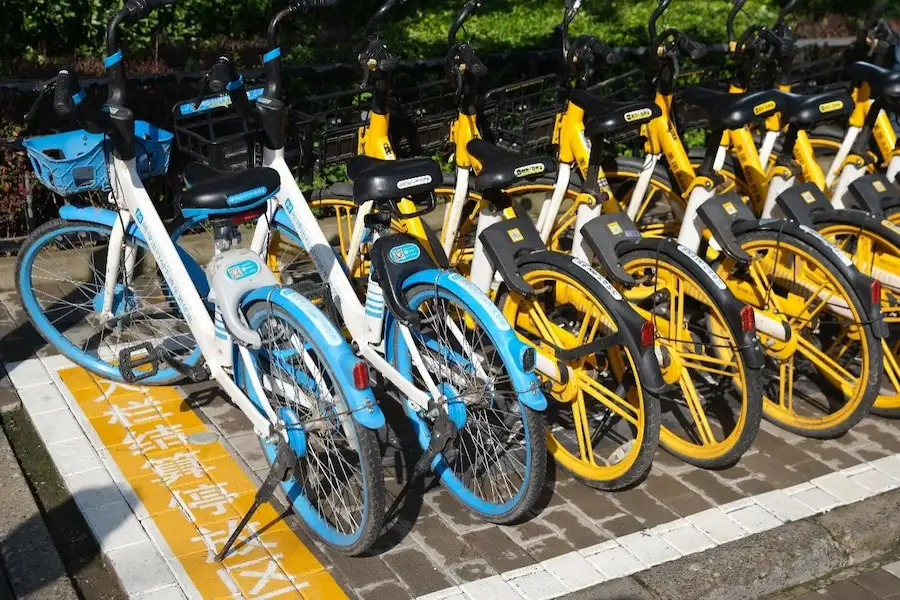
⚠️ Some tourist areas, gated residential compounds, and university campuses ban shared bikes. If you see a security guard waving or a sign that says “禁止共享单车入内,” park at the nearest P-zone outside and walk in.
Navigation Apps: Which One Will Actually Keep You From Getting Lost?
Google Maps does not work in China. It won’t load without a VPN, and even with one, its data is years out of date — wrong station locations, canceled bus lines, routing that makes no sense on the ground.
You need at least one of these alternatives. Here’s how they actually compare for a foreign traveler trying to use public transport in China:
| App | Language | Biggest Strength | Biggest Weakness | Best For |
|---|---|---|---|---|
| Apple Maps | Full English, clean translations | Pre-installed, clear UI, accurate metro data | iPhone only; smaller cities less detailed | ⭐⭐⭐⭐⭐ All iPhone travelers — first choice for china public transport routing |
| MetroMan | Full English, works offline | No internet needed; precise transfer times and fares | Metro only — no bus, walking, or driving | ⭐⭐⭐⭐ Metro-only minimalist travelers |
| Baidu Maps | Primary interface in Chinese, partial English | Most comprehensive data, best real-time traffic | High language barrier for non-Chinese readers | ⭐⭐⭐ Travelers with Chinese reading ability |
| Gaode (高德地图) | Chinese only | Richest POI database, locals’ top choice | Nearly unusable without Chinese proficiency | ⭐⭐ Travelers with Chinese skills or local help |
One-sentence recommendation: if you have an iPhone, Apple Maps handles 90% of what you need for navigating china public transport. Add MetroMan for offline metro navigation as a backup. Skip Baidu and Gaode unless you read Chinese — the language barrier wipes out their feature advantages.
Between Cities: High-Speed Trains, Long-Distance Buses & Domestic Flights
China is vast — Beijing to Guangzhou is over 2,100 km (1,300 miles), Shanghai to Chengdu over 1,600 km. Three modes of transport in China connect cities once you leave the urban metro bubble. Each sits at a different point on the speed-vs-access spectrum within the broader public transportation in China network.
High-speed rail is the default answer for most intercity routes. Trains run at up to 350 km/h, and the network reaches almost every major city. Beijing to Shanghai takes 4.5 hours — often faster than flying when you factor in airport security and routine delays. Book through Trip.com (English interface, foreign currency payment) or the official 12306 app. Our complete guide to booking China high-speed rail tickets covers seat classes, ticket collection, and station navigation in detail.
Intercity buses fill the gaps in the china public transport network. When you’re heading to a smaller city, a county-level town, or a scenic area without a high-speed rail station — destinations like Yangshuo, Fenghuang, or the gateways to many national parks — the long-distance bus network is often your only option. Fares run ¥30–150 (4.29–21.43 USD). Check routes and schedules on Ctrip or Baidu Maps. Quality and punctuality vary — budget extra time and manage your expectations.
Domestic flights make sense for very long distances (1,500+ km) or crossing water (e.g., reaching Hainan). Trip.com lets you book china domestic flights in English with foreign currency. Fares range from ¥300 to ¥1,500+ (43–214+ USD). Check out our dedicated guide to China domestic flights for airline comparisons, airport tips, and booking strategies.
10 Mistakes Foreigners Keep Making (and What to Do Instead)
Even with the best planning, public transportation in China has quirks that trip up first-timers. Here are the most common ones — each paired with a local’s fix.
1. Downloading Alipay and WeChat after landing. Fix: install both before you fly. Complete passport verification and link your foreign card at home, on stable Wi-Fi, without the pressure of a jet-lagged airport moment. The traveler at the top of this article learned this the hard way.
2. Thinking East Nanjing Road and West Nanjing Road are the same station. Fix: directional prefixes (East/West/South/North) in station names mean separate stations. Confirm the full name before you exit.
3. Not saving destination names in Chinese characters. Fix: before your trip, save hotel names, train stations, and major attractions in Chinese in your phone’s notes app. Showing a screenshot to a taxi driver is ten times faster than typing.
4. Taking a street taxi outside a train station or airport. Fix: the “helpful” drivers waiting at arrivals are often unlicensed operators charging triple. One of the oldest scams in china public transport. Walk past them, open DiDi, and book a ride with upfront pricing and GPS tracking.
5. Assuming every bus stops at every station. Fix: Chinese buses run on a “wave to board, press to alight” model. Signal the driver when you see your bus. Press the red stop button before your stop. No signal, no stop.
6. Parking a shared bike wherever you feel like it. Fix: check the ground for white lines or a “P” marker before locking. The ¥5–20 dispatch fee for parking outside a zone is real and non-negotiable.
7. Panicking when security asks you to drink from your water bottle. Fix: this is standard procedure at every metro station in China, for everyone. Take a calm sip. You’re not being singled out — the grandma behind you is about to do the same thing.
8. Dragging a large suitcase onto a rush-hour metro. Fix: 7:30–9:00 AM and 5:30–7:30 PM on a weekday metro with a suitcase is an experience you don’t need. Shift your timing, or take a DiDi. If you absolutely must ride during peak hours, park your suitcase in the space near the carriage connector, away from the doors.
9. Treating cash as your primary payment. Fix: urban transport in China is nearly cashless. Many buses have no fare collector and no coin slot — just a QR scanner. Carry ¥100–200 as an emergency layer. Your phone handles everything else.
10. Assuming every city has a metro. Fix: only 46 Chinese cities have metro systems as of 2025. Popular destinations without one include Dali, Lijiang, Zhangjiajie, Yangshuo (Guilin area), and Huangshan. Check before you go — if there’s no metro, DiDi plus buses becomes your primary strategy for public transport in China.
Quick Answers to the Questions Everyone Asks
Can foreigners use public transportation in China?
Yes, and since 2024 it’s become genuinely straightforward. Metro, buses, and DiDi all accept Alipay and WeChat linked to foreign cards. Major-city signage and announcements are bilingual. You don’t need a Chinese bank account or a Chinese phone number. The entire public transportation in China system is designed to work with the same Alipay or WeChat QR code across modes and cities.
How do I pay for metro rides?
The most efficient method is Alipay’s Transport QR code — activate it once per city (five minutes), then scan in and out at turnstiles. Select gates in Beijing and Shanghai also accept Visa and Mastercard contactless taps, though the per-ride rate is slightly higher than the Alipay fare.
Can tourists use DiDi?
Yes. Use DiDi through the WeChat mini program — you don’t need to download the DiDi app separately, and you don’t need a Chinese phone number. The interface is in English, driver messages auto-translate, and payment runs through your linked WeChat Pay foreign card.
Does China have free public transit?
No fully free system exists. Children under 1.2 meters ride metro and buses for free. Some cities offer transfer discounts (Shanghai gives a reduced fare when you transfer from metro to bus within a certain window). A handful of scenic-area cities run free shuttle buses around tourist zones — but this is the exception, not something to count on.
—
You don’t need to speak Chinese to navigate public transportation in China with confidence. You need one payment app, one navigation app, and a rough sense of which mode fits your current situation. The rest is just practice. Your first metro ride will feel like a small adventure. By your third, you’ll scan through turnstiles without breaking stride — same as the Beijing local next to you. That’s when China’s cities really open up.
Explore all our China transportation guides for deeper dives into high-speed rail, city metro systems, and more.

Ke Ping — Founder, InsiderChinaTravel
I personally reply to every email and create free, custom trip frameworks. Already have a plan? I can arrange vetted local guides and private drivers. Over 5,000 travelers from 30+ countries have started their journey this way.
📋 Tell me about your trip ideaReplied within 24 hours. No charge, no obligation.