China Itinerary 7 Days: The Golden Triangle Route (Beijing → Xi’an → Shanghai)
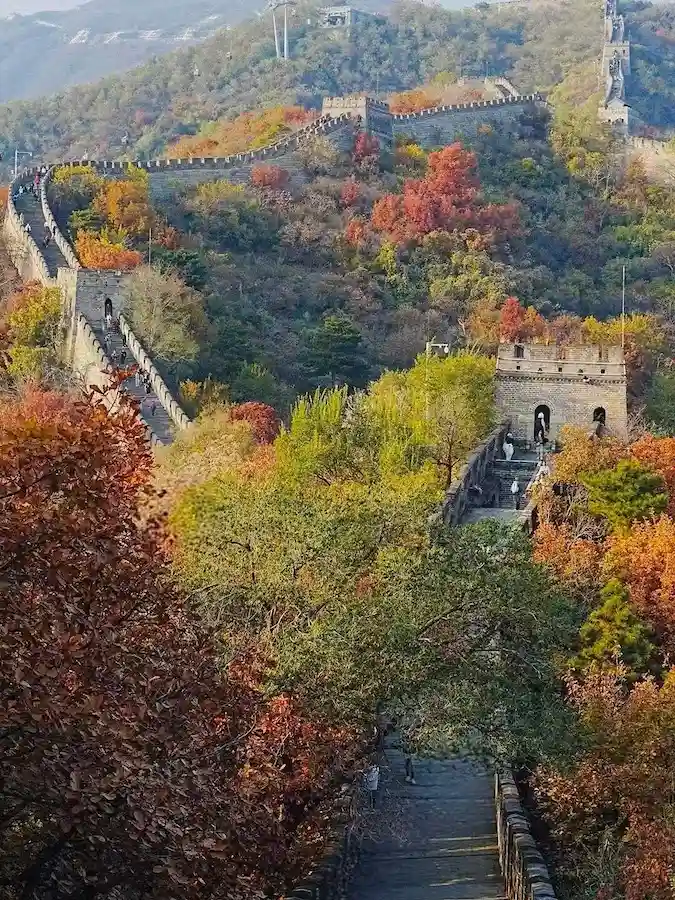
You’re standing on Watchtower 20 at Mutianyu. The wind shaves across the ridge. October sunlight pushes the distant mountains into layers of blue silhouettes. Three minutes ago you were gasping for air — that final incline was steeper than it looked. Right now, watching the wall snake along the ridgeline until it vanishes into the horizon, one thought lands:
Three days ago I was answering emails. Now I’m on the Great Wall of China.
This is what a well-spent 7 days in China buys you.
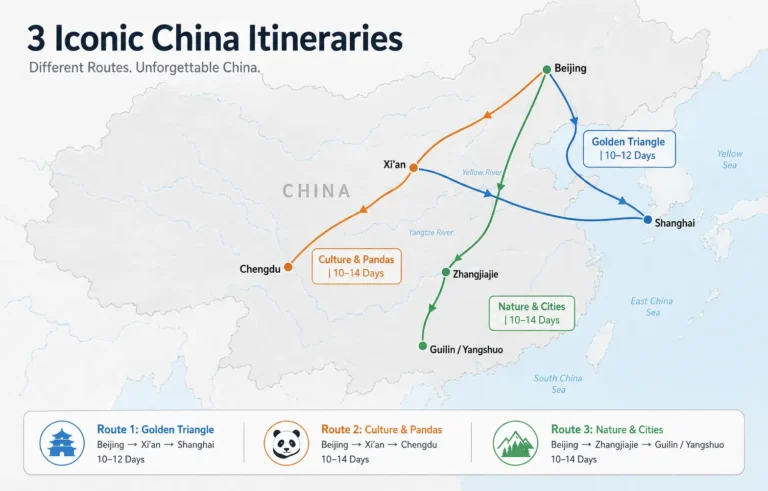
Let’s be honest about what a china itinerary 7 days can and cannot do. You won’t see Tibet. You won’t hike Tiger Leaping Gorge. You won’t even finish Beijing — nobody does. But seven days is exactly enough to take three deep bites out of China: the imperial weight of Beijing, the ancient capital swagger of Xi’an, and the sci-fi skyline of Shanghai. Three cities. Two high-speed trains. One week. If you have more time, a 10 day china itinerary opens up Chengdu or Guilin — but for one week, the Golden Triangle is the sharpest knife in the drawer.
This is the Golden Triangle. It’s the most tested, least stressful 7 days china travel itinerary available. Each city looks nothing like the last. The trains connecting them are world-class. And the day-by-day plan below — when to go, what to skip, how much everything actually costs in CNY and USD — is built to be stolen.
- How to Spend 7 Days in China: The Golden Triangle Day by Day
- What to See in China in a Week: Two Alternative Routes
- Your China Itinerary 7 Days at a Glance: Pick the Right Route
- How to Book a 7 Day Trip to China Without Losing Your Sanity
- Add-Ons, Upgrades, and Mistakes First-Timers Keep Making
- China Travel Essentials: What to Know Before You Land
- FAQ: Things People Google at 2 AM Before Their Flight
- Your 7 Days China Travel Itinerary Checklist — Screenshot This
How to Spend 7 Days in China: The Golden Triangle Day by Day
Days 1–3: Beijing — The Empire’s Backyard
Day 1: The Forbidden City + Jingshan Park
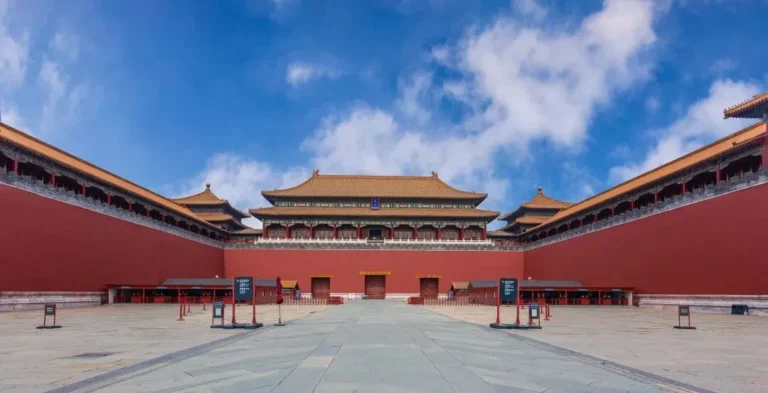
Get to the Meridian Gate by 8:00 AM. The Palace Museum requires booking exactly 7 days in advance through the official mini-program — enter your passport number, then scan your passport at the gate. No paper ticket needed. Peak season costs 60 CNY (9 USD), off-peak 40 CNY (6 USD). No foreigner surcharge. That rumor is nonsense.
Tick the Treasure Gallery and Clock Gallery when booking. The gold-inlaid pearl celestial globe and the kingfisher-feather phoenix crowns inside are the most unapologetic displays of wealth in the entire Forbidden City.
Walk north from the Meridian Gate. Pick two or three of the Six Eastern and Six Western Palaces — the Palace of Eternal Longevity and the Palace of Gathered Elegance have the most character. Don’t try to see all 9,000 rooms. Nobody has time for that. Nobody ever did.
Around 3:00 PM, exit through the Gate of Divine Prowess. Jingshan Park is directly across the street. Fifteen minutes uphill to Wanchun Pavilion. Turn around. The entire Forbidden City central axis lies beneath you — yellow tiles, red walls, stretching to the horizon. Best panoramic view in Beijing. Full stop.
Dinner near Qianmen Street or Dashilan. Do not eat inside the Forbidden City. It’s overpriced and terrible. Bring water and snacks in your bag.
Day 2: The Great Wall + Olympic Park at Night
Pick Mutianyu. Not Badaling.
Both cost 40 CNY (6 USD) for entry. Mutianyu has 60% fewer people, denser forest cover, and one thing Badaling will never have: a 1.5-kilometer metal toboggan slide snaking from the mountaintop back down to the base (yes, the toboggan slide). The round-trip cable car plus toboggan package runs 140–160 CNY (20–23 USD). Worth every yuan.
Leave the city by 7:30 AM. Tourist shuttle buses run from Dongzhimen. If you’d rather not navigate that, book a half-day join-in tour on Trip.com — 210–350 CNY (30–50 USD) per person including round-trip transport. By noon, eat grilled rainbow trout at a farmhouse restaurant at the foot of the Wall.
Head back around 2:30 PM. Ask the driver to drop you at the Olympic Park on the way into town. The Bird’s Nest and Water Cube lit up at dusk are far more impressive than they are during the day.
Day 3: Temple of Heaven + Summer Palace + Evening Train to Xi’an
Hit the Temple of Heaven before the tour buses arrive. The Hall of Prayer for Good Harvests — triple-eaved, blue-glazed, standing alone in the early light — looks like architecture from another planet. Enter through the North Gate, exit through the South Gate. The long corridor of ancient cypress trees between them is where local retirees play cards, kick shuttlecocks, and write calligraphy on the ground with water brushes. Sometimes that’s better than the temple itself.
Quick lunch. Then the Summer Palace. Don’t walk the whole thing — it’s 3 square kilometers. Your legs will quit. Enter through the East Palace Gate, follow the Long Corridor to the foot of the Tower of Buddhist Incense, cut toward the Marble Boat, exit through the North Ruyi Gate. Two hours, best hits only.
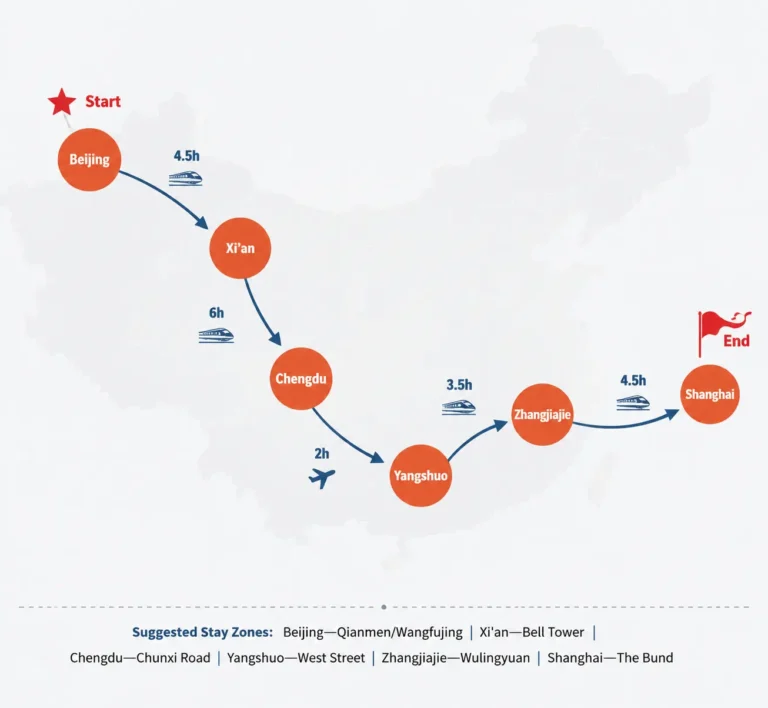
Grab your luggage. Catch an 18:00 high-speed train from Beijing West Station to Xi’an North Station. Fastest journey: 4 hours 10 minutes (trains G55/G59). Second class: 470–577.5 CNY (67–85 USD). Book on Trip.com 15 days ahead — they charge 10–30 CNY (2–5 USD) extra per ticket, but your foreign credit card won’t get rejected. The official 12306 English site has improved (90%+ foreign card acceptance in 2026), but refunds still take 7–15 business days. For a one-week trip, that’s not a gamble worth taking.
You’ll roll into Xi’an around 10:30 PM. Check into a hotel near the Bell Tower. Sleep.
Best area to stay in Beijing: Dongsi / Dengshikou / Wangfujing. Walk to the Forbidden City. Metro access everywhere. Night strolls through the hutongs without needing a cab.
Days 4–5: Xi’an — The Ancient Capital
Day 4: Terracotta Warriors + Muslim Quarter
No rush this morning. Xi’an runs half a beat slower than Beijing. Head to the City Wall’s South Gate (Yongningmen) by 9:00 AM. Rent a bike. The full loop is 13.7 kilometers — ride half of it. The wall is wide enough to land a small plane on.
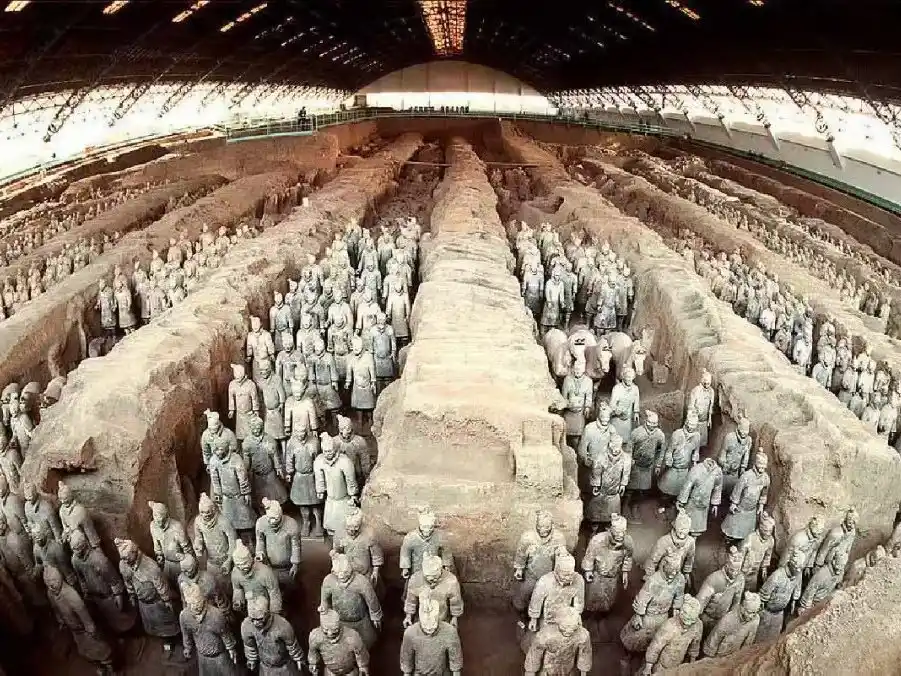
Leave for the Terracotta Warriors by noon. They’re in Lintong, 40 kilometers outside the city. A Didi costs about 100–120 CNY (14–17 USD). Bus 306 from Xi’an Railway Station is the budget option. Entry: 120 CNY (17 USD), no seasonal pricing. Register your passport in the official booking system beforehand.
Hire a guide. I’ll say it again. Hire a guide. A shared official guide costs 200 CNY (29 USD) per group. Without one, you’re looking at pits of dirt and clay figures. With one, you learn that every single warrior in Pit 1 has a different face — not a mold, not a copy — and that the kneeling archer in Pit 2 has tread patterns on the sole of his shoe carved with the same detail as a real cloth shoe. These aren’t details you spot on your own. Walking through without commentary is a waste of 120 CNY and an afternoon.
The Huaqing Hot Springs are next door (120 CNY / 17 USD). If you’re there in the evening, the Song of Everlasting Sorrow performance — Tang Dynasty love story, Li Mountain as the backdrop, stage rising from the water — is genuinely worth staying for.
Back in the city by nightfall. Head straight to the Muslim Quarter. Skip the first few stalls on the main drag. Walk deeper. Turn onto Sajinqiao — that side street is where locals actually eat. Cumin-crusted lamb skewers, yangrou paomo (flatbread torn into lamb soup), biangbiang noodles, sour soup dumplings. Go with a group of four and spend 60–80 CNY (9–12 USD) per person sampling seven or eight different things.
Day 5: Shaanxi History Museum + Tang Paradise + Overnight Train to Shanghai
Morning belongs to the Shaanxi History Museum. Entry is free but requires booking 3–7 days ahead on their WeChat mini-program. During summer and Golden Week, these tickets are harder to get than Forbidden City slots. Backup plan: buy a 30 CNY (4 USD) ticket to the Treasure Gallery — it still gets you in. The collection runs from Western Zhou bronzes to Tang Dynasty gold and silver. Three hours minimum. The density of artifacts here ranks top three nationwide.
Afternoon near the Big Wild Goose Pagoda. The Great Tang All-Day Mall at its base is a Tang Dynasty theme park on a street — during the day it’s pleasant; at night, with every lantern lit and half the crowd wearing rented hanfu costumes, it’s a spectacle that shouldn’t work and absolutely does.
Collect your bags. Catch an 18:00–19:00 high-speed train from Xi’an North to Shanghai Hongqiao. Fastest journey: 5 hours 56 minutes (G362). Second class: 659–772.5 CNY (97–113 USD). This train timing is perfect — eat dinner on board, doze off somewhere past Nanjing, and wake up as the train pulls into Shanghai. You will go from Han Dynasty Chang’an to the LED jungle of Lujiazui in the space of a half-dream. That transition is the single most cinematic moment of the entire route.
Best area to stay in Xi’an: Bell Tower or South Gate area. The Muslim Quarter and City Wall are both within a 10-minute walk. There are some excellent boutique courtyard hotels tucked into alleys near Yongningmen — 30–40% cheaper than Beijing equivalents of the same quality.
Days 6–7: Shanghai — Tomorrowland
Day 6: The Bund + French Concession
Don’t set an alarm. After the previous five days, your body needs a soft morning. Roll out by 10:00 AM. Head straight to the Bund.
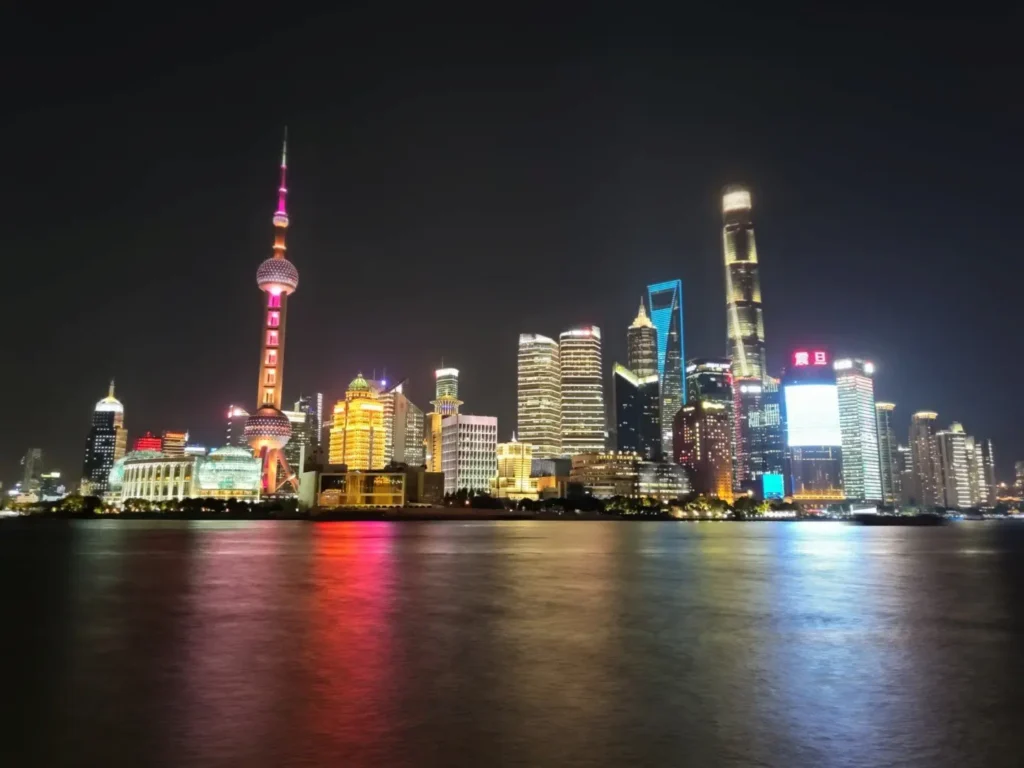
Stand on the western bank of the Huangpu River and look across. The Shanghai Tower rises 632 meters in front of you. The Oriental Pearl Tower, which photographs make look enormous, sits beside it looking like a toy. The view hits differently in person. Every time.
Lunch near East Nanjing Road. Go for xiaolongbao at Lai Lai — their crab roe soup dumplings (48 CNY / 7 USD per steamer) have skins so thin they’re translucent. Bite a small hole, slurp the broth first, then dip in vinegar. Wrong order and you’ll scald the roof of your mouth. You’ve been warned.
Afternoon: the French Concession. Start on Wukang Road — the Normandie Apartments building at the corner, shaped like a ship’s bow, is the most photographed structure in Shanghai. Turn onto Anfu Road, then Wuyuan Road. Plane trees form a green tunnel overhead. 1930s lane houses and courtyard cafes line both sides. Sit down. Order a pour-over. For a moment you’ll forget you’re in China — until the woman at the next table takes a phone call in Shanghainese and the spell breaks. This is Shanghai at its best. It refuses to be one thing.
Evening: find a rooftop bar in Lujiazui. Flair at the Ritz-Carlton sits on the 58th floor, aimed directly at the Oriental Pearl — cocktails run 120–150 CNY (17–21 USD). Too steep? Grab a beer from a convenience store near the Bund and sit on the riverfront steps. Similar effect. Much better price.
Day 7: Shanghai Museum / Tianzifang + Departure
No fixed plan for the last day. It depends on your flight.
Afternoon or evening flight: Morning at the Shanghai Museum (People’s Square, free but requires booking). Their bronze and ceramics collections are national-level. Then wander Tianzifang or Xintiandi for last-minute gifts.
Midday flight: Sleep until checkout. Find a Shanghainese restaurant near your hotel and order hongshao rou (red-braised pork belly, 88 CNY / 13 USD) and yanduxian (bamboo shoot and pork soup). Make it a proper farewell meal. Then the airport.
Pudong and Hongqiao airports both connect by metro and maglev. Standing in the departure hall, thinking back to the moment you landed in Beijing seven days ago — it won’t feel like seven days. It’ll feel like two weeks. Not because it was exhausting. Because each city packed in more than your brain could process in real time.
Best area to stay in Shanghai: Somewhere between the Bund and the French Concession. East Nanjing Road gives you metro access to everything. The quieter streets around Jing’an Temple are better if you want a neighborhood feel.
What to See in China in a Week: Two Alternative Routes
The Golden Triangle is built for first-timers — the kind of first time china itinerary that hits the greatest hits without requiring a PhD in Chinese logistics. But if you’re not a first-timer, or your travel style leans heavily in one direction, here are two other routes that have been battle-tested by thousands of travelers. If you’re planning a longer stay, our 2 week china itinerary guide covers more ground.
Route B: Yunnan Classic Loop — Dali → Lijiang → Shangri-La
For people who want nature, ethnic minority culture, and a slower rhythm. This line strings together Cangshan Mountain and Erhai Lake, Jade Dragon Snow Mountain, and high-altitude Tibetan plateau — all while ascending gradually (Dali 2,000m → Lijiang 2,400m → Shangri-La 3,300m). Altitude sickness risk is low.
The 7-day flow: Day 1 arrive Dali, old town and Erhai sunset; Day 2 Cangshan cable car + Erhai west bank (Xizhou Old Town, Bai tie-dye); Day 3 Erhai east bank → bullet train to Lijiang, Shuhe Ancient Town; Day 4 Jade Dragon Snow Mountain (Glacier Park cable car, 4,680m marker) + Blue Moon Valley; Day 5 Lijiang → Tiger Leaping Gorge → Shangri-La Dukezong Ancient Town; Day 6 Songzanlin Monastery + Pudacuo National Park; Day 7 return to Lijiang, fly out.
Budget for mid-range guesthouses, private car transfers, and tickets: 4,000–5,500 CNY (571–786 USD), excluding flights.
Route C: Beijing Deep Dive — All 7 Days in One City
For people who don’t want to drag suitcases onto trains. Beijing’s density of sights can fill 7 days without breaking a sweat — Forbidden City, Great Wall, Summer Palace, Temple of Heaven, National Museum, Yonghe Temple + 798 Art District, hutong biking, plus the scattered temples, food streets, and markets you stumble into along the way. You never switch hotels. The pace is entirely yours. Budget: 5,000–7,500 CNY (714–1,071 USD) for a comfortable week, flights excluded.
Your China Itinerary 7 Days at a Glance: Pick the Right Route
| Route | Best for | Pace | 7-Day Budget (excl. flights) | Signature Moment |
|---|---|---|---|---|
| Golden Triangle Beijing → Xi’an → Shanghai | First-timers | Moderate-high 2 train transfers | 7,000–10,000 CNY (1,000–1,429 USD) | Three different Chinas in one week |
| Yunnan Loop Dali → Lijiang → Shangri-La | Nature lovers, culture seekers | Moderate 1 train + car transfers | 5,500–8,000 CNY (786–1,143 USD) | Snow mountains + Tibetan highlands |
| Beijing Deep Dive One city, all 7 days | Slow travelers, return visitors | Low Zero packing | 5,000–7,500 CNY (714–1,071 USD) | Knowing one city inside out |
How to Book a 7 Day Trip to China Without Losing Your Sanity
Trains
China’s high-speed rail network links the entire Golden Triangle. You don’t need a single domestic flight.
- Trip.com (recommended): 10–30 CNY (2–5 USD) service fee per ticket. Accepts Visa/Mastercard without rejection issues. Lets you pre-book 90 days ahead. Refunds come fast. For a traveler still fighting jet lag, the extra few dollars are money well spent.
- 12306 English site: Much improved as of 2026 — foreign passport + foreign card support is now above 90%. But some overseas banks still trigger fraud alerts on payment, and refunds to international cards take 7–15 business days. Use it if you have a Chinese bank card or enjoy troubleshooting.
Hotels
Stick to Booking.com, Agoda, or Trip.com. Meituan and Fliggy still lack English-native interfaces, and their passport verification for non-Chinese ID remains painful. Don’t waste hours on them.
Mid-range hotels (JI Hotel, Atour): Beijing and Shanghai average 500–800 CNY (71–114 USD) per night. Xi’an drops to 300–500 CNY (43–71 USD). Xi’an is noticeably cheaper — this is the city where you can afford to upgrade your room.
Attraction Tickets
The Forbidden City requires booking exactly 7 days ahead, passport number required, passport scan for entry. Daily cap: 40,000 tickets. In peak season, they vanish. If you miss out, Trip.com sells guide-inclusive packages (200–300 CNY / 29–43 USD) that often solve the problem. The Terracotta Warriors and Shaanxi History Museum also demand advance booking. The Great Wall does not — scan and buy at the gate.
Add-Ons, Upgrades, and Mistakes First-Timers Keep Making
Which Great Wall Section?
| Section | Entry | Access | Crowds | Verdict |
|---|---|---|---|---|
| Badaling | 40 CNY (6 USD) | Excellent — high-speed train | Extreme | Perfect restoration. Perfect crowds. Too perfect. |
| Mutianyu | 40 CNY (6 USD) | Good — shuttle bus or join-in tour | Low-moderate | The sweet spot. Lush scenery, toboggan slide, foreigner favorite. |
| Simatai | 40 CNY (6 USD) | Limited — dedicated trip needed | Low | Only section with original Ming appearance. Night visits possible. |
| Jinshanling | 65 CNY (9 USD) | Poor — no easy public transit | Very low | Photographer’s dream. Not for a 7-day itinerary. |
Mutianyu is the answer for the Golden Triangle. Book the toboggan.
Guided Tour or DIY?
English join-in group tours in Beijing or Xi’an run 500–800 CNY (71–114 USD) per person — includes entry, guide, and round-trip transport. Private custom tours cost 1,050–1,750 CNY (150–250 USD) per person per day for a group of 2–4. If you’re solo or a couple and don’t want to figure out bus routes, a join-in tour hits the sweet spot. If you’re traveling with kids or older relatives, or you just like control, DIY is completely viable — the high-speed rail + Didi + translation app combination solves 99% of situations.
When to Go (and When to Stay Home)
- Ideal: April–May, September–October. Comfortable weather. The week before or after the October Golden Week is the true sweet spot. For a full seasonal breakdown, see our guide on the best time to visit China.
- Acceptable: March, November. Colder but uncrowded. Hotels and flights start discounting.
- Avoid: China’s three Golden Weeks — Chinese New Year (January/February), Labor Day (May 1–5), National Day (October 1–7). During these periods, attractions overflow, high-speed train tickets evaporate, and hotel rates double. If National Day is your only option, do the Beijing Deep Dive and stay put.
What a 7 Day Trip to China Cost Really Looks Like
Hidden costs first-timers never budget for:
- Mobile payment fees: Alipay and WeChat charge 2% on single transactions over 200 CNY (29 USD) when using linked Visa/Mastercard. Transactions under 200 CNY are fee-free.
- eSIM: Airalo’s China package runs 10GB/30 days for 20–28 USD. No separate VPN needed — overseas eSIMs route through their home network, so Google, Instagram, and WhatsApp work natively. Holafly’s unlimited plan costs 27 USD for 7 days.
- Ticket stacking: Forbidden City 60 CNY + Great Wall 40 CNY + cable car 140 CNY + Terracotta Warriors 120 CNY + Summer Palace 30 CNY + Temple of Heaven 15 CNY. That’s 405 CNY (58 USD) per person before you’ve hired a single guide or seen a single show.
Full 7-day budget, mid-range standard, international flights excluded:
| Item | CNY | USD |
|---|---|---|
| Accommodation (6 nights) | 2,400–3,600 | 343–514 |
| Intercity trains (2 trips) | 1,100–1,350 | 157–193 |
| Local transport | 400–600 | 57–86 |
| Tickets + guides | 800–1,200 | 114–171 |
| Food & drinks | 1,400–2,100 | 200–300 |
| Other (eSIM, insurance, etc.) | 300–500 | 43–71 |
| Total | 6,400–9,350 | 914–1,336 |
China Travel Essentials: What to Know Before You Land
Payments — Alipay & WeChat Pay for Foreigners (2026)
The setup is straightforward: download Alipay International → register with your passport → link a Visa or Mastercard → scan QR codes everywhere. Single transactions under 200 CNY have zero fees. The per-transaction limit is now 5,000 USD (up from 1,000 USD), and the annual cap sits at 50,000 USD — more than enough for any trip. Cash still works, but many small vendors no longer carry change. Mobile payment isn’t optional. It’s the default.
Getting Around
- Didi English version: Works beautifully. Independent English interface with built-in translation — your English messages auto-translate to the driver, their Chinese replies come back in English. International credit cards supported. Auto-payment on arrival. No awkward fare negotiations.
- Metro: Beijing, Xi’an, and Shanghai metros all accept Alipay QR code scanning at the gate. No physical tickets needed. Shanghai’s metro is the largest in the world — you can reach anywhere on it.
- Maps: Gaode and Baidu Maps do not support full English navigation. Use Apple Maps — it runs on Gaode’s data but the entire interface is in English. Accuracy is excellent. Google Maps works if you’re on an eSIM but has persistent GPS offset issues within China.
Internet — eSIM, VPNs & Offline Maps
An overseas eSIM (Airalo, Holafly, Nomad) is the cleanest solution. It activates on landing, bypasses the firewall natively, and saves you from buying and troubleshooting a VPN. If you’re using a Chinese SIM card, you’ll need a VPN — Astrill is the most reliable (and most expensive), while LetsVPN is the budget pick that still works. Whatever you choose, download offline map packs before departure. Just in case.
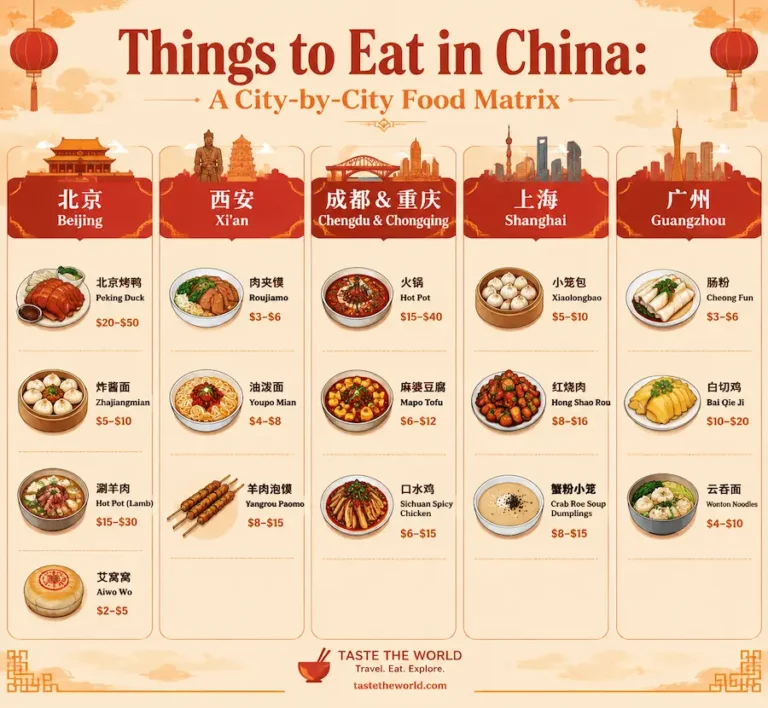
What to Eat — Quick Hits by City
- Beijing: Peking duck — Siji Minfu, half duck 139 CNY (20 USD). Zhajiangmian — Haiwanju, 28 CNY (4 USD). Mongolian hotpot — Jubaoyuan, 120 CNY (17 USD) per person. Candied hawthorn skewers from any hutong vendor: 5–10 CNY (1–2 USD). Buy one. Eat it while walking.
- Xi’an: Cumin lamb roujiamo — Sajinqiao, 15 CNY (2 USD). Yangrou paomo — Tongshengxiang, 38 CNY (5 USD). Biangbiang noodles, 18–25 CNY (3–4 USD). Sour soup dumplings, 20 CNY (3 USD). The main Muslim Quarter street handles the atmosphere. Sajinqiao handles the food.
- Shanghai: Crab roe xiaolongbao — Lai Lai, 48 CNY (7 USD). Shengjianbao (pan-fried pork buns) — Da Hu Chun, 12 CNY for 4 (2 USD). Hongshao rou — Old Jesse, 88 CNY (13 USD). Scallion oil noodles from any neighborhood noodle shop: 15–25 CNY (2–4 USD).
FAQ: Things People Google at 2 AM Before Their Flight
Can I fit Chengdu into a one week in China itinerary?
Technically yes — swap Xi’an for Chengdu (3 days Beijing + 3 days Chengdu + 1 day Shanghai). But Beijing to Chengdu by high-speed rail takes 8 hours; Chengdu to Shanghai takes 12. You’ll likely need two flights instead (adds cost), and Chengdu’s surrounding sights — Dujiangyan, Mount Qingcheng, Leshan Giant Buddha — are all full-day trips. With only 7 days, the math gets tight. If pandas are the goal, Chengdu deserves its own trip. A well-built china itinerary 7 days doesn’t try to do everything — it does three things deeply.
I don’t speak any Chinese. Will I survive?
Yes. Translation apps (Google Translate or Youdao’s camera translation) plus hand gestures plus smiling solve 80% of situations. Didi English handles transport. Hotel front desks almost always have basic English. Restaurants: point at pictures, point at the next table’s food, or scan the QR code on the table — many restaurants now run fully self-service ordering through Alipay. You’ll eat. You might not know exactly what it’s called. It’ll be good.
Is China safe for solo travelers?
China is one of the safest countries on the planet. Walking alone through a city street past midnight is genuinely low-risk for violent crime. The real dangers: electric scooters (they’ve invented their own rules about red lights) and the occasional scammer near tourist sites who invites you to a “traditional tea ceremony” and then hands you a bill for 300 CNY (43 USD). Politely decline the tea.
How much cash should I bring?
500–1,000 CNY (71–143 USD) as emergency backup. You’ll use Alipay or WeChat for 90% of transactions. But there will be one remote snack stand or one subway underpass with no signal that demands paper money. Carry it.
Your 7 Days China Travel Itinerary Checklist — Screenshot This
1–3 months before:
- Confirm visa or visa-free eligibility (as of 2026: 30+ countries enjoy unilateral visa-free access; 54 countries qualify for 240-hour transit visa-free entry)
- Book international flights — fly into Beijing, out of Shanghai. An open-jaw ticket saves you one extra train ride versus a round-trip to the same city.
- Book hotels with free cancellation in case your plans shift.
- Set a calendar reminder: Forbidden City tickets open exactly 7 days before your visit date.
1 week before:
- Download Alipay International + link Visa/Mastercard
- Download Didi English version
- Buy eSIM (Airalo or Holafly) or confirm VPN is working
- Download Apple Maps offline pack
- Book high-speed train tickets on Trip.com — Beijing → Xi’an, Xi’an → Shanghai
1 day before:
- Print hotel + flight + insurance confirmations (save digital copies too)
- Exchange 500–1,000 CNY cash
- Charge your power bank — 25,000 steps a day minimum. Your phone will not survive on its own.
- Confirm your first hotel has a 24-hour front desk
After landing:
- Connect to airport Wi-Fi. Activate eSIM.
- Open Alipay. Confirm payment is working.
- Call your first Didi to the hotel. Ignore the touts offering “cheap rides” inside the terminal.
- Open Apple Maps. See what’s still open near your hotel past midnight. You’re probably hungry. There’s almost certainly a noodle shop still serving.
Seven days in a country this size is a stone thrown into an ocean. But some stones leave ripples. Walk the Golden Triangle — the mountain wind on the Great Wall, the carved sole of a kneeling archer from 200 BC, a cocktail on the 58th floor as the Huangpu River glows beneath you — and those ripples will follow you home.
Now the real question: when you get back, how do you describe any of it to someone who wasn’t there?
Ke Ping — Founder, InsiderChinaTravel
I personally reply to every email and create free, custom trip frameworks. Already have a plan? I can arrange vetted local guides and private drivers. Over 5,000 travelers from 30+ countries have started their journey this way.
📋 Tell me about your trip ideaReplied within 24 hours. No charge, no obligation.