10 Day China Itinerary: 4 Perfect Plans for First-Timers
China is enormous. You could spend a month here and barely scratch the surface. But most people don’t have a month. They have 10 days—a week off work, bookended by two weekends. That’s enough. More than enough, actually, if you plan it right. This 10 day China itinerary guide is built for exactly that window.
The real challenge with any 10 day China itinerary isn’t what to see. It’s what to skip. China packs more UNESCO sites, more regional cuisines, and more sheer geographic drama into its borders than almost anywhere else on earth. You need a plan that gives you the highlights without turning your trip into a checklist marathon. That’s what this china travel guide is here to help with.
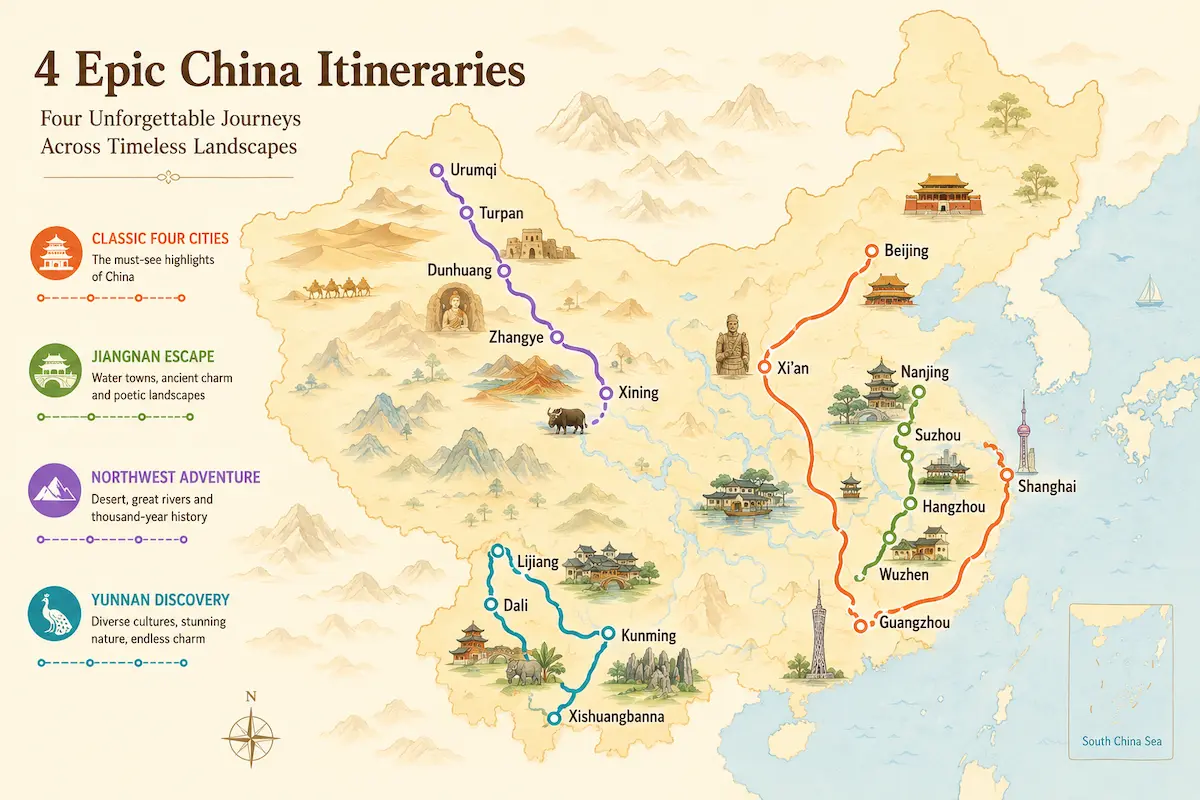
Below are four different ways to spend 10 days in China. Each one has a distinct personality—slow-paced Yunnan, water-town Jiangnan, wild Northwest landscapes, and a classic four-city greatest-hits route. Pick the one that matches how you like to travel. If you’re still exploring options, our full china itinerary hub has even more route ideas for different trip lengths.
A quick note before diving in: travelers with Australian or New Zealand passports currently get 30-day visa-free entry to China. For everyone else, check out our step-by-step china visa application guide to get your paperwork sorted before booking flights. This alone removes a huge barrier that used to make a china itinerary 10 days feel like a logistical nightmare.
- Plan 1: Yunnan Slow Loop — Kunming → Dali → Lijiang
- Plan 2: Jiangnan Water Towns — Hangzhou → Wuzhen → Suzhou → Shanghai
- Plan 3: Northwest Landscapes — Xining → Qinghai Lake → Chaka → Dunhuang → Zhangye
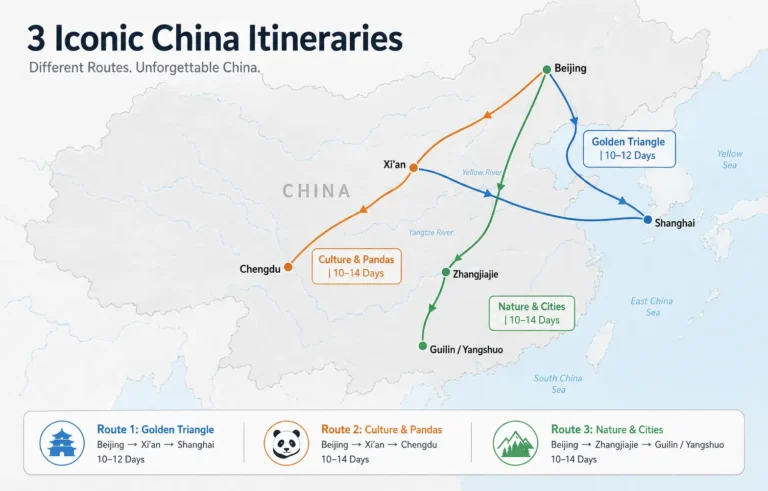
- Plan 4: Classic Four Cities — Shanghai → Beijing → Xi'an → Chengdu
- Only Have 7 Days? A China Itinerary 7 Days Quick Trim
- China Travel Tips for Any 10 Day China Tour
Plan 1: Yunnan Slow Loop — Kunming → Dali → Lijiang
Best for: people who want to slow down, not sprint. Families. Anyone who likes the idea of cycling past rice paddies with snow-capped mountains in the distance. This 10 day China itinerary keeps the daily pace relaxed and the scenery constant.
Yunnan sits on a high plateau in southwest China. The altitude ranges from 1,800m to 2,400m—high enough to keep the air cool and crisp, low enough that most people feel fine after a day of adjusting. Kunming, the capital, is called the “City of Eternal Spring.” Temperatures hover between 15°C and 25°C year-round.
Days 1–2: Kunming
Fly into Kunming Changshui Airport (KMG). The metro connects straight to the city center. Stay in Wuhua or Panlong district. Everything you need is within walking distance or a short DiDi ride away.
Head to Dianchi Lake’s Haigeng Dam on your first afternoon. From November through March, thousands of black-headed gulls migrate here from Siberia. They swoop over the water, snatch breadcrumbs from outstretched hands, and generally put on a show. The dam is flat, paved, and wheelchair-friendly—zero effort required.
Dinner should be crossing-the-bridge noodles (过桥米线). A bowl of scalding chicken broth arrives at your table. You slide in raw pork slices, vegetables, and rice noodles yourself. They cook in seconds. If you want it less oily, ask for the “low-fat version” (低油版). Expect to pay around 35–60 CNY (5–9 USD) per bowl.
Day two: the Yunnan Provincial Museum (free entry) walks you through 25 ethnic minority cultures in air-conditioned comfort. Afterward, wander Green Lake Park. Locals practice tai chi, sing opera, and walk their birds in ornate cages. It’s everyday Kunming at its most unfiltered.
Days 3–4: Dali
A 2-hour high-speed train gets you from Kunming to Dali. Stay inside Dali Ancient Town or along the shores of Erhai Lake.
Rent an electric-assist bicycle and ride a section of the Erhai Ecological Corridor. You don’t need to bike all 46 kilometers. Pick a 15-kilometer stretch. Cangshan Mountain looms on your left, Erhai Lake glitters on your right, and Bai ethnic villages dot the fields in between. The electric motor means hills don’t matter.
On day four, visit the Three Pagodas of Chongsheng Temple. These three white towers have stood at the foot of Cangshan for over a thousand years. The site has wheelchair-accessible paths and audio guides in English. Entry is about 75 CNY (11 USD).
In the afternoon, drive 30 minutes to Zhoucheng Village for a Bai tie-dye workshop. You’ll use needle and thread to bind patterns into cotton cloth, then dip it into natural indigo dye made from banlangen root. After 30 to 40 minutes, you walk away with a square of fabric you made yourself. The workshop has cushioned workstations—easy on the back. Cost: roughly 50–100 CNY (7–14 USD) per person.
Days 5–7: Lijiang
Another 1.5-hour high-speed train from Dali. Lijiang Old Town is a UNESCO World Heritage site: cobblestone lanes, wooden Naxi houses, and streams running alongside every street. Wear shoes with grip—the stones can be slippery after rain. Electric carts shuttle visitors through the old quarter if your legs need a break. For a 10 day China itinerary that balances culture with comfort, Lijiang hits the sweet spot.
Day six belongs to Jade Dragon Snow Mountain. A cable car whisks you from green foothills to Glacier Park at 4,506 meters in about 15 minutes. The vertical drop exceeds 1,000 meters. From the upper station, a boardwalk leads to the 4,680-meter viewing platform.
Important: buy an oxygen canister in town before heading up (15–20 CNY / 2–3 USD). Altitude sickness doesn’t care how fit you are. Walk slowly, breathe deeply, and don’t be a hero. If winds are too strong, the cable car shuts down—ask your guesthouse host about conditions before you leave.
Day seven: Baisha Old Town. It’s 10 kilometers from Lijiang, a 15-minute taxi ride. Of Lijiang’s three ancient towns, Baisha is the quietest and least commercialized. The Tea Horse Road Museum here is free, uncrowded, and has rest areas where you can sit and learn about the ancient trade route that once linked Yunnan to Tibet.
Fly out from Lijiang Sanyi Airport (LJG) on day eight, nine, or ten—whatever fits your schedule. If you have an extra day, swing by the Stone Forest near Kunming on your way back. Limestone pillars rise from the ground like a petrified forest. It’s a UNESCO Global Geopark and worth the 1.5-hour drive from the city. If you happen to have two full weeks instead of ten days, take a look at our 2 week china itinerary for a more relaxed version of this route.
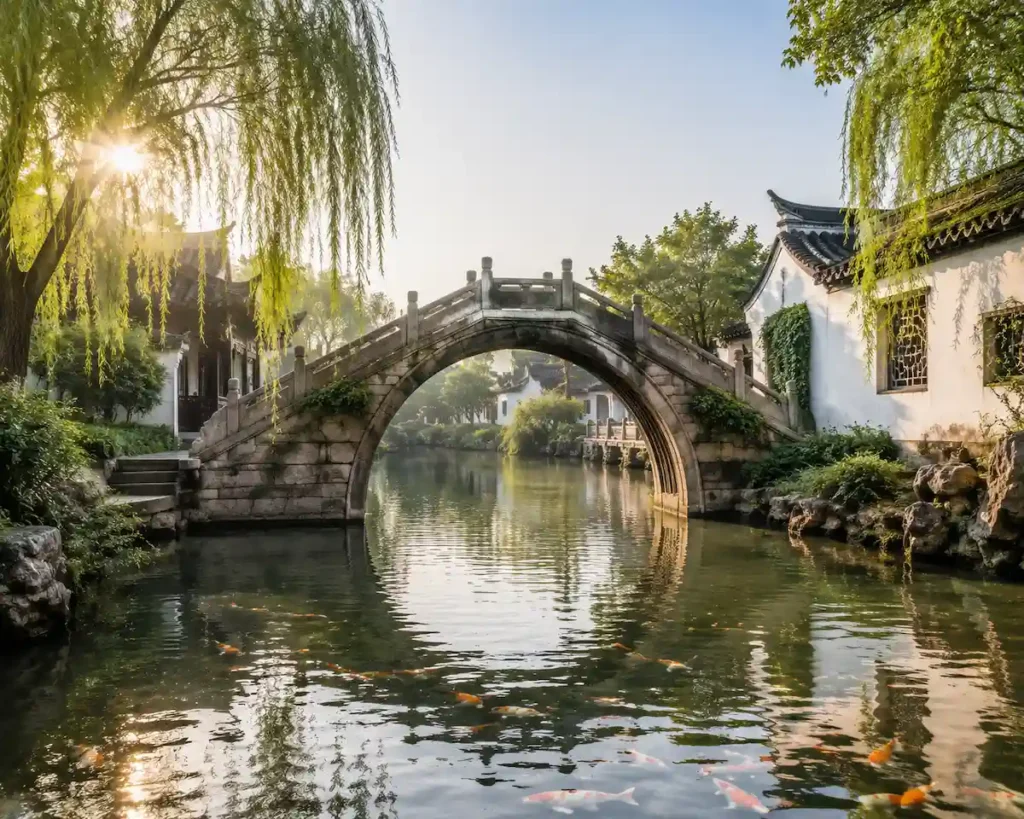
Plan 2: Jiangnan Water Towns — Hangzhou → Wuzhen → Suzhou → Shanghai
Best for: travelers who want misty lakes, ancient canals, classical gardens, and zero mountain climbing. This 10 day China itinerary strings together four cities by high-speed rail. No leg is longer than 1.5 hours.
Jiangnan—the region south of the Yangtze River—is the China of ink-wash paintings. Think willow trees trailing in still water. Stone bridges arched over narrow canals. Teahouses where you sit for hours over a single pot of Dragon Well tea.
Days 1–3: Hangzhou
Fly into Hangzhou Xiaoshan Airport (HGH). Book a hotel near Hubin Road or Nanshan Road—you’ll be steps from West Lake.
West Lake is best experienced in pieces, not in one go. Walk from Broken Bridge down Bai Causeway, then pick up Su Causeway. If walking isn’t your thing, hop on a lake-circuit electric cart. It costs 10 CNY (1.50 USD) per ride and covers the section from Broken Bridge to Leifeng Pagoda. The breeze off the lake does half the work.
On day two, visit the China National Tea Museum (free). It sits inside actual Dragon Well tea terraces. Staff demonstrate how to brew Longjing tea with water cooled to exactly 80°C—any hotter and you scorch the leaves, killing their delicate chestnut sweetness.
Walk uphill to Longjing Village afterward. This is where the real Dragon Well tea grows. Find a tea farmer’s terrace, order a fresh brew, and look out over the terraced slopes. A pot runs about 30–80 CNY (4–11 USD) depending on the grade of tea.
Day three: Huqingyutang Traditional Chinese Medicine Museum. This 150-year-old pharmacy still operates inside its original Qing Dynasty building. You can watch herbalists slice roots, grind powders, and roll pills by hand. The atmosphere is part apothecary, part time capsule. Entry is free.
Days 4–5: Wuzhen
From Hangzhou, it’s 1.5 hours by road to Wuzhen. This water town is split into two scenic zones: Dongzha (East Gate) and Xizha (West Gate). Dongzha still has residents living in the old houses. Xizha is more polished—no visible power lines, no external AC units, all modern infrastructure buried underground.
Xizha comes alive after dark. Rent a hand-rowed boat (private charters available, life jackets provided) and float under stone bridges lit from below. The only sound is the oar dipping into water. A night boat ride costs about 60 CNY (9 USD) per person for shared, or 300–400 CNY (43–57 USD) for a private boat.
The next morning, visit the Mu Xin Art Museum. Mu Xin was a writer and painter born in Wuzhen. The museum was designed by a student of I.M. Pei—clean concrete lines, still water reflecting the walls, an almost religious quiet. Wheelchair accessible, free wheelchairs available. Entry: 20 CNY (3 USD).
Before leaving, try making dingsheng cake (定胜糕), a soft rice-flour pastry with red bean paste that’s been a Jiangnan staple for centuries. Workshops take about 40 minutes. You sift the flour, fill the mold, steam it, and eat it warm. Cost: around 50 CNY (7 USD).
Days 6–8: Suzhou
A 1.5-hour drive or quick train ride from Wuzhen. Suzhou built its reputation on silk, gardens, and canals. Marco Polo called it the “Venice of the East.”
Wake up early for the Humble Administrator’s Garden (拙政园). Arrive at 7:00 AM when the gates open, before the tour groups flood in. This is the largest and most celebrated classical garden in Suzhou. The design follows a simple principle: every step should reveal a new composition—a framed window here, a borrowed view of a pagoda there. Walking sticks available to borrow. Entry: 80 CNY (11 USD).
Next door is the Suzhou Museum, designed by I.M. Pei (he was born in Suzhou). The building itself outshines many of the exhibits—geometric white walls, grey tile, water courtyards, light everywhere. Free entry, but reserve online in advance.
Day seven: Pingjiang Road. A narrow stone-paved lane running alongside a canal. Old whitewashed houses now hold tea shops, bookstores, and craft studios. Benches are spaced closely—you can sit down whenever you need a break. Duck into a canal-side teahouse for pingtan (评弹), Suzhou’s traditional storytelling art. A performer sings in the local dialect while playing the pipa. You won’t understand the words. It won’t matter.
Dinner at Songhelou or Deyuelou: order squirrel-shaped mandarin fish (松鼠鳜鱼). The fish is scored, fried, and drenched in sweet-sour sauce. Ask for the de-boned version. A whole fish costs about 120–180 CNY (17–26 USD).
Day eight: Jinji Lake on Suzhou’s modern side. Take an air-conditioned sightseeing boat (motion sickness pills on board if needed). Then a 30-minute high-speed train to Shanghai.
Days 9–10: Shanghai
The Bund is Shanghai’s defining image: 1920s Art Deco on one side of the Huangpu River, futuristic skyscrapers on the other. Walk it twice—once in the morning when it’s quiet, once after dark when the lights hit the water.
Yu Garden is a 15-minute walk from the Bund. A Ming Dynasty-era private garden squeezed into the city center. Dragon-shaped walls, rockeries, winding paths—it’s small but packed with detail. Entry: 40 CNY (6 USD). The adjacent City God Temple food court serves Nanxiang soup dumplings (xiaolongbao) and Shanghai-style pork ribs with rice cakes.
Spend your last afternoon in Tianzifang, a maze of Shikumen lane houses turned into artist studios, indie boutiques, and coffee shops. It’s chaotic and charming in equal measure. Fly out from Pudong (PVG) or Hongqiao (SHA).
Plan 3: Northwest Landscapes — Xining → Qinghai Lake → Chaka → Dunhuang → Zhangye
Best for: photographers, road trip lovers, anyone who wants landscapes that look like another planet. Not ideal for young children or travelers with mobility concerns—the drives are long and the altitude is real. If you’re after a 10 day China itinerary that delivers maximum visual drama per day, this is the one.
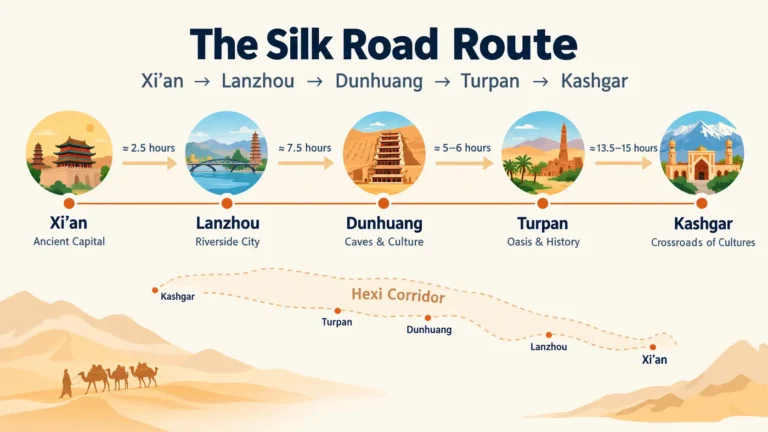
This route cuts across the northeastern edge of the Tibetan Plateau and follows the ancient Hexi Corridor. Salt lakes. Sand dunes. Rainbow-colored mountains. Buddhist caves carved into cliffs. Every day delivers a different postcard.
Be honest with yourself before choosing this 10 day China itinerary: the longest single drive is around 5 to 6 hours. Some sections sit above 3,200 meters. Temperatures can swing 20°C between noon and midnight—bring a down jacket even in July. If all of that sounds like part of the adventure, read on.
Days 1–2: Xining → Qinghai Lake → Chaka Salt Lake
Fly into Xining Caojiabao Airport (XNN). Renting a car with a driver is the norm in northwest China—public transit coverage is thin. A 5-seat sedan with driver runs 600–800 CNY (86–114 USD) per day, covering fuel and tolls. A 7-seat business van costs around 800–1,000 CNY (114–143 USD) per day.
Qinghai Lake is 2.5 hours from Xining. China’s largest inland saltwater lake, ringed by mountains on one side and golden rapeseed fields on the other (peak bloom: July). Skip the crowded Erlangjian scenic area and head to the quieter east shore. Some herders charge 10–20 CNY (1.50–3 USD) to cross their land to the water’s edge. Pay it. The lake view you get is borderline unreal.
Sleep in Heimahe, a tiny town on the west shore famous for sunrise. The next morning, the sun rises directly over the lake. The water and sky catch fire together. It’s worth the 5:30 AM alarm.
Chaka Salt Lake is 2.5 hours from Qinghai Lake. People call it the “Mirror of the Sky.” The water is ankle-deep. When it’s still, the surface reflects the sky so perfectly you can’t tell where one ends and the other begins. Rent waterproof boot covers at the entrance (essential—the salt will destroy your shoes). Wear a bright color. Red is the classic choice, but white and yellow work too. Entry plus boot covers: about 100 CNY (14 USD).
Drive 3 hours to Delingha for the night. It’s the capital of Haixi Prefecture—better hotels, real restaurants, a chance to restock supplies.
Days 3–4: Da Qaidam
Three hours from Delingha, Da Qaidam’s Emerald Lake is actually hundreds of small salt lakes scattered across the desert floor. Each one a different color—emerald green, Tiffany blue, milky white, deep turquoise—depending on mineral concentration. If you have a drone, this is where you fly it. Entry: about 50 CNY (7 USD).
Day four: Qarhan Salt Lake, China’s largest salt flat (56 times bigger than Chaka). The water is lime-green. The salt crust is 15 to 18 meters thick. A road runs across it—the “Ten-Thousand-Zhang Salt Bridge”—built entirely from salt. Fewer tourists come here. You won’t be waiting in line for photos. Sleep in Da Qaidam.
Days 5–6: Dunhuang
The drive from Da Qaidam to Dunhuang takes about 5 hours. The landscape shifts from high plateau to Gobi Desert. Sand and gravel stretch to the horizon. A camel caravan appears. Suddenly the words “Silk Road” feel very real.
On arrival, head straight to Mingsha Mountain and Crescent Moon Spring. Climb the dunes for sunset. A spring shaped like a crescent moon sits in a hollow between sand mountains, and it hasn’t dried up in over a thousand years. Camel rides and sandboarding are available. Entry: 120 CNY (17 USD). Keep your camera and phone sealed against the fine sand.
Day six is reserved for the Mogao Caves. Book online in advance. In peak season, tickets sell out a week ahead. The A-class ticket (8 caves + two films, 238 CNY / 34 USD) is the one you want. The visit starts with a dome-screen film at the digital center—genuinely excellent—then a shuttle bus to the caves. A guide leads each small group through. No photos inside. The murals have survived over a millennium. Let’s keep it that way.
Evening: Shazhou Night Market. Lamb skewers, donkey-meat noodles, and apricot drink (杏皮水), a local sour-sweet refresher that cuts through the desert heat.
Days 7–8: Zhangye
About 6 hours by car or 4.5 hours by high-speed train from Dunhuang. Zhangye’s Rainbow Danxia is a UNESCO Global Geopark. Layers of red, yellow, white, and grey-green rock ripple across the landscape like someone poured colored sand onto the earth and sculpted it into waves. Four viewing platforms connected by shuttle bus. Platform 4 at sunset is the payoff—the low sun turns the red layers crimson. If it rained the day before, the colors are even more vivid. Entry: 75 CNY (11 USD).
Day eight: choose between Ice Trench Danxia (bizarre rock formations, 20 minutes from Rainbow Danxia) or Pingshanhu Grand Canyon (called “China’s version of the Grand Canyon,” about 1 hour from downtown Zhangye). Don’t try to do both.
Days 9–10: Return via Qilian
Drive back toward Xining through the Qilian Mountains. Qilian Grassland in summer is impossibly green—sheep scattered like pearls across the slopes. Stop at Zhuo’er Mountain. From the summit, you see snow peaks, Danxia formations, grassland, and forest all in one frame. Locals call it “Little Switzerland.” The nickname undersells it.
Fly out from Xining on day ten. If you have a few hours before your flight, Dongguan Mosque and Mojia Street market in the city center are worth a quick visit—yak yogurt, cold lamb offal soup, and hand-pulled noodles make a fitting last meal.
Plan 4: Classic Four Cities — Shanghai → Beijing → Xi’an → Chengdu
Best for: first-time visitors who want the definitive China sampler. Chinese diaspora families on roots trips. Anyone who wants to check off the heavy hitters in one go. This is the most popular 10 day China itinerary for a reason—it covers China’s greatest hits without feeling rushed.
This route connects four cities that span China’s economic heart, political center, ancient capital, and food capital. Modernity collides with 3,000 years of history at every stop. High-speed trains make the whole thing flow. If you like this classic approach, you might also enjoy browsing our china itinerary page for variations on the four-city theme.
Days 1–2: Shanghai
Fly into PVG or SHA. Stay near the Bund or Nanjing Road. Evening one: walk the Bund. The colonial-era buildings glow gold. Across the river, the Oriental Pearl Tower and Shanghai Tower (China’s tallest at 632 meters) pierce the skyline. The contrast is the point.
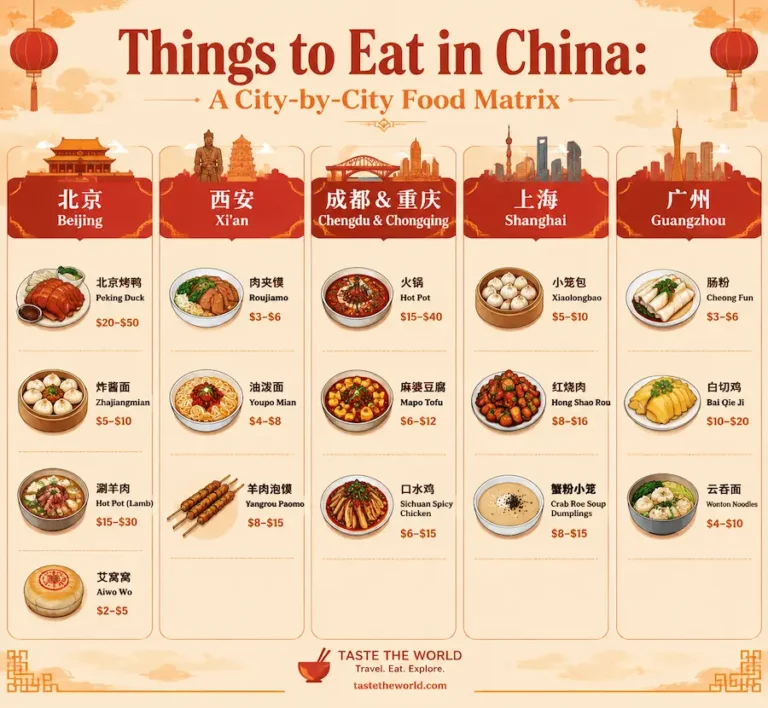
Dinner: shengjianbao (生煎包)—pan-fried pork buns with a crispy bottom and a scalding-hot soupy center. Locals swear by Dahuchun for the traditional version (thicker dough, less soup). A plate of four runs about 15–25 CNY (2–4 USD).
Day two: Yu Garden, then Tianzifang’s Shikumen lane houses turned creative quarter. Walk Nanjing Road from People’s Square to the Bund in the late afternoon. Dinner: Nanxiang xiaolongbao or Shanghai-style pork ribs with rice cakes (排骨年糕).
Days 3–5: Beijing
The Shanghai–Beijing high-speed train takes 4.5 hours. The Fuxing trains have wider seats and more legroom. Stay near Wangfujing or Qianmen.
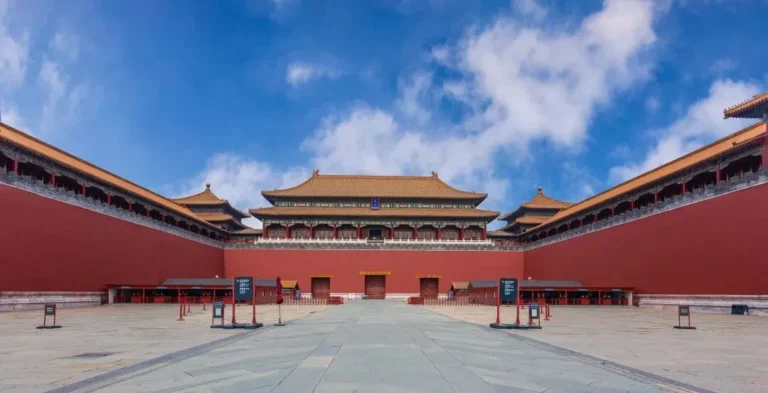
Tiananmen Square hits you with its sheer scale. Then the Forbidden City. Book online in advance (search “Palace Museum” on WeChat or their website). During peak season, reserve at least a week ahead. Walk the central axis—Meridian Gate in, Gate of Divine Prowess out. It takes 3 to 4 hours. Cross the street to Jingshan Park and climb to Wanchun Pavilion. The view of the Forbidden City’s sea of golden roofs is the defining image of Beijing. Entry: 60 CNY (9 USD) for the Forbidden City, 2 CNY (0.30 USD) for Jingshan.
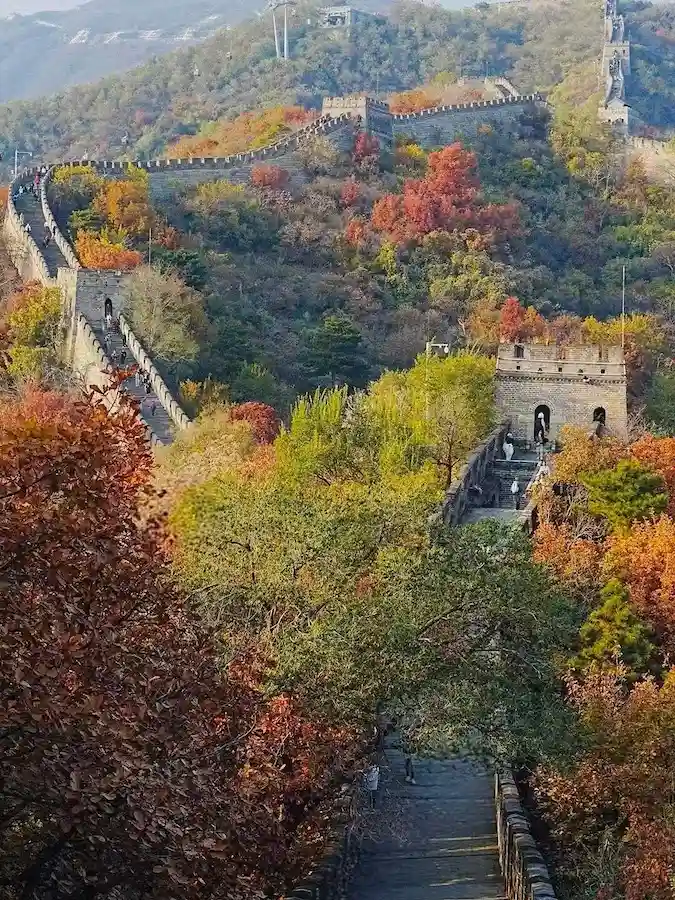
The Great Wall needs most of day four. Badaling is the easiest to reach (S2 train from Beijing North Station or bus 877 from Deshengmen). Mutianyu has fewer crowds, better greenery, and a toboggan slide down. Either way, budget 5 to 6 hours door to door. Evening: Nanluoguxiang hutong alleys for paper-cutting crafts and zhajiangmian (炸酱面)—noodles topped with soybean paste, shredded cucumber, and diced pork. A bowl costs 25–40 CNY (4–6 USD).
Day five: China Science and Technology Museum (interactive, great for kids) or 798 Art District (contemporary galleries, great for adults). Swing by the Bird’s Nest and Water Cube on the way. Evening high-speed train to Xi’an (4.5–5.5 hours). Check into a hotel near the Bell Tower.
Days 6–7: Xi’an
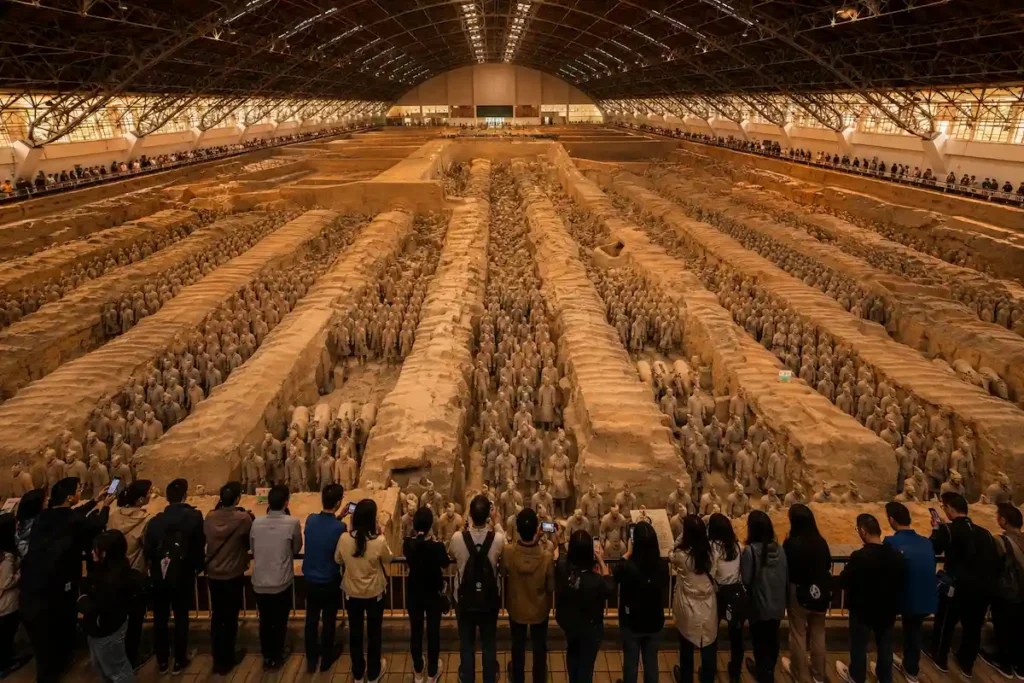
The Terracotta Warriors are worth every cliché. Take bus 306 from Xi’an Railway Station east square, about 1 hour. Pit 1 is the showstopper—thousands of life-sized soldiers standing in battle formation, each face carved differently. The scale is overwhelming in a way photos can’t capture. Entry: 120 CNY (17 USD).
Next door: Huaqing Palace, the Tang Dynasty hot spring retreat of Emperor Xuanzong and his consort Yang Guifei. If you stay into the evening, the Song of Everlasting Sorrow live performance uses the entire mountain as its backdrop. Tickets start around 300 CNY (43 USD).
Back in the city: the Muslim Quarter for dinner. Yangrou paomo (羊肉泡馍)—you tear a flatbread into tiny pieces, then the kitchen drowns it in lamb broth. Roujiamo (肉夹馍)—shredded braised pork stuffed into a crispy flatbread, often called China’s answer to the burger. Bring an appetite.
Day seven: Big Wild Goose Pagoda in the morning, then rent a bike and cycle the Xi’an City Wall. The wall is 14 kilometers around, the most complete ancient fortification in China. Riding the full loop takes 1.5 to 2 hours. Bike rental: about 45 CNY (6 USD).
Days 8–10: Chengdu
Xi’an to Chengdu by high-speed rail: 3.5 to 4 hours through the Qinling Mountains. The scenery out the window is spectacular. Stay near Chunxi Road or Taikoo Li.
Evening: Kuanzhai Alley (宽窄巷子)—three Qing Dynasty lanes turned into a polished cultural quarter. Tea houses serve jasmine tea in covered bowls. Sichuan opera performers change masks in a blink. Ear-cleaning masters ply their trade on bamboo chairs. A bowl of sweet water noodles (甜水面)—thick, chewy noodles in a sweet-spicy sauce—costs about 10–15 CNY (1.50–2 USD).
Day nine: Chengdu Panda Base. Arrive by 8:00 AM. Pandas eat, climb, roll around, and generally perform between 8 and 10 AM. After that, they sleep. The Moonlight and Sunshine nurseries have the youngest pandas. Entry: 58 CNY (8 USD).
Afternoon options: Sanxingdui Museum (1.5 hours from Chengdu) for the eerie, massive bronze masks of a mysterious ancient civilization. Or Wuhou Shrine and Jinli Ancient Street for Three Kingdoms history and street snacks. Sanxingdui entry: 72 CNY (10 USD).
Day ten: spend your final morning at People’s Park. Find Heming Tea House. Collapse into a bamboo chair. Order a cup of bamboo-leaf green tea (竹叶青). Watch retirees ballroom dance and calligraphy-write on the pavement with giant water brushes. This is what Chengdu means by “slow living.” Fly out from Tianfu Airport (TFU).
Only Have 7 Days? A China Itinerary 7 Days Quick Trim
Seven days means dropping one city and being ruthless about transit time. A shorter china itinerary 7 days works best when you stop trying to do everything. Here’s how to condense each plan:
- Yunnan: Kunming (2 days) → Dali (2 days) → Lijiang (3 days). Drop the Stone Forest detour.
- Jiangnan: Hangzhou (2 days) → Suzhou (2 days) → Shanghai (2 days). Skip Wuzhen—it hurts, but something has to give.
- Northwest: Qinghai Lake (1 day) → Chaka (1 day) → Dunhuang (2 days) → Zhangye (2 days) → Xining (1 day). Cut the Da Qaidam section and fly directly to Dunhuang from Xining.
- Classic Four Cities: Shanghai (2 days) → Beijing (3 days) → Xi’an (2 days). Save Chengdu for your next trip.
Picking just two cities and going deeper almost always beats rushing through three.
China Travel Tips for Any 10 Day China Tour
These china travel tips apply no matter which route you choose for your 10 day China tour. A little preparation goes a long way.
Visas
Australian and New Zealand passport holders currently qualify for 30-day visa-free entry. Most other nationalities need an L tourist visa applied in advance. Some cities offer 72-hour or 144-hour transit visa-free policies, but for a 10 day China itinerary, these rarely cover your full trip. Read our detailed china visa application walkthrough and apply early.
Paying for Things
WeChat Pay and Alipay dominate. Download Alipay’s international version before your trip and link a Visa or Mastercard—this now works for foreign cards. Still, carry some RMB cash. Small food stalls and rural scenic spots often only take QR code payments or cash. Large hotels and high-end restaurants in big cities accept foreign credit cards. ATMs are widespread; withdraw from Bank of China or ICBC for the best exchange rates.
Internet and VPNs
Google, Facebook, Instagram, WhatsApp, Gmail, and YouTube are blocked on mainland China’s networks. Install and test a VPN on your phone before departure—you won’t be able to download VPN apps once you’re inside the country. Alternatively, purchase an eSIM data plan (Airalo, Nomad, and Holafly all offer China-compatible options). Some eSIMs route data outside the firewall, which means you may not need a VPN at all. Hong Kong and Macau have unrestricted internet.
Getting Around: China High Speed Rail
China’s high-speed rail network is the best way to connect cities in any 10 day China itinerary. Trains are punctual, comfortable, and surprisingly spacious—even second class has decent legroom and power outlets. Book tickets through Trip.com (the international version of Ctrip) or the official 12306.cn. For long-distance jumps like Xi’an to Chengdu or Dunhuang to Zhangye, compare flights and trains—sometimes flying is cheaper and faster. For a full breakdown of options, check our china transportation guide, which also covers china high speed rail in detail.
Within cities, the metro is almost always your best option. Download each city’s metro app or use Alipay’s built-in transport QR code. DiDi (China’s Uber equivalent) works everywhere and accepts foreign cards through Alipay. Bike-sharing is ubiquitous—scan with Alipay to unlock.
For the Northwest route (Plan 3), hiring a private car with driver is standard. A 5-seat sedan runs 600–800 CNY (86–114 USD) per day including fuel and tolls.
Where to Stay
- Kunming: Wuhua or Panlong district
- Dali: Inside the ancient town or along Erhai Lake
- Lijiang: Old Town or Shuhe Ancient Town
- Hangzhou: Hubin Road or Nanshan Road (walking distance to West Lake)
- Wuzhen: Inside or just outside Xizha Scenic Zone
- Suzhou: Near Pingjiang Road or Guanqian Street
- Shanghai: Near the Bund or Nanjing Road
- Xining: City center near Dongguan Mosque
- Dunhuang: Near Shazhou Night Market
- Zhangye: City center near Drum Tower
- Beijing: Wangfujing or Qianmen
- Xi’an: Near the Bell Tower
- Chengdu: Chunxi Road or Taikoo Li
Choosing the Best Time to Visit China for Your Itinerary
Spring (March–May) and autumn (September–November) deliver the most comfortable weather across most of the country. Temperatures are mild, rainfall is low, and tourist crowds haven’t peaked. If you’re planning a 10 day China itinerary and have flexibility, aim for these windows. We’ve written a dedicated best time to visit china guide that breaks things down month by month.
Summer (June–August) is hot and crowded—but it’s also the best season for the Northwest route, when Qinghai Lake’s rapeseed fields bloom and the Qilian grasslands are at their greenest. Yunnan works well in summer too, thanks to its high-altitude cool. Winter (December–February) brings cold temperatures up north but far fewer crowds. If you want snow-dusted Great Wall photos, winter delivers.
One hard rule: avoid Golden Week (October 1–7). It’s China’s biggest national holiday. Scenic spots turn into human traffic jams. Hotel prices double or triple. High-speed train tickets sell out in seconds. Just don’t.
Language
English is spoken in major hotels and tourist-facing businesses in big cities. Outside those bubbles, don’t count on it. Download a translation app with offline capabilities—Baidu Translate and Youdao Translate both support photo translation for menus and signs. Three phrases go a long way:
- Nǐ hǎo (你好) — Hello
- Xiè xiè (谢谢) — Thank you
- Duō shǎo qián? (多少钱?) — How much does it cost?
Altitude Awareness
Plans 1 and 3 both involve elevation above 3,000 meters. Altitude sickness can hit anyone regardless of age or fitness level. Symptoms include headache, fatigue, and trouble sleeping. Most people adjust within a day or two. First-day rules: no strenuous exercise, no alcohol, drink plenty of water. In Lijiang and at Qinghai Lake, portable oxygen canisters are sold at convenience stores for 15–20 CNY (2–3 USD). Keep one in your daypack.
You’ve got the plan. You’ve got the tips. The only thing left is to pick a route and book the flight. China isn’t the easiest place to travel, but the payoff—standing on the Great Wall, staring down at a terracotta army, watching mist roll across a water town canal, biting into a soup dumpling that’s been perfected over centuries—is bigger than the effort it takes to get there.
Go. China’s been waiting.
Ke Ping — Founder, InsiderChinaTravel
I personally reply to every email and create free, custom trip frameworks. Already have a plan? I can arrange vetted local guides and private drivers. Over 5,000 travelers from 30+ countries have started their journey this way.
📋 Tell me about your trip ideaReplied within 24 hours. No charge, no obligation.