Best China SIM Card for Tourists — Prepaid, eSIM & Where to Buy (2026)
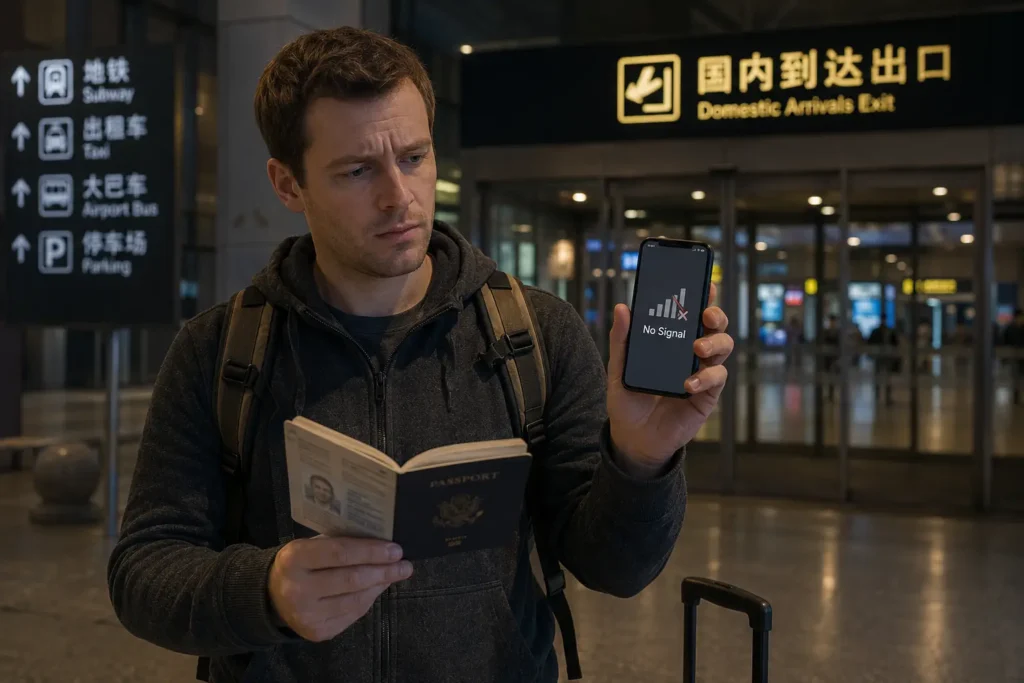
Landing at Chengdu Tianfu Airport at 1 a.m. without a China SIM card. One suitcase. Dead phone. No signal.
You walk toward the arrival hall, open your phone, and try to connect to airport Wi-Fi. The login page asks for a Chinese phone number to send a verification code. You don’t have one. No code, no Wi-Fi. Google Maps won’t load. Uber doesn’t exist here.
You spot a service counter and ask for an eSIM. The clerk shakes her head. “No eSIM here. Physical card only. Passport, please.” One hour later — passport scanned, face verified, forms signed — the SIM finally works. You breathe. Then WeChat pops up: “Login abnormal. Account temporarily locked.”
Why? Because you switched between your foreign data SIM and the new local SIM too many times. The system flagged you as suspicious. It’s 2 a.m. No internet. No WeChat. No Alipay. No way to pay for anything.
This is not an edge case. A foreign resident in Shenzhen described it on Reddit as a “digital desert” — you download Alipay and WeChat thinking you’re covered, then both apps demand SMS verification to a Chinese number you don’t have. Even scanning a QR code at a restaurant to order food? A local phone number is required. Finding the right China SIM card before you land isn’t extra credit — it’s the difference between a smooth trip and getting locked out of every app you need.
The truth: getting a China SIM card — the right one, from the right place — is the single most important pre-trip decision you’ll make. Let’s walk through every option, every price point, and every pitfall.
- Physical SIM vs eSIM: What Actually Works for China Travel
- China Prepaid SIM Card Plans: Real Prices for 2026
- Where to Buy a SIM Card in China — Airport, Store, or Online
- 5 Things Nobody Warns You About
- You've Got Your SIM Card — Now What?
- Quick Questions, Quick Answers
- Your 5-Minute China SIM Card Checklist
Physical SIM vs eSIM: What Actually Works for China Travel
Three paths to getting a China SIM card that works. Each has trade-offs that matter more than you’d think.
Option 1: China Prepaid SIM Card (Physical, With a Local Number)
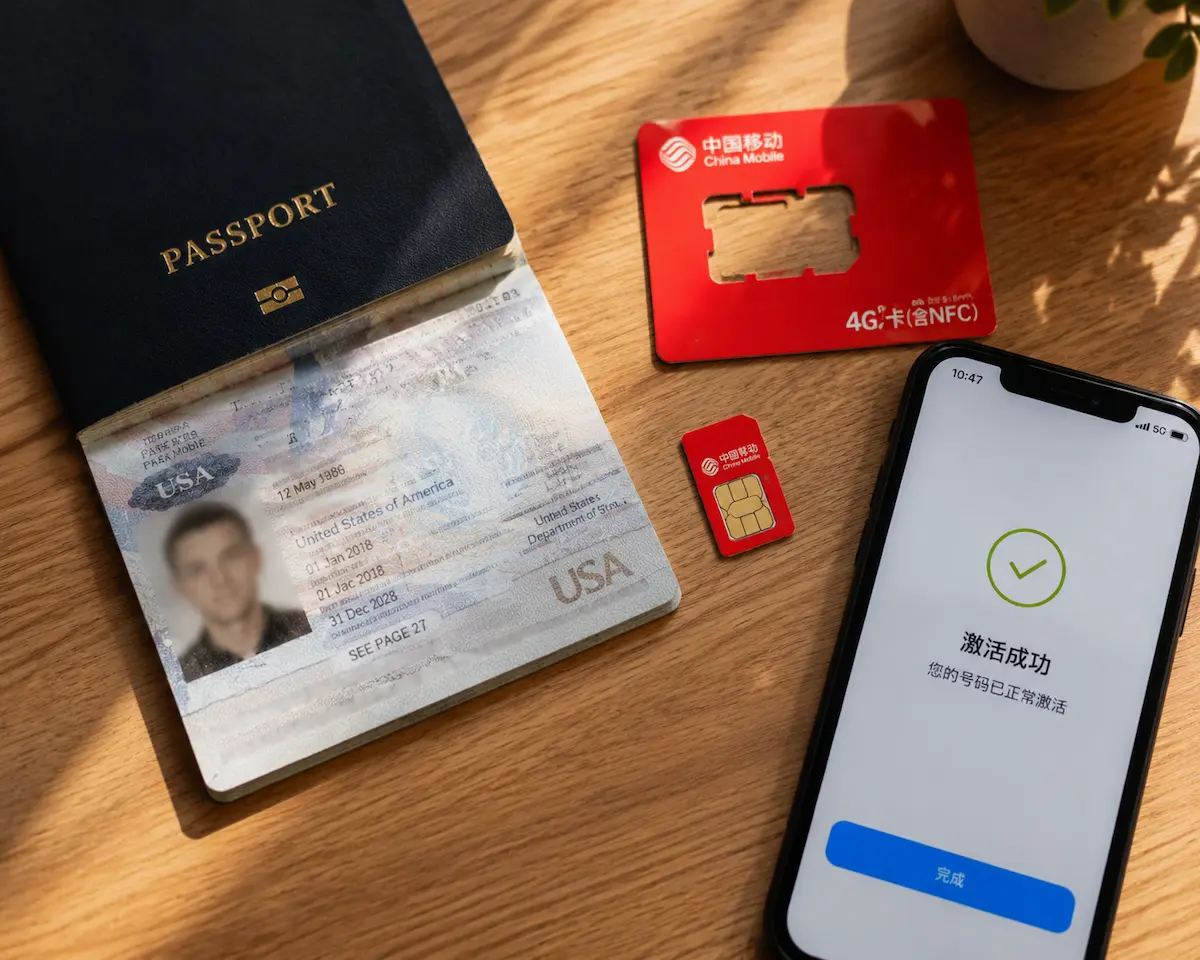
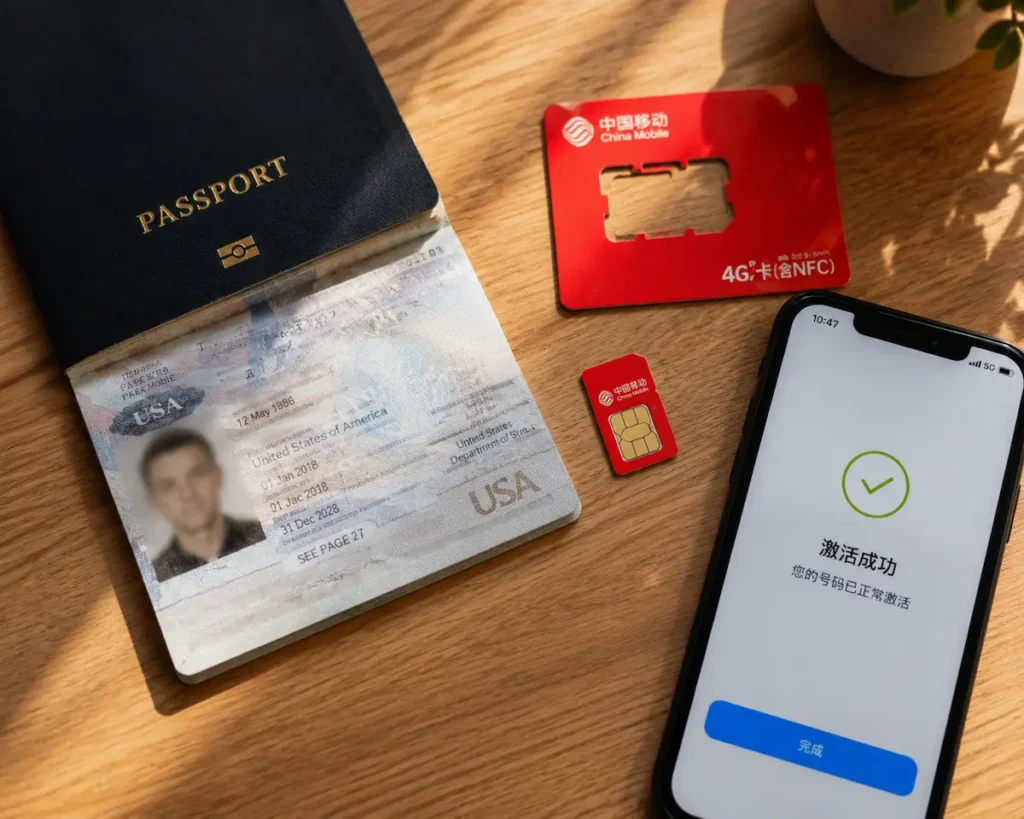
You walk into a carrier store. Hand over your passport. Do a face scan. Walk out with a real Chinese phone number. A china prepaid sim card for tourist is still the most complete solution for anyone staying longer than a few days.
China Mobile short-term tourist plans (widest coverage, best for rural areas and mountain regions):
- 7 days / 30GB + 100 minutes: 90 CNY (≈12.86 USD)
- 15 days / 50GB + 200 minutes: 150 CNY (≈21.43 USD)
- 30 days / 80GB + 300 minutes: 250 CNY (≈35.71 USD)
China Unicom / China Telecom short-stay cards hover around 100–150 CNY/month (≈14–21 USD) with 30–40GB data and 100 local minutes. Unicom scores higher on iPhone compatibility; Telecom offers flexible 7-to-30-day tourist windows. For a china mobile prepaid sim card specifically, China Mobile remains the go-to if your itinerary includes rural stops or remote areas where only their towers reach.
The upside: A real Chinese phone number. Ride-hailing, food delivery, Wi-Fi logins, SMS codes — all unlocked.
The downside: You’re behind the Great Firewall. Google, WhatsApp, Instagram, Gmail — all blocked. Bring your own VPN.
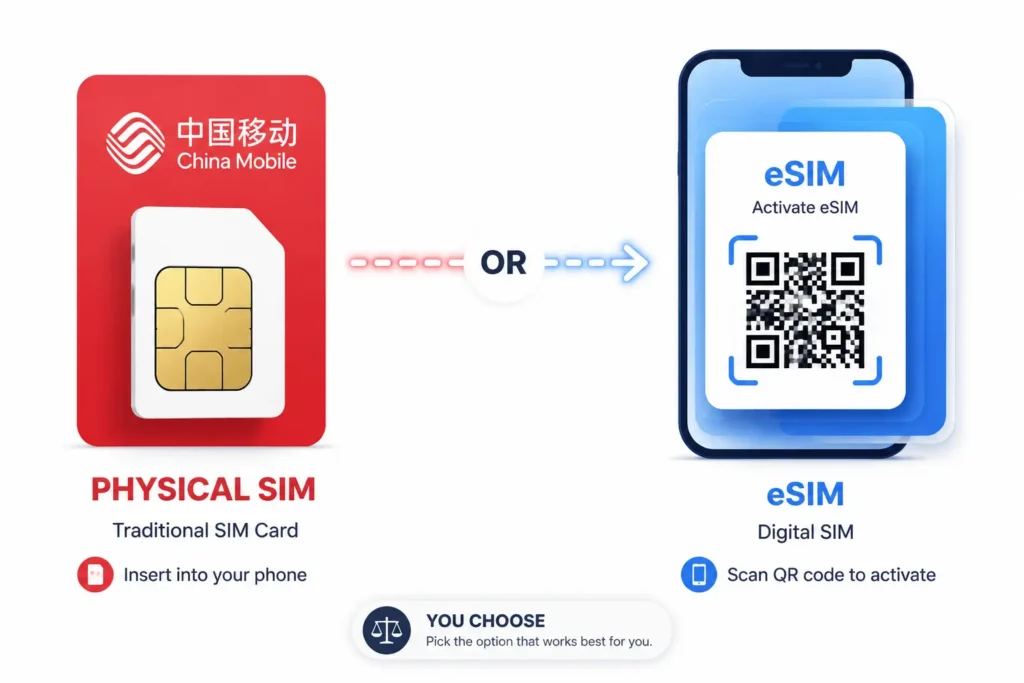
Option 2: eSIM for China Travel (No Local Number, No Firewall)
Buy before you fly. Activate on arrival. Zero paperwork. An e sim card for china travel works through roaming signals — meaning it bypasses the Great Firewall natively. Google and WhatsApp work straight out of the box. No VPN needed.
Popular eSIM providers for China:
- Airalo (Chinacom): 7 days/3GB ~10 USD; 30 days/20GB ~40 USD
- Holafly: 5 days “unlimited” ~19 USD; 15 days “unlimited” ~49 USD (no hotspot on most plans)
- Nomad: 7 days/1GB ~4 USD; 30 days/10GB ~12 USD; 30 days/20GB ~20 USD — best value for light users who treat this China SIM card as a backup data line
- Trip.com: 1 day/0.5GB for just 2 CNY (≈0.29 USD) — perfect if you need a bare-minimum sim card for China during a short transit layover
The upside: Install, activate, go. No passport checks. No Chinese phone number drama. Native access to Western apps.
The downside: No Chinese phone number. No SMS verification. Most local apps will lock you out at registration. If your travel style depends on ride-hailing, food delivery, or any app that demands a china phone number sim card, eSIM alone won’t cut it.
Option 3: International Roaming
Use your home carrier’s roaming plan. It’s expensive and often throttled. Think of it as a bridge — it keeps you online long enough to get to a store and buy a proper china data sim card or a travel eSIM. It is not a replacement for a real China SIM card, just a temporary patch.
How to Choose in 30 Seconds
- Staying 7+ days, need DiDi and food delivery? → A physical prepaid sim card china tourist (you need a real Chinese phone number)
- 3–7 days, mostly using Google apps? → An eSIM for China travel (no firewall, no hassle)
- Just a few hours in transit? → Trip.com 1-day eSIM (≈0.29 USD) — the lightest China SIM card solution that exists
China Prepaid SIM Card Plans: Real Prices for 2026
Here’s what you’ll actually pay for a china tourist sim card this year, across all three carriers and the major eSIM providers. Prices include taxes. No hidden activation fees. If you’ve been comparing china sim cards across different sites and getting inconsistent numbers, this table reflects what travelers on the ground are paying right now.
| Type | Duration | Data | Calls | Price (CNY) | Price (USD) | Local Number? |
|---|---|---|---|---|---|---|
| China Mobile (physical) | 7 days | 30GB | 100 min | 90 | ≈12.86 | ✅ |
| China Mobile (physical) | 15 days | 50GB | 200 min | 150 | ≈21.43 | ✅ |
| China Mobile (physical) | 30 days | 80GB | 300 min | 250 | ≈35.71 | ✅ |
| China Unicom (physical) | 15 days | 40GB | 100 min | 140 | ≈20.00 | ✅ |
| Airalo (eSIM) | 7 days | 3GB | — | — | ≈10 | ❌ |
| Nomad (eSIM) | 30 days | 20GB | — | — | ≈20 | ❌ |
| Trip.com (eSIM) | 1 day | 0.5GB | — | 2 | ≈0.29 | ❌ |
A quick note on China Unicom: they offer an official international social media add-on — 7 days for 30 CNY (≈4.29 USD) — that lets you use WhatsApp and Instagram legally, without a VPN. Worth considering if you’re on Unicom and want to stay compliant.
Where to Buy a SIM Card in China — Airport, Store, or Online
Three ways to get your hands on a sim card in china. They differ massively in convenience, price, and the amount of patience you’ll need. Before you go, check our China travel tips for more pre-trip advice that pairs well with your SIM card plan.
Airport Counters: Fastest, Priciest
Walk off the plane. Find the counter. Hand over your passport. Done.
Beijing Capital (PEK): Terminal 3 arrival hall — 24 hours. Terminal 2 — 9:00 to 18:00. Third-party counters (24h) usually have fluent English-speaking staff. Official carrier counters have translation devices on hand.
Shanghai Pudong (PVG): Terminal 2 — 24 hours. Terminal 1 — 6:00 to 24:00. Generally the best English support of any airport in mainland China. If you’re landing here, picking up a China SIM card is about as frictionless as it gets.
Guangzhou Baiyun (CAN): Terminal 1 third-party counters — 24 hours. Official partner counters — 7:00 to 22:00.
Airport counters push limited, higher-priced plans. You’re paying for convenience, not variety.
City Flagship Stores: Cheapest, Slowest
Not every store works. Neighborhood kiosks and small franchise outlets cannot process foreign passport registration. You need a main carrier hall — the kind you’ll find on major commercial streets or in city centers.
Typical time at the counter: 30 to 60 minutes. Passport photo, face scan, paper contracts, digital contracts, service password setup. Go on a weekday morning. Lunch hours and weekends get crowded.
Search Amap (高德地图) for the nearest “China Mobile / China Unicom / China Telecom 营业厅.” Or call their English hotlines: China Mobile 10086, China Unicom 10010, China Telecom 10000.
Pre-Order Online + Airport Pickup: Smartest
Klook and Trip.com let you reserve a physical sim card for china before you fly. You pick a plan with a local number and data. Land. Walk to the designated pickup desk. Show your voucher and passport. They hand you the activated China SIM card. No fumbling with translation apps at the counter.
A handful of expat-focused services (like SIMCardChina) even ship the SIM to your hotel ahead of your arrival. You’ll need to upload your passport page online beforehand for compliance checks.
5 Things Nobody Warns You About
1. “Unlimited Data” Is Usually a Lie
Nearly every china travel sim card or eSIM plan labeled “unlimited” comes with a Fair Usage Policy. Your daily high-speed allowance is typically 1GB, 2GB, or 3GB. Exceed that, and your speed drops — fast.
To what? 1 Mbps — or worse, 256 Kbps.
At 1 Mbps: sending WeChat text messages works (barely). Loading an Alipay payment code works (slowly). But Amap’s detailed street maps? They won’t load. Meituan menus freeze. DiDi’s location refresh lags hard. Videos are out of the question.
For a foreign traveler navigating entirely by phone — maps, translation, ride-hailing — getting throttled means you’re effectively offline, and your China SIM card becomes about as useful as a paperweight. Buy a fixed-data plan (20GB/30GB). Skip the “unlimited” trap.
2. Not Every Store Takes Your Passport
Small franchise stores = wasted trip. Go straight to a flagship hall or an official airport counter. Call ahead to confirm they process foreign passports before you haul yourself across town for a China SIM card.
3. eSIM + Physical SIM: The Combo That Backfires
The dream setup: one physical China SIM card for a local number, one travel eSIM for unfiltered internet. The reality: WeChat’s security system watches for frequent SIM switching. Switch too often and you get locked out — like that traveler on Reddit, stranded in Chengdu at 2 a.m. with no WeChat access.
4. Your Power Bank Might Not Survive Security
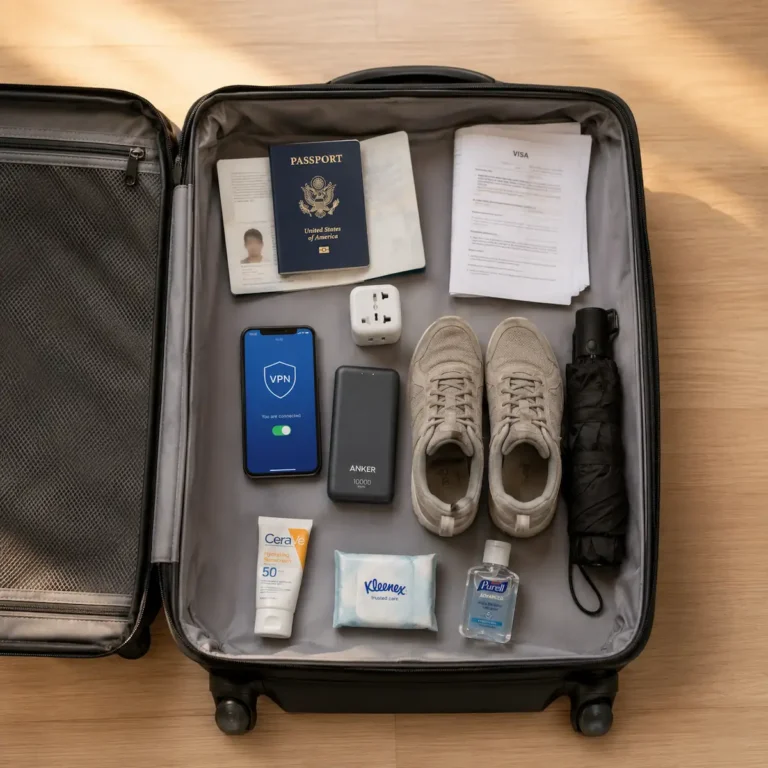
Chinese airport and train station security confiscate power banks that lack the 3C certification mark. No exceptions. Even 3C-certified power banks get seized if they exceed capacity limits. Check yours before you pack — a dead phone makes any China SIM card useless.
5. Carrier eSIM Is Coming — But Not Ready for Tourists Yet
In October 2025, China’s three major carriers received government approval for consumer eSIM services. China Unicom leads with coverage across 25 provinces. China Telecom is live in all 31 provincial regions. China Mobile is rolling out nationwide.
But here’s the catch: this eSIM push is built for long-term residents, not short-term visitors. Tourist-friendly carrier eSIM plans need more time. For now, a physical sim card for china purchase at a carrier store remains the only way to get a real Chinese phone number without a long-term residency setup.
You’ve Got Your SIM Card — Now What?
You have a signal. You have a Chinese phone number. Here’s what to do in the next 10 minutes — ranked by urgency.
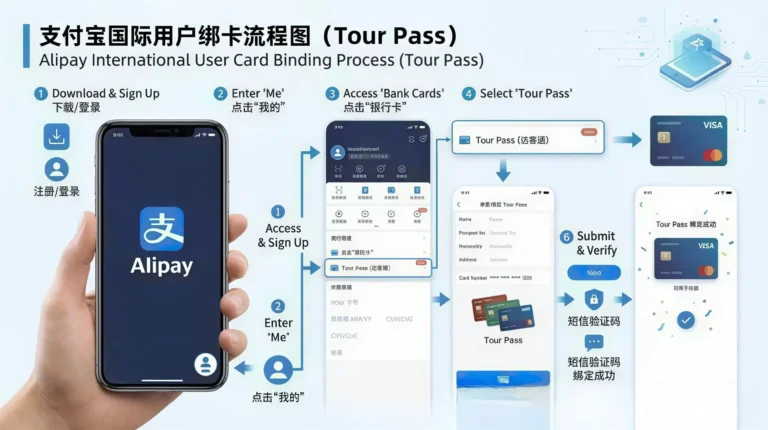
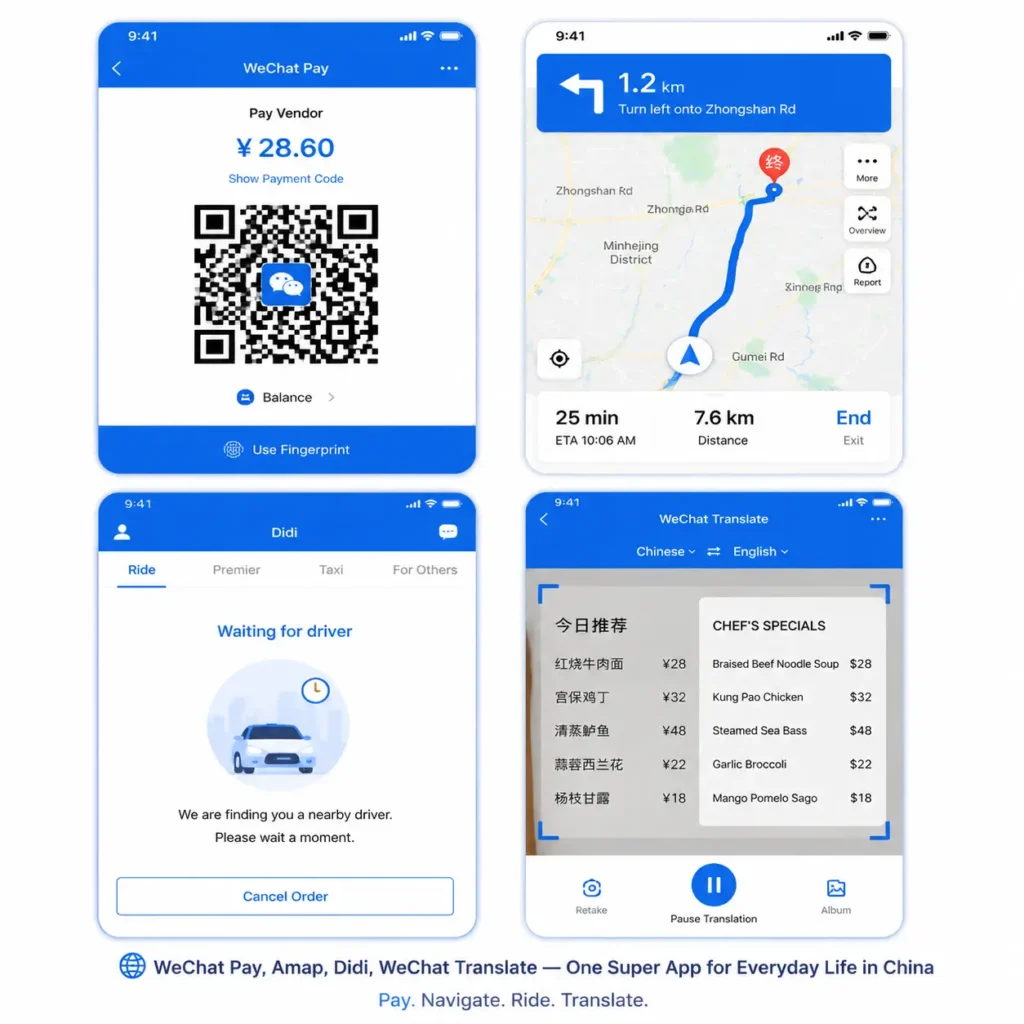
First: Link your number to Alipay and WeChat Pay. Open each app. Go to Settings. Bind the new number. Link an international card (Visa, Mastercard, JCB, Discover all work). For a full walkthrough, read our Alipay for foreigners guide — it covers every setup step in detail. Heads up — transactions under 200 CNY (≈28.57 USD) carry no service fee. Above that, a 3% fee applies. Annual cap: 50,000 USD.
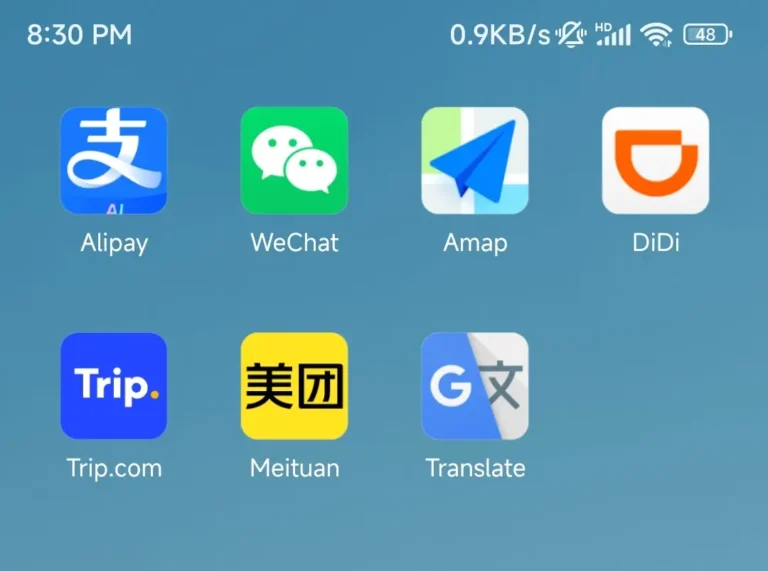
Second: Download Amap (高德地图). Google Maps drifts in China — GPS offset is an actual thing here. Amap is accurate. The interface is Chinese-only, but the map visuals are self-explanatory enough to navigate by.
Third: Activate DiDi. Open WeChat or Alipay. Find the “DiDi” mini-program. It works immediately with your new number. Taxis and private cars cost a fraction of what you’d pay in Europe or the US. Once you’re comfortable getting around, explore our China transportation guide for high-speed rail, metro tips, and long-distance travel hacks that pair perfectly with your new mobile connection.
Fourth: Set up WeChat’s built-in translator. WeChat → Me → Settings → General → Translation → pick your language → enable auto-translate. This doesn’t just translate chats. Point your camera at a menu. It translates that too. In an all-Chinese restaurant with no pictures, this is your lifeline — all thanks to the China SIM card now sitting in your phone.
Quick Questions, Quick Answers
“Can I buy a SIM card at the airport at midnight?”
Beijing PEK T3 and Shanghai PVG T2 have 24-hour counters where you can grab a China SIM card any time. Other airports — check before you land.
“Does a China SIM card work in Hong Kong or Taiwan?”
No. Hong Kong, Macau, and Taiwan are outside mainland China’s network coverage. Your domestic data plan won’t apply there. Buy a separate SIM or activate roaming.
“I lost my SIM card. What now?”
Call your carrier immediately to suspend the number (China Mobile: 10086 / Unicom: 10010 / Telecom: 10000). Bring your passport to a flagship store for a replacement China SIM card.
“Can I keep my Chinese number after leaving?”
Short-term tourist SIMs auto-expire. If you plan to return, ask about long-term plans with minimal monthly fees before you leave.
“I have a US iPhone 14/15/16 with no SIM tray.”
eSIM is your only option if you need a China SIM card but can’t insert a physical one. Go with Airalo, Holafly, Nomad, or the Trip.com transit plan. Carrier-issued eSIM for tourists isn’t ready yet. For now, you won’t have a Chinese phone number.
Your 5-Minute China SIM Card Checklist
Screenshot this. Before you do anything else, browse our China travel tips for the full picture on what to prep beyond connectivity.
- ☐ Before you fly: Confirm your phone is unlocked. Check your power bank for the 3C mark. No 3C = it gets confiscated.
- ☐ Decide: 7+ days + need rides/food = physical China SIM card. 3–7 days + Google user = eSIM.
- ☐ On arrival: Airport counter (if pre-booked) or head to a flagship city store. Skip neighborhood shops — they can’t register foreign passports.
- ☐ At the store: Passport → pick a number → choose a plan → face scan → sign → pay (cash, Alipay, WeChat, Visa, and Mastercard all accepted).
- ☐ After activation: Link to Alipay & WeChat → download Amap → open DiDi → set up WeChat translate.
- ☐ Every day: Watch your remaining high-speed data. Getting throttled to 1 Mbps mid-trip turns your China SIM card into dead weight.
One tiny plastic card. Get it right, and it’s the most useful tool in your pocket for navigating China — maps, payments, rides, translation, all flowing through one connection. Get it wrong, and it’s the first domino that knocks over every app you were counting on.
How long has it been since you tried going an hour without internet in a country where you don’t speak the language?

Ke Ping — Founder, InsiderChinaTravel
I personally reply to every email and create free, custom trip frameworks. Already have a plan? I can arrange vetted local guides and private drivers. Over 5,000 travelers from 30+ countries have started their journey this way.
📋 Tell me about your trip ideaReplied within 24 hours. No charge, no obligation.