China High Speed Rail Map & Network: Where Trains Can Take You
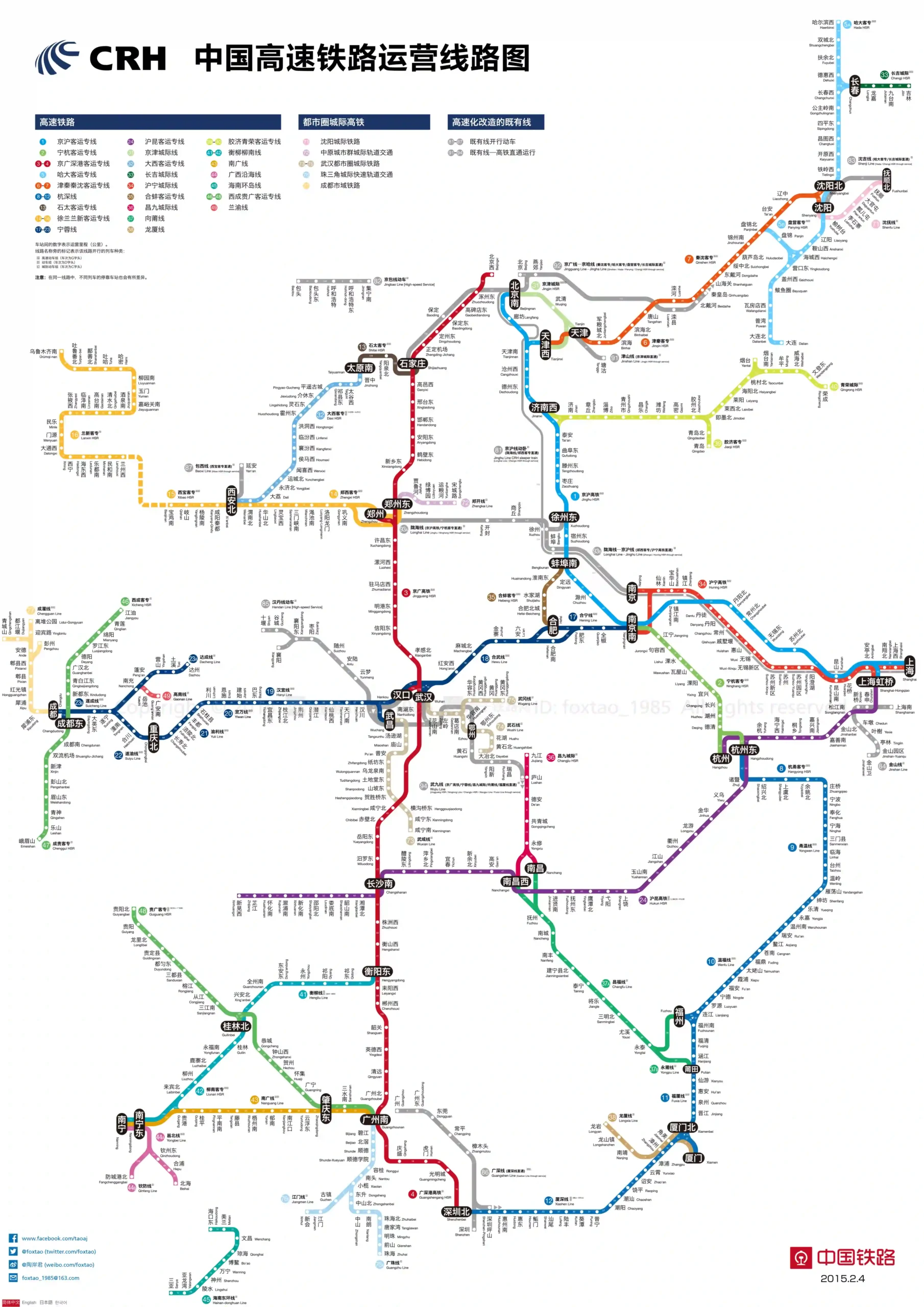
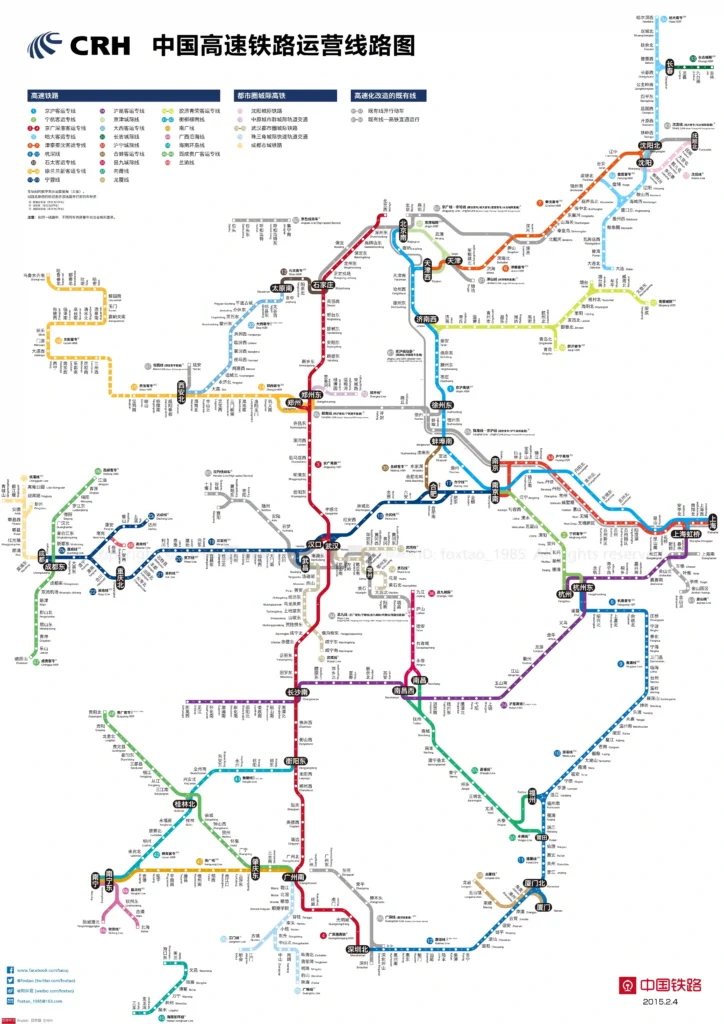
If you’ve never taken a high-speed train in China, you’re about to experience something remarkable. China runs the largest high-speed rail system on the planet. By the end of 2024, the network had surpassed 55,000 kilometers in total length — that’s two-thirds of all high-speed rail track on Earth. To put that in perspective: 97% of Chinese cities with over half a million residents are now connected by rail. If you pull up a china high speed rail map, what you’ll see is a dense web of lines reaching nearly every corner of the country.
This guide is built around the china high speed rail map 2026 landscape. If you’re planning your first trip — or your fifth — keep a china high speed rail map nearby as you read. You’ll get a clear picture of where the trains go, how the network is laid out, how to buy tickets without stress, which seat class to pick, and a handful of routes that are genuinely worth building an itinerary around. Before diving into the details, you might also want to bookmark our china travel guide for broader trip-planning advice.
- How Big Is China's High Speed Rail Network?
- Understanding the China High Speed Rail Network: The "8+8" Grid
- What's Changed on the 2026 Map?
- The Coastal Corridor: 4,000 Kilometers of Coastline
- Beijing as Your Launchpad: 1–5 Hour Travel Circles
- How to Buy Tickets as a Foreign Traveler
- Which Seat Class Should You Pick?
- From Station Entrance to Your Seat: A Step-by-Step Walkthrough
- 5 Routes Worth Planning a Trip Around
- Things Worth Knowing Before You Go
- Quick Answers to Common Questions
How Big Is China’s High Speed Rail Network?
A few numbers put the scale into perspective. Scroll through any high speed rail map china travelers share online, and the sheer density can feel overwhelming at first glance. Here’s what the data actually means on the ground:
- Total operational track: over 55,000 km (2024), roughly two-thirds of global high-speed rail
- Top commercial speed: 350 km/h (217 mph) on core lines like Beijing–Shanghai and Beijing–Tianjin
- Annual passenger trips: more than 2 billion (pre-pandemic peak, recovering strongly)
- Cities served: 97% of urban areas with populations above 500,000
- Next-gen train (CR450): test speeds have reached 450 km/h
- 2035 target: 70,000 km of track, covering every city above 500,000 people
What does this mean for your trip? Adjacent major cities sit within a 1-to-4-hour travel circle. Inside urban clusters, commutes shrink to 0.5 to 2 hours. A morning meeting in Shanghai and an afternoon stroll by West Lake in Hangzhou isn’t ambitious. It’s just Tuesday. China’s high speed rail network has quietly erased distances that used to eat up entire days.
The backbone of all this is a master plan called “8 Vertical, 8 Horizontal” (八纵八横). Think of it as a grid of 8 north–south corridors and 8 east–west corridors. The government first mapped it out in 2016, building on an earlier “4 Vertical, 4 Horizontal” framework. By 2026, roughly 84% of the planned 45,000 km network is operational. Full completion is expected between 2026 and 2030. For a deep dive into how these trains actually work day-to-day, check our china high speed rail transportation guide.
Understanding the China High Speed Rail Network: The “8+8” Grid
You don’t need to memorize 16 corridors. For trip planning, four of them will cover the vast majority of destinations you’re likely to visit. Pick up any china high speed rail map and trace these four first — everything else is detail you can fill in later.
The 8 Vertical Corridors (North–South)
| Corridor | Key Route | Status |
|---|---|---|
| Coastal | Dalian/Dandong → Tianjin → Shanghai → Xiamen → Shenzhen → Beihai | Mostly open; remaining gaps closing by 2028 |
| Beijing–Shanghai | Beijing → Tianjin → Jinan → Nanjing → Shanghai | ✅ Fully operational (second line under construction) |
| Beijing–Hong Kong (Taiwan) | Beijing → Hefei → Nanchang → Shenzhen → Hong Kong | Main corridor open; cross-strait section long-term |
| Beijing–Harbin & Beijing–Hong Kong/Macau | Harbin → Beijing → Zhengzhou → Wuhan → Guangzhou → Hong Kong | ✅ Fully operational |
| Hohhot–Nanning | Hohhot → Taiyuan → Luoyang → Changde → Nanning | Partially open |
| Beijing–Kunming | Beijing → Xi’an → Chengdu (Chongqing) → Kunming | Partially open; Chongqing–Kunming section under construction |
| Baotou–Haikou | Baotou → Xi’an → Chongqing → Guiyang → Nanning → Haikou | Partially open; cross-sea section planned |
| Lanzhou (Xining)–Guangzhou | Lanzhou → Chengdu → Guiyang → Guangzhou | Partially open |
The 8 Horizontal Corridors (East–West)
| Corridor | Key Route | Status |
|---|---|---|
| Suifenhe–Manzhouli | Suifenhe → Harbin → Manzhouli | Partially open |
| Beijing–Lanzhou | Beijing → Hohhot → Yinchuan → Lanzhou | Partially open |
| Qingdao–Yinchuan | Qingdao → Jinan → Shijiazhuang → Taiyuan → Yinchuan | Partially open |
| Eurasian Land Bridge | Lianyungang → Zhengzhou → Xi’an → Lanzhou → Ürümqi | ✅ Fully operational (~3,400 km) |
| Yangtze River | Shanghai → Nanjing → Wuhan → Chongqing → Chengdu (350 km/h design) | Partially open |
| Shanghai–Kunming | Shanghai → Hangzhou → Changsha → Guiyang → Kunming | ✅ Fully operational |
| Xiamen–Chongqing | Xiamen → Changsha → Zhangjiajie → Chongqing | Partially open |
| Guangzhou–Kunming | Guangzhou → Nanning → Kunming | ✅ Fully operational |
For travelers: the corridors in bold are the ones that will show up again and again in your planning. Beijing–Shanghai, Coastal, Beijing–Guangzhou (part of the Beijing–Harbin & Beijing–Hong Kong/Macau corridor), and Shanghai–Kunming form a rough quadrilateral. Lay them over a china high speed rail map and you’ll see they cover Beijing, Shanghai, Guangzhou, Shenzhen, Hong Kong, Kunming, Hangzhou, and most of the east coast. That’s easily 80% of a first-time visitor’s itinerary. If you’re still shaping your route, our china itinerary planning page can help you stitch cities together.
What’s Changed on the 2026 Map?
The china high speed rail map keeps evolving. Here are the lines that have recently opened or are about to make a difference for travelers. Mark these on your mental china high speed rail map 2026 — they unlock parts of the country that were previously harder to reach.
Recently Opened
- Guangzhou–Zhanjiang HSR (opened late 2025, 350 km/h): Cuts the trip to about 1.5 hours. A crucial link on the southern Coastal Corridor.
- Shantou–Shanwei HSR (late 2025): Connects two eastern Guangdong cities, filling a gap on the coastal route.
- Xi’an–Yan’an HSR (2025): Xi’an to the revolutionary city of Yan’an in about 1 hour.
- Hangzhou–Wenzhou HSR (2023): A new north–south artery through Zhejiang province.
- Nanning–Pingxiang HSR (2024): Runs from Guangxi’s capital to the Vietnam border.
Under Construction (Key Projects)
- Shenzhen–Jiangmen Railway: Includes a record-breaking underwater tunnel in the Pearl River Delta (116 meters below the surface at its deepest). Once open (~2028), Shenzhen to Zhanjiang drops to about 3 hours.
- Hepu–Zhanjiang HSR: The last piece connecting Guangxi and Guangdong on the Coastal Corridor. Expected around 2028.
- Wenzhou–Fuzhou HSR: A new 350 km/h line (construction started 2025) to relieve the busiest stretch of the southeast coast.
- Zhanjiang–Haikou HSR: Approved and in planning. Trains will cross the Qiongzhou Strait via ferry — high-speed rail “crossing the sea” to Hainan Island.
Hong Kong’s West Kowloon Station has been fully reintegrated into the network since 2023. Direct trains now connect Hong Kong to Beijing, Shanghai, Guangzhou, Shenzhen, Xiamen, Changsha, Kunming, and dozens of other cities. Find Hong Kong on any current china high speed rail map and you’ll see it’s no longer a standalone dot — it’s woven into the grid.
The Coastal Corridor: 4,000 Kilometers of Coastline
Among all the corridors, the Coastal one deserves a closer look. It stretches roughly 4,000 kilometers from Dandong on the North Korean border all the way to Fangchenggang near Vietnam. Three climate zones. Over 20 cities. One continuous train journey — if you piece it together right. Trace it with your finger on a china high speed rail map and you’ll cover more geographic diversity than most cross-continental routes anywhere in the world.
The Coastal Corridor isn’t a single named line. It’s a patchwork of individually built segments stitched into one route: Qingdao–Yancheng, Yancheng–Nantong, Shanghai–Suzhou–Nantong, Fuzhou–Xiamen, Guangzhou–Zhanjiang, and others.
What this means for your trip: you don’t buy a single “Coastal Corridor ticket.” You buy segments. Use the connecting ticket (联程票) feature on the 12306 app, or book segments manually. Here’s how the journey breaks down by region — timing your visit right matters, so if you’re weighing when to go, our best time to visit china guide breaks it down by season and region:
| Section | Range | Best Season | Vibe |
|---|---|---|---|
| North | Dandong–Qingdao | Summer (escape the heat) or autumn (seafood season) | Historic port cities, northeastern character |
| Central | Shanghai–Xiamen | Spring (flowers) or autumn (mild weather) | Water towns, tea hills, Minnan culture |
| South | Shenzhen–Beihai | Winter (warm escape) or spring (sea breezes) | Greater Bay Area energy, laid-back Guangxi coast |
Beijing as Your Launchpad: 1–5 Hour Travel Circles
Beijing is the natural starting point for many visitors. A quick glance at a china high speed rail map centered on the capital shows just how much ground you can cover in a single day. Here’s where you can reach — and how fast.
Within 1 Hour
- Tianjin (35 minutes): Ancient Culture Street, colonial architecture, legendary street food
- Baoding (48 minutes): Baiyangdian Lake, Yesanpo national park
- Jinan (1 hour 22 minutes): The city of springs — Baotu Spring and Daming Lake
1–2 Hours
- Tai’an (2 hours): Mount Tai, China’s most sacred peak. Hike or take the cable car.
- Qufu (2 hours 13 minutes): The hometown of Confucius. Three connected heritage sites in one compact area.
- Zhengzhou (2 hours 28 minutes): Shaolin Temple and the legendary martial arts monastery
- Qinhuangdao (2 hours): Shanhai Pass, where the Great Wall meets the sea
2–3 Hours
- Qingdao (2 hours 58 minutes): Beaches, German-era architecture, Tsingtao beer on tap
- Kaifeng (3 hours 9 minutes): Song Dynasty-era street food and the Millennium City Park
- Nanjing (3 hours 24 minutes): Sun Yat-sen Mausoleum, Qinhuai River, duck blood noodle soup
3–5 Hours
- Luoyang (4 hours 13 minutes): Longmen Grottoes — thousands of Buddhist statues carved into cliff walls
- Xi’an (4 hours 20 minutes): Terracotta Warriors, ancient city walls, the Muslim Quarter
- Wuhan (4 hours 18 minutes): Yellow Crane Tower, morning “hot dry noodles” culture
- Shanghai (4 hours 40 minutes): The Bund skyline, French Concession lanes, world-class dining
- Hangzhou (5 hours): West Lake, tea villages, and the starting point for trips into the Yellow Mountains
- Suzhou (5 hours 14 minutes): Classical gardens, silk history, canal-side old town
- Huangshan (5 hours 33 minutes): The Yellow Mountains — granite peaks and sea-of-clouds views
These times work in reverse too. If you’re based in Shanghai or Xi’an, the same corridors bring Beijing within reach for a weekend detour.
How to Buy Tickets as a Foreign Traveler
This is the part that trips people up. It’s gotten much easier since 2024, but having a plan before you arrive saves time and stress. For a broader set of practical advice before your trip, our china travel tips page covers everything from payment apps to SIM cards.
Option 1: Trip.com (Easiest for First-Timers)
Trip.com (Ctrip’s international platform) accepts foreign passports, Visa, Mastercard, and Amex. The interface is entirely in English. It handles ID verification on the backend. You’ll pay a small service fee per ticket — around CNY 10–30 (USD 1.4–4.3). Cancellations and changes follow the same rules as the official system.
Start here if you’ve never booked a Chinese train before and want the smoothest possible experience.
Option 2: Railway 12306 App (Official, Full Features)
The official “Railway 12306” app has an English version. Foreign passport holders can now register, upload passport photos for verification, and book entirely online.
Here’s the flow:
- Download “Railway 12306” from your app store.
- Register with your passport number. Upload a photo of your passport information page.
- Wait for verification — anywhere from a few minutes to a few hours.
- Once verified, search routes, book, change, or cancel tickets directly.
- At the station, scan your passport at the gate. No paper ticket needed.
Heads up: the ID verification step occasionally fails. If you get stuck after a few attempts, take your passport to any train station counter and complete verification in person once. After that, your account works normally online.
Option 3: Station Counter (Always Works)
Bring your passport to any station ticket window. Write down your trip details in Chinese beforehand and show it to the clerk. Something like:
“June 25, Beijing South → Shanghai Hongqiao, G1, Second Class, 1 ticket”
6月25日 北京南 → 上海虹桥 G1 二等座 1张
Cash (RMB) works reliably. International credit cards are hit-or-miss at station counters.
When to Book
Tickets open 15 days before departure. On peak routes (Beijing–Shanghai, Beijing–Guangzhou) and during national holidays (Chinese New Year, Golden Week in early October, Labor Day in early May), popular departures can sell out within minutes. For regular travel on non-holiday dates, 2–3 days ahead is usually fine.
What About Long Multi-Segment Trips?
For routes like the Coastal Corridor, use the connecting ticket feature on the 12306 app. It automatically finds transfer options and bundles them into one booking. You can also search for individual segments manually on Trip.com or 12306.
Which Seat Class Should You Pick?
G-series high-speed trains offer three classes. Here’s what you get at each level.
Business Class (商务座)
- 1+2 or 2+1 layout. Only 5–10 seats per train.
- Full leather recliners that go nearly flat.
- Price: roughly 3× Second Class. Beijing to Shanghai runs about CNY 1,748 (USD 250).
- Includes: private waiting lounge, priority boarding, complimentary meals, slippers, snack box.
- Worth it for: trips over 7 hours, special occasions, or if you’re just curious about the top-tier experience.
First Class (一等座)
- 2+2 layout. Wider seats, more legroom.
- Seats recline significantly. Some models have leg rests.
- Price: 1.5–1.8× Second Class.
- Complimentary snacks and drinks on some (not all) services.
- Worth it for: 4–7 hour journeys. This is the sweet spot for comfort-per-yuan.
Second Class (二等座)
- 2+3 layout.
- Seat pitch is comparable to or better than economy class on most airlines.
- Price: Beijing to Shanghai runs CNY 553–662 (USD 79–95) depending on the specific train.
- For trips under 4 hours, this is perfectly comfortable. The seats on Chinese high-speed trains are generally wider and better-padded than what you’d find on European second-class carriages.
Quick rule: under 4 hours? Second Class is fine. 4–7 hours? Upgrade to First. 7+ hours or a bucket-list ride? Business Class is worth the splurge.
From Station Entrance to Your Seat: A Step-by-Step Walkthrough
Step 1 — Arrive. Get to the station 30–45 minutes early. No need for the 2-hour airport buffer. Big warning: cities often have multiple stations. Beijing has Beijing South (北京南), Beijing West (北京西), Beijing Station (北京站), and Beijing Chaoyang (北京朝阳). Double-check the exact station name on your ticket. The metro is the most reliable way to reach any major station.
Step 2 — Security. Show your passport at the manual gate (more stations now support passport-enabled automatic gates). Bags go through X-ray. Rules to know: aerosol sprays (sunscreen, hair spray) max 150ml per bottle, lighters limited to 2, power banks capped at 100Wh (about 27,000mAh), no knives.
Step 3 — Wait and board. Check the departure board for your train number, gate, and platform. Boarding usually starts 10–15 minutes before departure and closes 3–5 minutes before. Do not cut it close. Scan your passport at the gate.
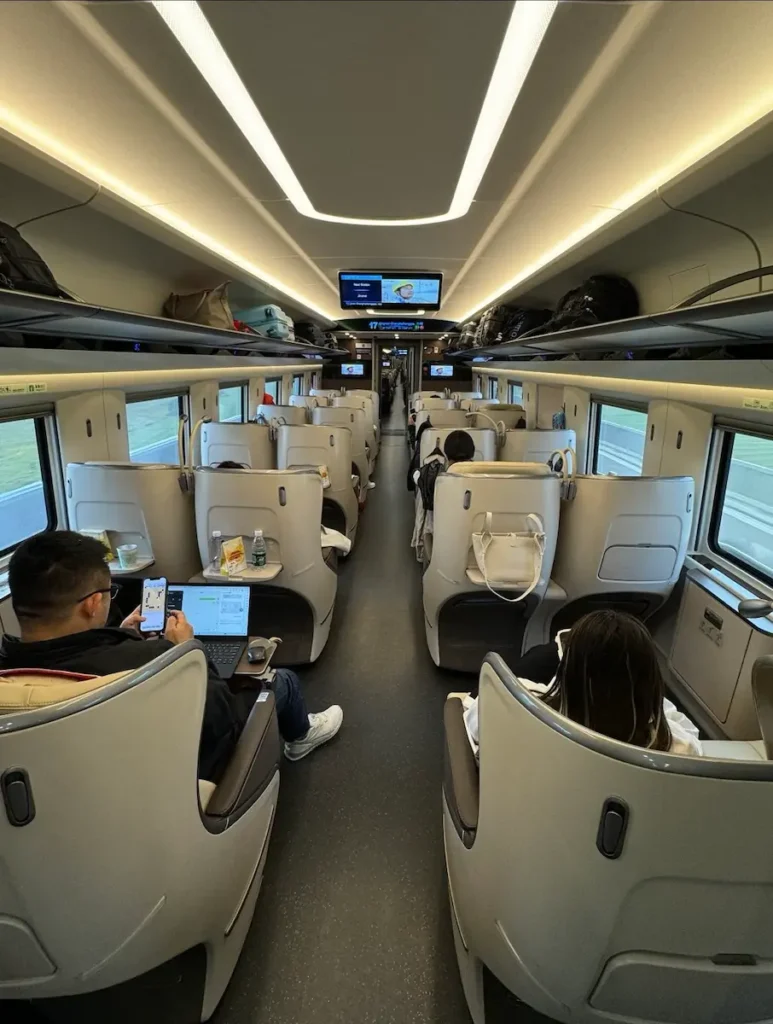
Step 4 — Onboard. Seat letters: A and F are window seats, C and D are aisle. B is the middle seat in the 3-seat row. Luggage goes above your seat or in the racks at either end of the carriage. Every carriage has a free hot water dispenser — bring a cup, and you can make tea or instant noodles like everyone else. Most trains have a dining car or QR-code ordering with seat delivery. Eating on the train is completely normal. Nobody blinks at a bowl of noodles or a bag of snacks.
Step 5 — Exit. Scan your passport again to leave the station. Metro, bus, and taxi connections are directly outside — follow the signs.
5 Routes Worth Planning a Trip Around
Each of these routes earns its place on any china high speed rail map worth following. They connect major sights, run frequently, and give you a genuine feel for how fast and smooth the system is.
1. Beijing → Shanghai
4 hours 18–40 minutes. G1–G28 series, Fuxing train, 350 km/h. The flagship route. You’ll cross the North China Plain into the Yangtze River Delta. Pick a window seat (A) on the left side for the best scenery transition. The china high speed rail speed standard on this line — a steady 350 km/h — makes it one of the fastest point-to-point intercity trips in the world.
2. Shanghai → Hangzhou → Huangshan
Shanghai to Hangzhou: 45 minutes. Hangzhou to Huangshan: ~1.5 hours. Start with West Lake in Hangzhou, then head west to the Yellow Mountains — a UNESCO World Heritage site with granite peaks and hot springs. The Huangshan North station is about an hour by road from the scenic area entrance, so book your onward transfer in advance.
3. Guangzhou → Guilin → Guiyang
Guangzhou to Guilin: ~2.5 hours. Guilin to Guiyang: ~2 hours. Guilin’s karst landscape is famous for a reason. This line cuts through one of the most dramatic limestone regions on Earth. There are plenty of tunnels, but every exit from one is a photo opportunity. Keep your phone charged.
4. Xi’an → Chengdu
3–4 hours via the Xi’an–Chengdu HSR. An engineering feat that crosses the Qinling Mountains — the geographic boundary between northern and southern China. Terracotta Warriors in the morning, Sichuan hot pot and giant pandas by afternoon. The mountain views are especially good in autumn.
5. Kunming → Dali → Lijiang
Kunming to Dali: ~2 hours. Dali to Lijiang: 1–1.5 hours (D-series train). This is the classic Yunnan corridor. Erhai Lake, the old towns of Dali and Lijiang, and Jade Dragon Snow Mountain all line up neatly. Lijiang sits at about 2,400 meters above sea level — take it easy when you first arrive.
Things Worth Knowing Before You Go
Do These
- Download offline maps before your trip. Phone signal drops in tunnels, and there are a lot of tunnels.
- Carry some RMB cash. Aim for CNY 500–1,000 (USD 71–143). China runs on mobile payments, but foreign cards don’t work everywhere.
- Install a translation app with Chinese offline pack. Station staff English varies by city. Google Translate or DeepL will save you.
- Verify station names carefully. “Beijing South” and “Beijing West” are not the same place.
- Use connecting tickets for long trips. The 12306 app’s multi-segment feature handles the planning for you.
Don’t Do These
- Don’t buy a regular train ticket by mistake. Train numbers tell you what you’re getting. G = high-speed (300–350 km/h). D = electric multiple unit (200–250 km/h). C = intercity. K, T, and Z are conventional trains — slower, different experience.
- Don’t arrive late. Gates close 3–5 minutes before departure. There’s no flexibility on this.
- Don’t bring oversized power banks. Anything above 100Wh (roughly 27,000mAh) can be confiscated at security.
- Don’t count on onboard Wi-Fi. Some Fuxing trains offer it, but coverage is patchy. Bring a local SIM or eSIM with data.
- Don’t hang out in the carriage connectors. That’s where people smoke. The smell travels.
A Few Chinese Phrases That Help
| English | Chinese | Pronunciation |
|---|---|---|
| Hello | 你好 | nǐ hǎo |
| Thank you | 谢谢 | xiè xiè |
| Is this seat taken? | 这个座位有人吗? | zhè ge zuò wèi yǒu rén ma? |
| How do I get to…? | 请问……怎么走? | qǐng wèn…zěn me zǒu? |
Quick Answers to Common Questions
Can I scan my foreign passport at the gate? Yes. Since 2024, the 12306 system fully supports foreign passport e-ticketing. Most major stations have passport-compatible gates. If the gate doesn’t read your passport, the manual lane next to it adds about 30 seconds.
Do I need to tip? No. Tipping is not a thing in China, on trains or anywhere else.
Can I bring a bike or a large instrument? Folding bikes in a bag are fine as carry-on luggage. Regular bikes need to be checked. For large instruments, buy an extra seat to place it on.
What if I miss my train? Within 30 minutes of departure, go to a station counter to rebook onto another train that same day (one change only). Before departure, you can change or cancel online — there’s a fee. Once the train has left, online changes are no longer available.
Is it safe? Exceptionally. China’s high-speed rail has the best operational safety record globally. Trains run on dedicated ballastless tracks with a CTCS-3 signaling system, continuously monitored by a central dispatch center. About 46% of the network runs at 300–350 km/h, and the china high speed rail speed standard keeps improving — next-generation CR450 trains have already hit 450 km/h in testing.
The station signage system is surprisingly international: pinyin and English on all major signs, bilingual departure boards, and English announcements on most trains. You can navigate the whole journey without speaking a word of Chinese.
A china high-speed rail map on your phone and a ticket in your hand — that’s all it takes. The trains are fast, the network is vast, and somewhere between a rice field at sunrise and a mountain pass at 300 kilometers an hour, the journey itself becomes the reason you came. 🚄

Ke Ping — Founder, InsiderChinaTravel
I personally reply to every email and create free, custom trip frameworks. Already have a plan? I can arrange vetted local guides and private drivers. Over 5,000 travelers from 30+ countries have started their journey this way.
📋 Tell me about your trip ideaReplied within 24 hours. No charge, no obligation.