Uber in China? No — Here’s How to Use Taxis, Didi & Ride-Hailing (2026)
1:00 AM. Beijing Capital Airport, Terminal 3.
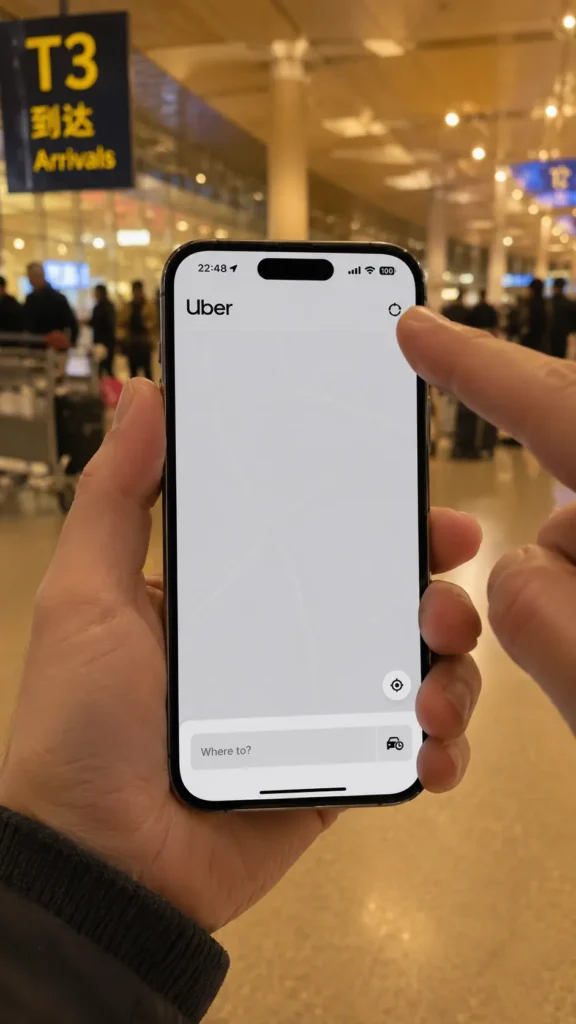
You drag your suitcase through customs, pull out your phone, and do what you’d do anywhere else — open Uber.
The location pin drifts for a second, then stops. The map is blank. No cars. No prices. Nothing.
You refresh. Same result.
Then it hits you. That Reddit thread you skimmed before the flight. The one that said “Uber doesn’t work in China.” You figured you’d deal with it later. Well, later is now — and you’re standing in a deserted arrivals hall with no way to get to your hotel.
Here’s the thing: there is no Uber in China. Not since August 2016, when Uber sold its entire China operation to DiDi in exchange for a 17.7% stake and walked away. Eight years later, travelers are still asking the same question: “Wait — is there Uber in China?”
No. But what replaces it is cheaper, faster, and — once you know how it works — genuinely easier. The Uber in China story is a closed chapter, and the alternative is better than most travelers expect.
And once you’ve got ride-hailing sorted, the rest of traveling in China gets a whole lot easier.
- Is There Uber in China? The Short Answer (No — Here's Why)
- Uber in China: Your 2 Real Alternatives (DiDi + Taxis)
- Option 1: DiDi — China's Uber (Literally)
- Option 2: Traditional Taxis — Cheap, Everywhere, but Know the Rules
- How to Set Up and Use DiDi as a Foreigner
- 5 Mistakes Foreigners Make With Ride-Hailing in China
- Quick FAQ: Uber, DiDi & Taxis in China
Is There Uber in China? The Short Answer (No — Here’s Why)
No. Uber does not operate in any city in mainland China. Open the app and you’ll see nothing — no rides, no drivers, no prices. Just a blank map and an icon that can’t help you. For anyone wondering “does Uber work in China,” the answer hasn’t changed since 2016.
What happened? In 2016, after two years of burning billions in a brutal subsidy war with DiDi, Uber folded its China business. It sold Uber China to DiDi and walked away with a 17.7% stake in the merged company. Uber hasn’t been back since. The question of Uber in China was settled in a single deal — one of the rare cases of a Silicon Valley giant losing a market outright.
(Hong Kong and Macau are a different story — Uber works fine in both. Everything below applies to mainland China only.)
The history between Uber and China is, at this point, old news. But for you, the traveler, the backstory matters less than the practical question: what do you use instead of Uber in China?
Uber in China: Your 2 Real Alternatives (DiDi + Taxis)
Two options cover every ride-hailing scenario you’ll face in Chinese cities. Once you accept that Uber in China is off the table, the path forward is straightforward:
| Option | Best For | Barrier to Entry |
|---|---|---|
| DiDi (滴滴出行) | Daily rides — China’s Uber equivalent. Full English interface, upfront pricing, supports international cards. | Requires app download, registration, and payment setup before your first ride |
| Traditional cruising taxis | Airport queues, train station pickups, backup when your phone dies | Language barrier + possible refusal to stop (more on this below) |
Most days, DiDi is all you’ll need. But there are moments — a dead phone, a failed payment, an impulse decision to just flag something down — when a traditional taxi saves the day. The good news: neither option requires a Chinese bank account, and neither requires speaking Mandarin. If you came here worried about Uber in China not working, you’re actually in better shape than you think.
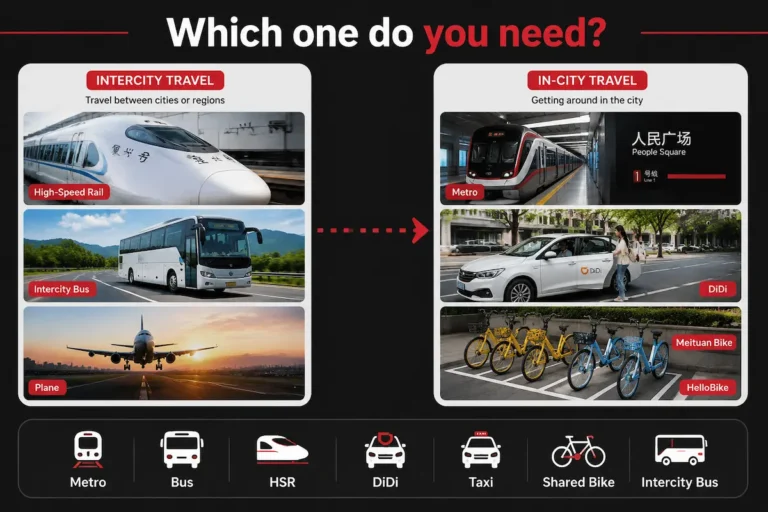
This guide focuses on city-level ride-hailing. For trains, flights, and intercity travel, see our full guide to getting around China.
Option 1: DiDi — China’s Uber (Literally)
Uber didn’t just lose to DiDi. Uber became a DiDi shareholder. To this day, Uber holds roughly 12% of DiDi. When you hail a DiDi in Beijing or Shanghai, there’s a direct lineage back to the Uber you already know — which is why many people call DiDi “China’s Uber.”
DiDi (full name: DiDi Chuxing) covers 400+ cities and handles tens of millions of rides a day. For most Chinese city dwellers, DiDi isn’t a choice — it’s the default. If Uber in China had survived, it would look a lot like this.
If you’re wondering “what is DiDi app,” think of it as Uber with a local Chinese ID. Same concept, same flow, but built for how China actually works — and, for foreign travelers, surprisingly easy to use.
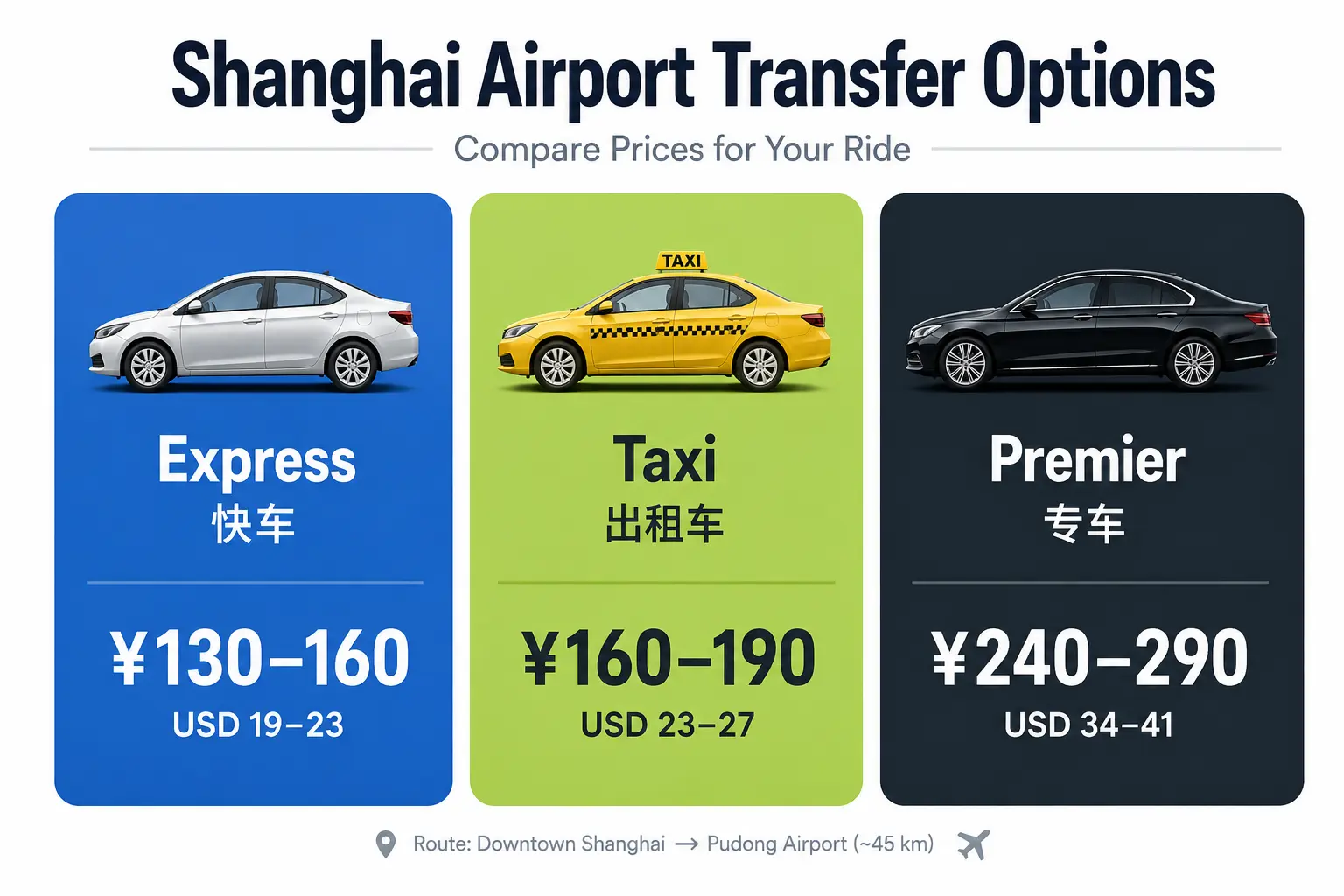
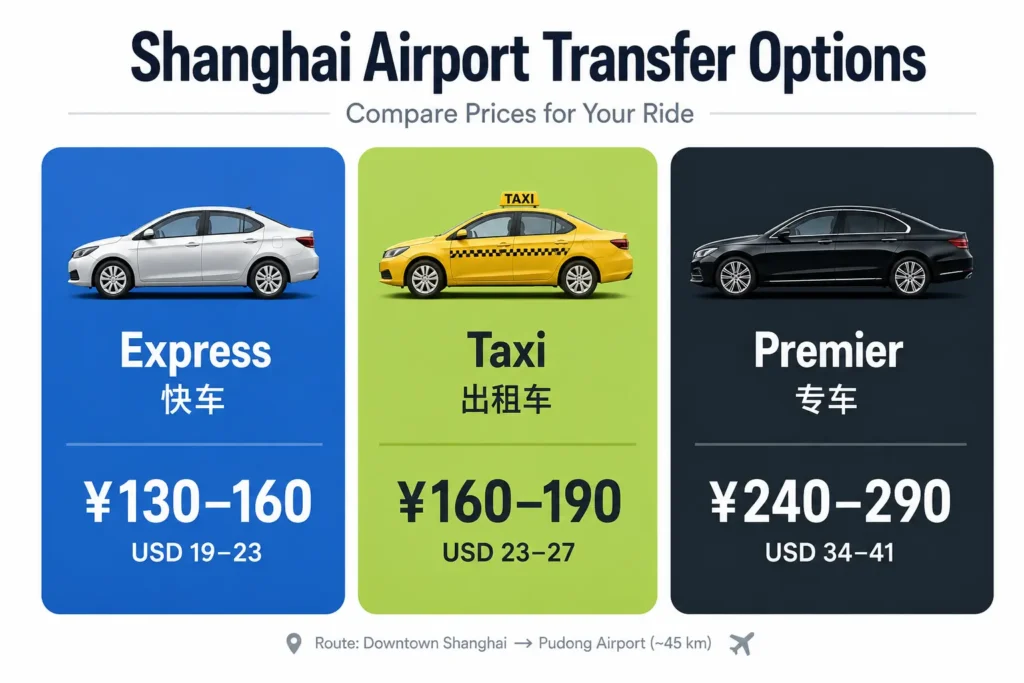
Three ride types worth knowing:
| Ride Type | What You Get | Sample Fare: Downtown Shanghai → Pudong Airport (~45 km) |
|---|---|---|
| Express (快车) | Standard everyday ride. BYD, Aion, and other electric sedans. Clean, efficient, best value. | ¥130–160 / USD 19–23 |
| Taxi (出租车) — booked via DiDi | Licensed metered taxi hailed through the app. Metered fare, slightly pricier than Express on long trips. | ¥160–190 / USD 23–27 |
| Premier (专车) | Black cars (Passat, Hongqi H9). Suited driver, bottled water in the back seat, luggage assistance. | ¥240–290 / USD 34–41 |
Why DiDi works for foreigners:
- Full English interface. Switch to English in Settings → Language. Every core screen — map, ride selection, booking, payment — is 100% translated. You’ll see the occasional untranslated promo banner, but nothing that affects your ride.
- Upfront pricing. The fare you see before confirming is the fare you’ll pay. No meter anxiety, no wondering if the driver is taking the scenic route.
- In-app translation. This is the feature that changes everything. Type your message in English (“I’m near the Starbucks at Exit 3”), and the driver sees it in Chinese. The driver types back in Chinese, and you see English. No English needed.
- Full trip records. GPS-tracked route, driver name, license plate, and fare breakdown saved for every ride. Share your live trip with a friend with one tap.
China’s Uber successor is, in many ways, a more polished product than the original — precisely because it had to win a market that Uber in China couldn’t crack.
Option 2: Traditional Taxis — Cheap, Everywhere, but Know the Rules
Before DiDi, this is how everyone in China got around: stand on the curb, spot a car with a red roof light (red = available; green = occupied), wave, get in, name your destination.
Simple in theory. For a non-Chinese speaker, traditional taxis in China come with three friction points: flagging one down, communicating where you want to go, and paying without friction. Still, they’re the original solution to the Uber in China void — and they work.
What you’ll pay (by city):
| City | Flag Fall | Per Kilometer | Night Surcharge (23:00–05:00) | Notes |
|---|---|---|---|---|
| Beijing | ¥13 (covers first 3 km) | ¥2.3 | +20% | 50% empty-return fee beyond 15 km |
| Shanghai | ¥14 (¥13 + ¥1 fuel surcharge) | ¥2.7 | +30% | Holiday surcharge: ¥10 during Spring Festival, ¥5 during Labor Day & National Day |
| Guangzhou | ¥12 (covers first 3 km) | ¥2.6 | +30% | Dynamic pricing: peak hours +10%, off-peak −10% |
| Chengdu | ¥9 (electric; covers first 2 km) | ¥1.9 | ~+30% (until 06:00) | Most taxis are now electric (Geely, Hongqi models) |
A real-world example: Forbidden City to Sanlitun in Beijing — about 8 km, 20 minutes in normal traffic. The taxi meter will read roughly ¥30–35 (USD 4–5). The same trip on DiDi Express costs around ¥25–35. The price gap is small, and a street taxi can actually run slightly higher if you hit traffic — waiting time ticks the meter too.
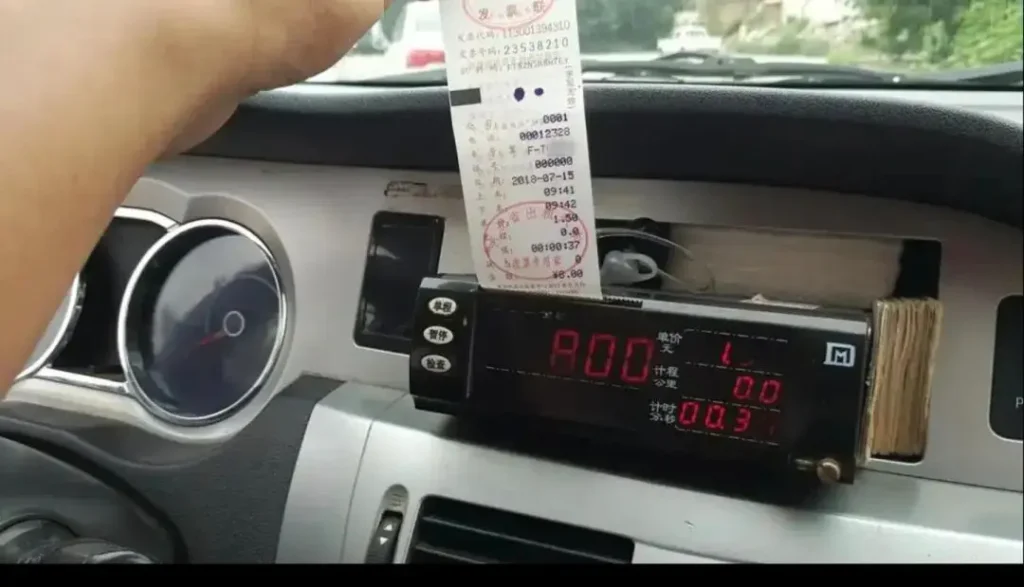
How to actually use a taxi without speaking Chinese:
- At airports and train stations: Follow the “Taxi” signs to the official taxi queue. Staff manage the line. Ignore anyone in the terminal who approaches you offering a ride — that’s a fake taxi, covered under Mistake #2 below.
- On the street: Look for the red roof light. Wave gently. If the light is green, the cab is taken — don’t bother.
- Communicating your destination: Save the Chinese address in your phone’s notes app before heading out. Or open a map app and show the driver your pinned destination. The single best tool? A hotel business card. Grab one from the front desk and keep it in your pocket.
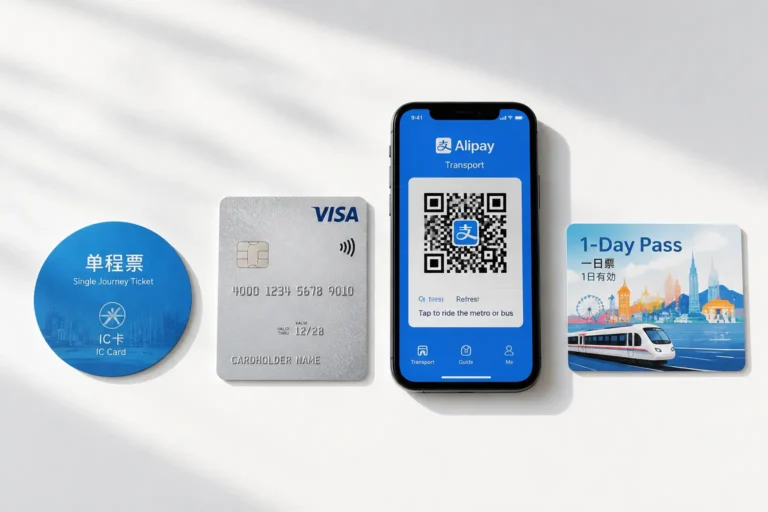
- Paying: Most taxis accept WeChat Pay or Alipay — the driver will show you a QR code; scan to pay and enter the meter amount. Cash in RMB works too, but carry small bills. Drivers rarely have change for ¥100 notes.
How to Set Up and Use DiDi as a Foreigner
This is the section that actually solves your problem. Every step below is based on the real-world DiDi experience in 2026 — not guesswork. Do everything before you fly, and you’ll land in China ready to book your first ride in under 60 seconds. Forget Uber in China — once DiDi is set up, you won’t miss it.
Before you start: you’ll want to handle your China visa application and app setup in the same pre-trip prep window. Both need your passport, both take a bit of time, and both are infinitely more painful to sort out after you’ve already landed.
Step 1: Download the App Before You Leave Home
Search for “DiDi – Rider” on the App Store (iOS) or Google Play (Android). The icon is an orange Chinese character “滴” on a white background. Do this before you board the plane — app stores can behave unpredictably once you’re inside China’s network environment.
What you’re downloading is the DiDi app — China’s dominant ride-hailing platform and the only one you’ll realistically need for city transport. It replaces everything Uber in China used to handle, and then some.
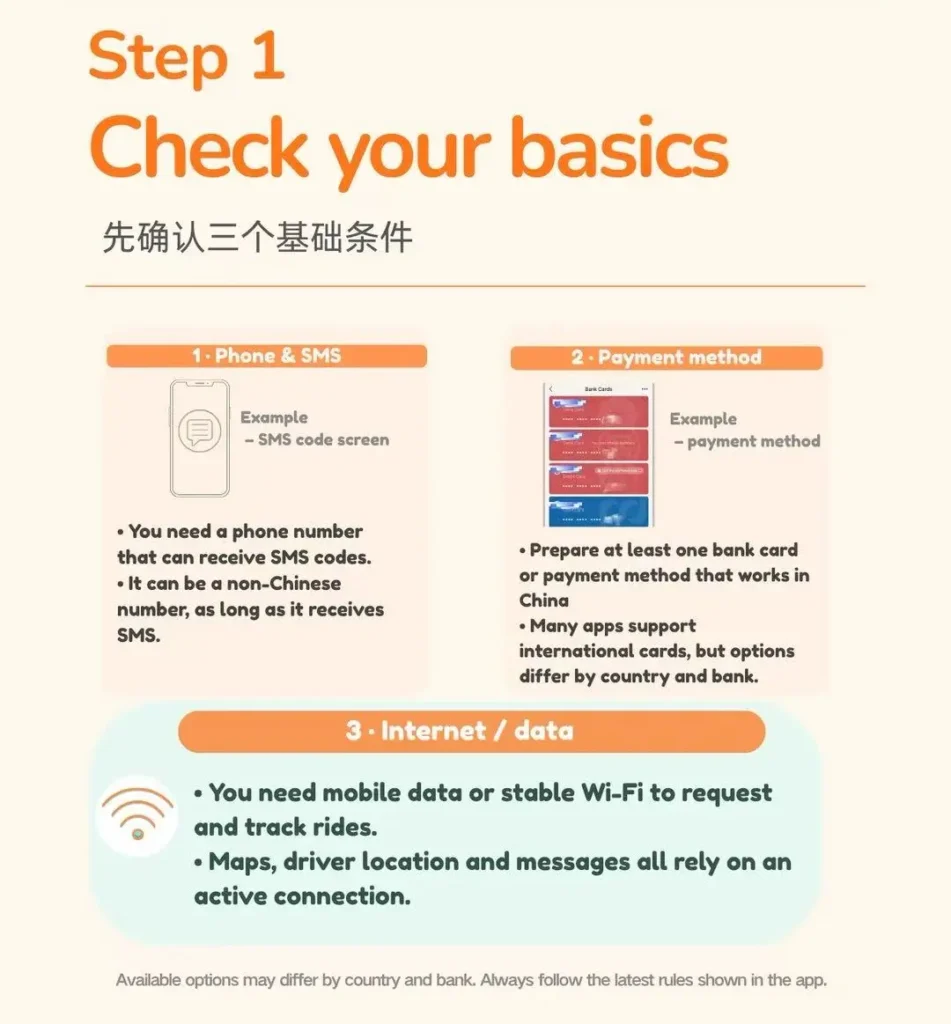
Step 2: Register With Your Overseas Phone Number
DiDi supports phone numbers from dozens of countries — US (+1), UK (+44), Japan (+81), Hong Kong (+852), and many more. Enter your number, receive the SMS verification code, done.
Heads up: some overseas carriers block or delay SMS codes from Chinese services. If the code doesn’t arrive within two minutes, try a different carrier’s number if you have one. The foolproof backup: getting a Chinese SIM card at the airport after you land. A China Mobile, China Unicom, or China Telecom number will receive the code instantly, every time.
Step 3: Switch to English
After registration, the app may default to Chinese. Tap your profile avatar (top-left corner) → Settings → Language → English. The interface flips instantly. You’ll see a familiar ride-hailing layout: map, destination box, ride type selector. Everything you need, nothing you don’t. It’s the moment you stop caring about Uber in China entirely.
Step 4: Set Up Payment (This Is Where People Get Stuck)
Two paths work. Pick one.
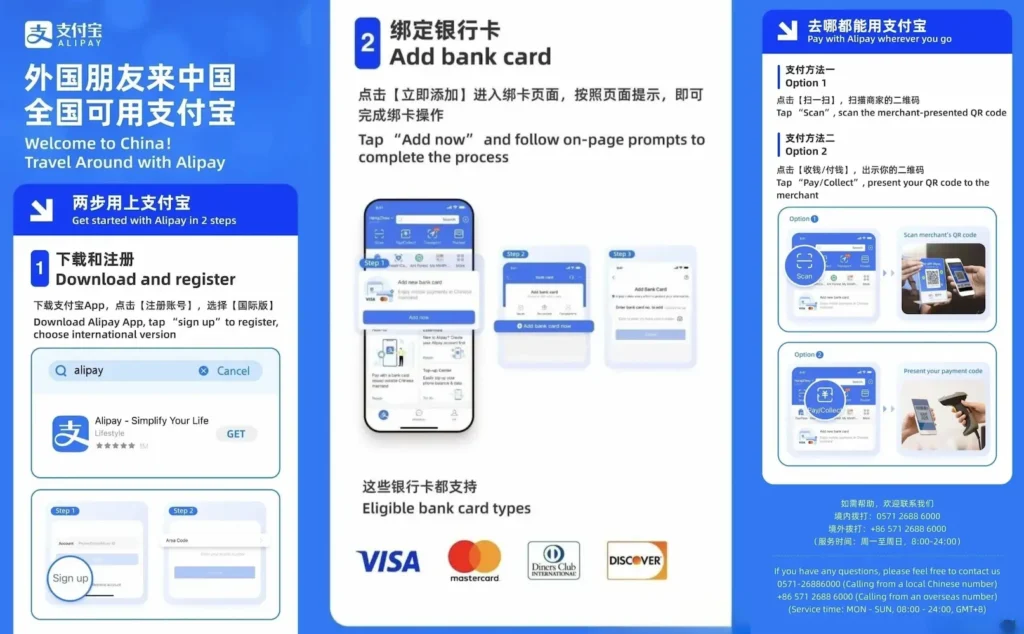
Path A: Link an international card to Alipay, then use Alipay inside DiDi. (Recommended)
- Download Alipay (the international version) or WeChat.
- Complete passport verification — upload a photo of your passport’s main page. The AI review usually takes 5–10 minutes. In rare cases it goes to manual review, which can take up to 24 hours. Do this ahead of time.
- Add your Visa, Mastercard, Discover, Diners Club, or JCB card in the “Bank Cards” section. (Amex works but occasionally gets declined on ride-hailing transactions — keep it as a backup.)
- Back in the DiDi app, go to Wallet → select Alipay or WeChat Pay as your payment method.
About that 3% fee you’ve heard about: it only kicks in on single transactions over ¥200 (USD 29). Most rides cost well under that threshold, so you’ll rarely trigger it. When you do, it’s a minor surcharge — ¥6 on a ¥200 ride.
📎 Official Alipay English guide: render.alipay.com/p/s/download
Path B: Link an international card directly inside DiDi.
DiDi supports some international cards natively, but success rates vary by country and issuing bank. If Path A works, stick with it. Path B is your backup.
If you hit any snags with passport verification or card limits, our full Alipay for foreigners guide walks through every screen.
Step 5: Book Your First Ride
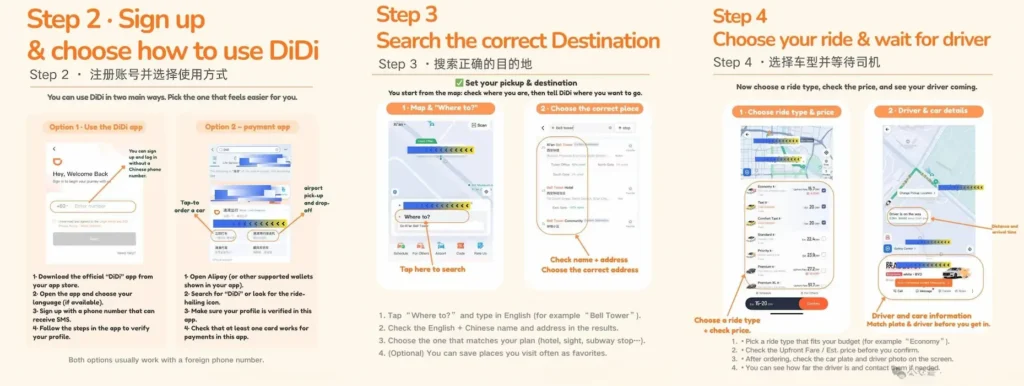
- Open DiDi. Confirm your pickup location on the map — GPS is usually accurate. If you’re inside a large shopping mall or train station, manually drag the pin to the nearest exit.
- Type your destination in the box at the top. English works. Try “Beijing Capital Airport T3” or “The Bund, Shanghai.” The app auto-matches it to the correct Chinese address.
- Pick a ride type. For your first trip, just choose Express — it’s the cheapest, most available, and hardest to get wrong.
- Check the upfront fare estimate. Tap Confirm.
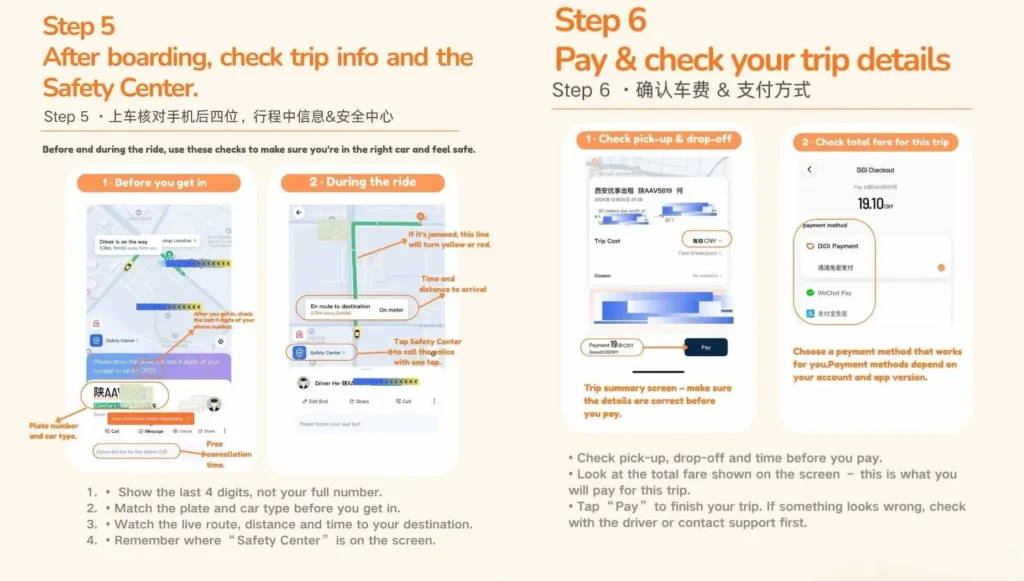
- Within seconds, the app matches you with a driver. You’ll see their name, photo, license plate number, car model and color, and ETA on your screen.
Step 6: During the Ride & After Drop-Off
- Before you get in: match the license plate on your screen to the actual car. This is non-negotiable. China’s golden rule of ride-hailing: plate first, door second.
- After you get in: the driver will usually ask “尾号四位是 XXXX?” — that’s “Are the last four digits XXXX?” referring to your phone number. Just say “Yes.” It’s a mutual confirmation that you’re in the right car.
- Mid-trip: the app tracks your route in real time. You’ll see if the driver deviates. The Safety Center (accessible from the ride screen) has one-tap emergency contact and trip sharing.
- At the destination: payment is automatic. You do nothing. Want to rate the driver? Swipe some stars. Don’t care? Just close the app and walk away. It’s that simple.
5 Mistakes Foreigners Make With Ride-Hailing in China
We trawled through hundreds of travel forum threads, and here are the most common complaints from tourists using ride-hailing services in China. Most of them trace back to one root cause: assuming Uber in China works the same way it does at home. It doesn’t. Here’s what goes wrong — and how to avoid it.
Mistake #1: Trying to Flag Down a Cab on the Street
This used to work. It doesn’t anymore — not reliably. Chinese drivers have moved on. They’re all on DiDi now, and an empty cab cruising past you is almost certainly headed to an app booking, not looking for a street hail.
One Reddit traveler put it bluntly:
“Don’t bother trying to wave down a taxi on the street in Shanghai or Beijing anymore. They will literally drive past you with an empty car because they are all pre-booked on apps. I stood in the rain for 30 minutes feeling completely invisible.”
The fix: Treat street hailing as a lucky bonus, not a strategy. Book through DiDi — including taxis, which you can hail right from the DiDi platform.
Mistake #2: Following the “Friendly Driver” at the Airport
You walk out of baggage claim. A man in a pressed shirt approaches, broken English, asking if you need a taxi. He seems official.
He is not. He is an unlicensed driver running a scam.
One TripAdvisor review tells the story:
“As soon as we walked out of the Beijing airport terminal, a guy in a nice shirt offered us a ‘taxi.’ He looked official, but took us to a private car and charged us 400 RMB for a ride that should have cost 100 RMB. Always go to the official taxi queue outside!”
That’s ¥400 (USD 57) for a ride worth ¥100 (USD 14). This is the dark side of the Uber in China vacuum — scammers know tourists are disoriented and target them at the arrival gate.
The fix: The moment you clear baggage claim, anyone who approaches you offering a ride is a no. Keep walking. Follow the “Taxi” signs to the official queue. Licensed airport taxis have uniform paint jobs, roof lights, meters, and a supervision hotline displayed on the dashboard.

Mistake #3: Assuming Your Card Will Work for Every Ride
This one is sneaky. Your first DiDi ride goes fine. Payment processes. You feel like a pro. Then on the second ride, the app throws a Chinese error message, the automatic payment fails, and your account gets locked.
A Reddit user on r/chinatravel described exactly this:
“Linked my Visa to Alipay before landing, thought I was a pro. First DiDi ride went fine. Second ride? The automatic payment failed, the app locked me out, and the driver couldn’t speak English to explain what was wrong. Carry some emergency cash just in case.”
The fix: Keep ¥200–300 (USD 30–40) in RMB cash on you. Not for daily use — for the one moment when your app payment fails and you need to pay the driver without standing on the curb in awkward silence.
Mistake #4: Trusting the GPS Pin Blindly
Inside large shopping malls, train stations, or crowded pedestrian areas, your GPS pin can drift — sometimes to the wrong side of an 8-lane road.
“I ordered a DiDi inside a huge mall in Shanghai, and the pin dropped on the opposite side of the highway. The driver was right there on the map but we were separated by 8 lanes of metal fences. We had to cancel and pay a fee.”
The fix: When booking from inside a large building, manually drag the pickup pin to the nearest exit or a visible landmark. Better yet — walk outside to an open area, then book.
Mistake #5: Answering the Driver’s Phone Call
Chinese drivers have a deeply ingrained habit: the second they accept your ride, they call you. Your phone rings. You answer. The driver speaks rapid Chinese. You understand nothing. Panic sets in. (And they will call you — drivers in China default to phone calls the moment they accept a ride.)
Here’s what they’re almost always saying: “Where exactly are you?”
The fix: Don’t answer. Let it ring. Immediately send a message through the app’s chat — “I’m at Exit 3, blue jacket.” The in-app translator converts it to Chinese on the driver’s end. When the driver replies in Chinese, you’ll see it in English. The app translation system is genuinely good — far more reliable than your Mandarin.
These ride-hailing pitfalls are just one piece of the puzzle. For more ways to avoid rookie mistakes, browse our full list of China travel tips.
Quick FAQ: Uber, DiDi & Taxis in China
Is there Uber in China?
No. There is no Uber in China — it left the mainland market in August 2016 and has not returned. The app opens but shows no available rides anywhere in mainland China.
Does Uber work in China?
No. Uber does not work in mainland China and hasn’t since 2016. For anyone searching “does Uber work in China,” the answer is a definitive no — but DiDi fills the gap completely.
Is DiDi safe?
Yes — safety standards are on par with Uber and Lyft. Every trip is GPS-tracked in real time, with in-app emergency contact and trip-sharing features built in.
Can I pay with my foreign credit card?
Yes, through Alipay or WeChat (link your Visa or Mastercard there first, then select it as your DiDi payment method). Direct card binding inside DiDi also works for some issuers but is less consistent.
Do taxi drivers speak English?
Almost never. Have your destination written in Chinese (phone notes app or hotel card) and show it to the driver. That’s all you need.
Is DiDi cheaper than Uber?
Dramatically. A 30-minute Beijing ride costs roughly ¥40–60 (USD 6–9). The same trip on Uber in New York would run you USD 25–35. The math on Uber in China not existing? You’re actually saving money.
What if I don’t have a Chinese phone number?
You don’t need one. DiDi supports overseas numbers for registration. Register before you fly to avoid SMS delivery issues.
Does Uber work in Hong Kong?
Yes — Uber operates normally in Hong Kong and Macau. The restrictions described in this guide apply to mainland China only. The Uber in China question has a completely different answer once you cross into Hong Kong.
What’s the difference between DiDi Express and DiDi Taxi?
Express is DiDi’s own peer-to-peer service with upfront pricing. DiDi Taxi dispatches a licensed metered cab through the app — you pay whatever the meter reads. Express is usually cheaper and more predictable.
You don’t need to speak Chinese to get around China. You don’t need a Chinese bank account. You just need the right app, set up the right way, with one backup plan in your pocket. The Uber in China chapter is closed — and honestly, what’s on the other side of it works better.

Ke Ping — Founder, InsiderChinaTravel
I personally reply to every email and create free, custom trip frameworks. Already have a plan? I can arrange vetted local guides and private drivers. Over 5,000 travelers from 30+ countries have started their journey this way.
📋 Tell me about your trip ideaReplied within 24 hours. No charge, no obligation.