China Trip Itinerary & Travel Plan: Best Routes for First-Time Visitors (2026)
I stood in the arrivals hall at Beijing Capital Airport for a solid ten minutes. Not lost — just stuck. My phone refused to connect to the Wi-Fi. Google Maps showed nothing but a blank gray grid. I had a wallet full of RMB, and three taxi drivers waved me off in succession. They only took QR codes.
That was my first trip to China. I’ve been back five times since. Each visit gets smoother.
It always does.
Over 30 million foreign travelers enter China every year. Most stay 10 to 14 days — long enough to hit the big cities, and just long enough to make every rookie mistake in the book. The one question worth obsessing over before you go isn’t “Should I visit?” It’s “Where do I start — and how do I string it all together?”
A solid china trip itinerary answers both. Get those two right. The rest takes care of itself.
- China Trip Itinerary & Travel Plan: Best Routes for First-Time Visitors (2026)
China Trip Itinerary & Travel Plan: Best Routes for First-Time Visitors (2026)
3 Best China Travel Itineraries for First-Timers (Compared)
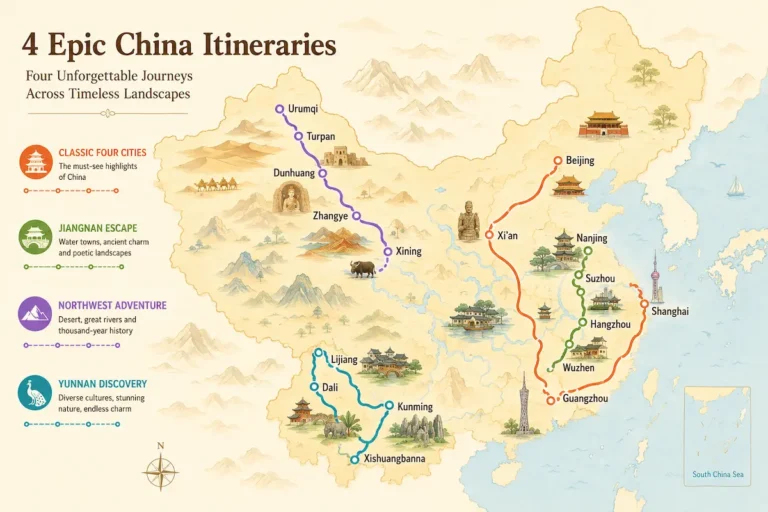
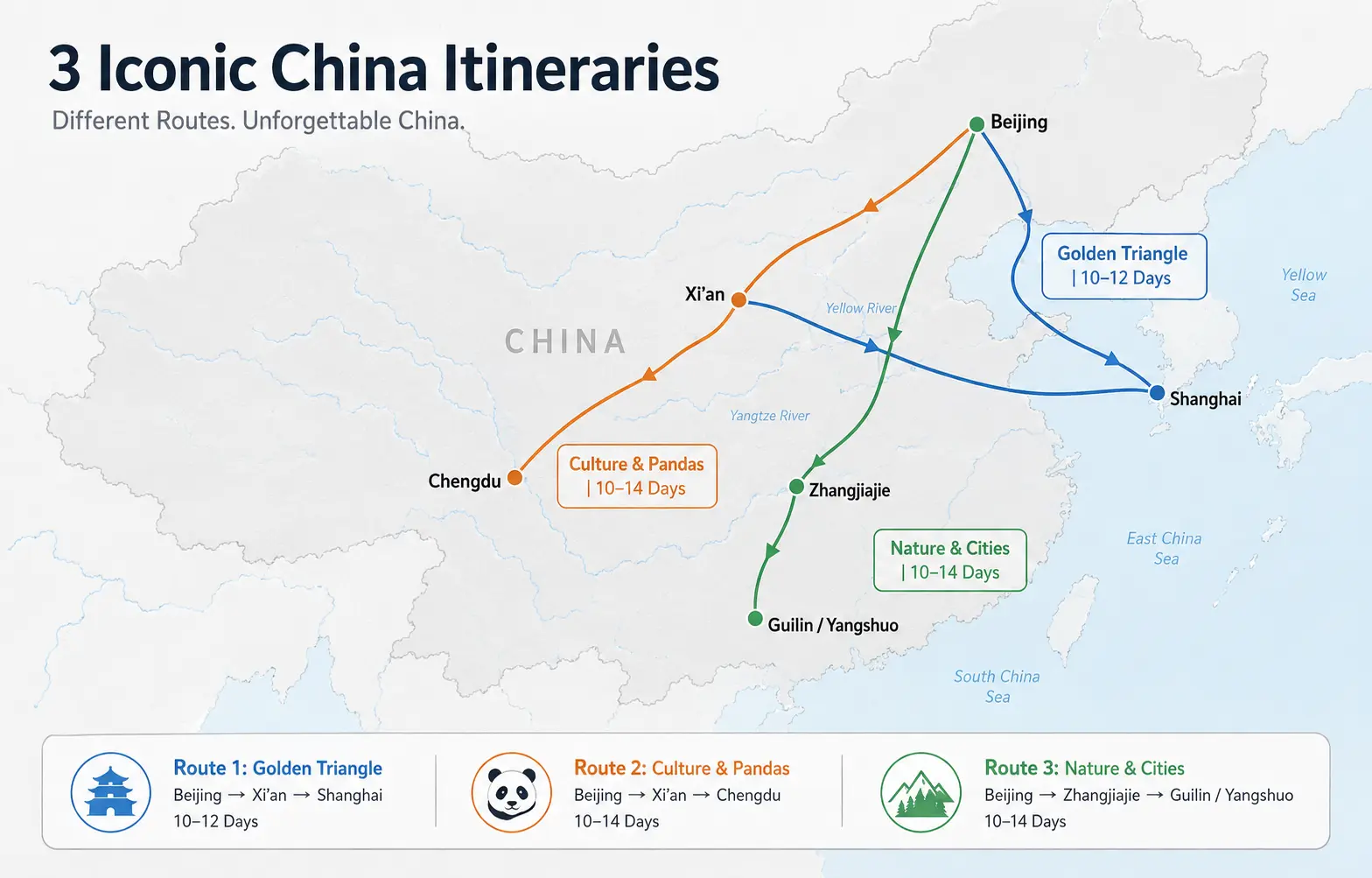
Here are three china trip itinerary blueprints — each one tested and refined by real travelers, not pulled from a tour brochure. Pick one, tweak it, or use all three to map out something entirely your own.
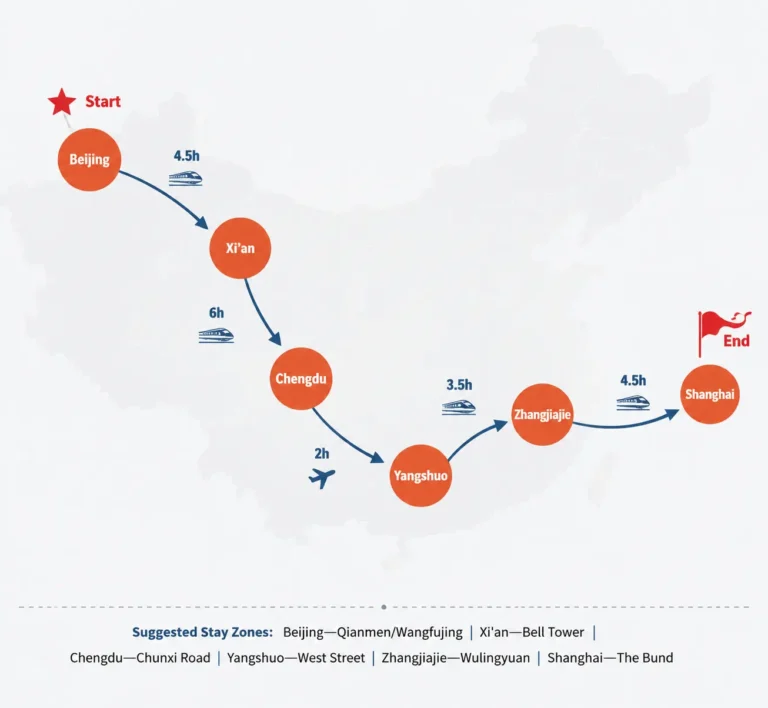
Route 1 — The Classic Golden Triangle: Beijing → Xi’an → Shanghai
Ideal length: 10–12 days
Best for: First-timers who want to see China’s three most iconic cities in a single, efficient loop.
The travel industry has been calling this the “Golden Triangle” for decades, and it stuck for good reason. Beijing gives you imperial scale. Xi’an hands you two thousand years of history in one archaeological pit. Shanghai throws you into a skyline that feels like the future.
Day-by-day at a glance:
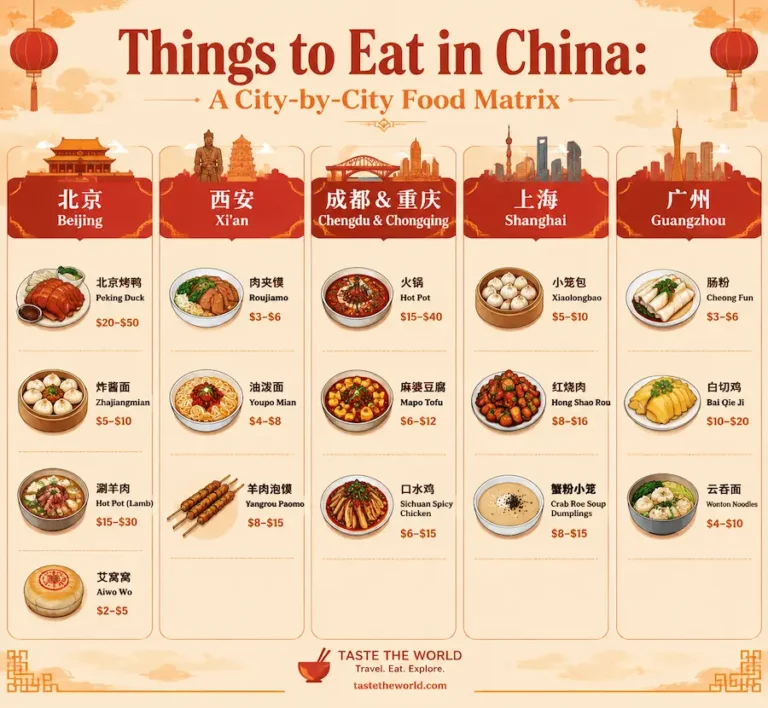
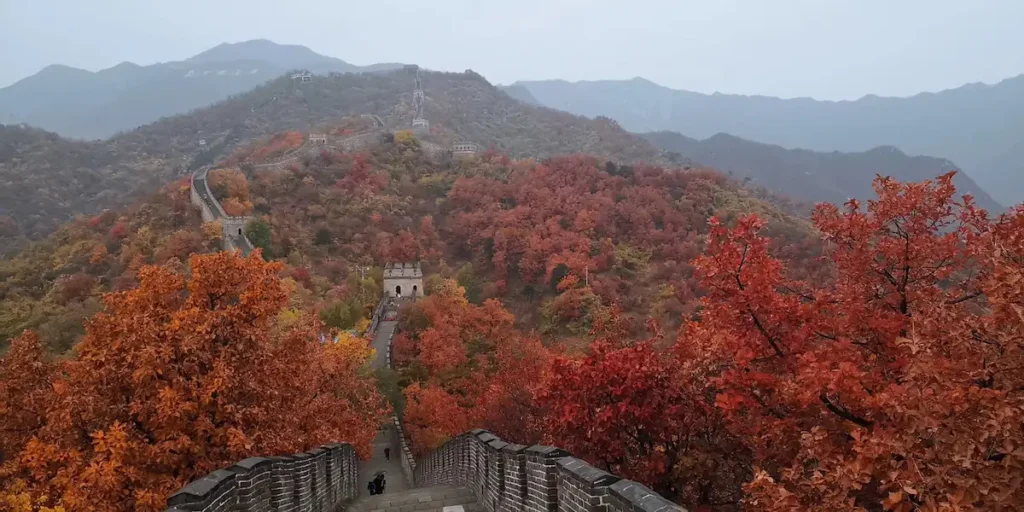
- Beijing (4 days): Watch the flag-raising ceremony at Tiananmen Square at dawn → walk the Forbidden City’s central axis (allow 3–4 hours) → climb Jingshan Park’s Wanchun Pavilion for that postcard shot of russet rooftops → take the cable car up Mutianyu Great Wall and the toboggan slide back down (¥40 / ~USD 6 for the wall ticket, ¥140 / ~USD 20 for the cable car round trip) → stand under the blue-tiled Hall of Prayer for Good Harvests at the Temple of Heaven → rent a boat on Kunming Lake at the Summer Palace → end a long day with zhajiangmian in a tucked-away hutong alley.
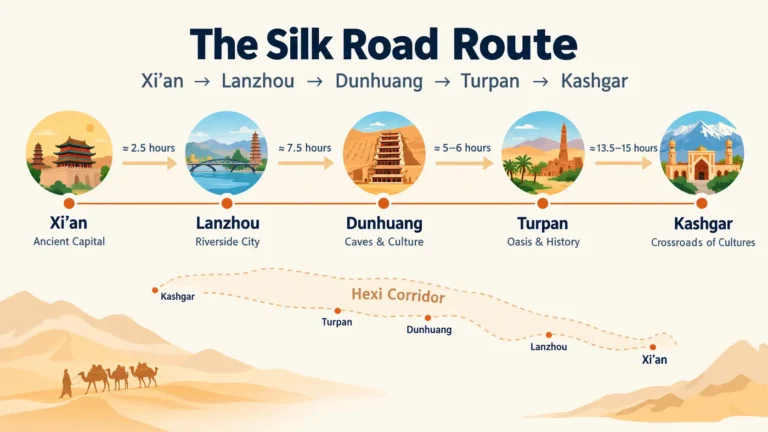
- Xi’an (2–3 days): Stand in front of Pit 1 at the Terracotta Army Museum (¥120 / ~USD 17) for ten minutes. You’ll understand why it’s called the eighth wonder of the world — no photo prepares you for the scale → rent a bike and ride the full 13.7-km loop atop the ancient city wall → eat your way through the Muslim Quarter from one end to the other → catch the fountain show at the Giant Wild Goose Pagoda after dark.
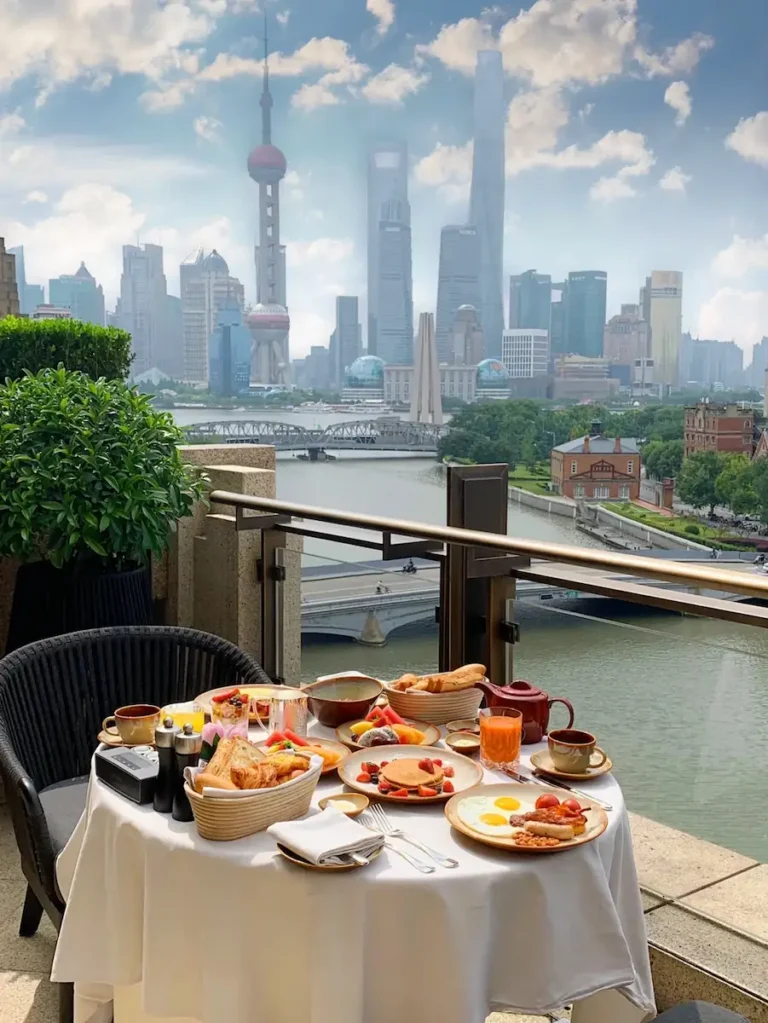
- Shanghai (2–3 days): Walk the Bund at dusk and watch the Pudong skyline light up → ride the elevator to the 632-meter observation deck of Shanghai Tower → cross the Nine-Turn Bridge at Yu Garden → grab a coffee under the plane trees on Wukang Road → let the crowds sweep you down Nanjing Road at night.
Estimated budget (per person, excluding international flights, mid-range standard):
| Category | Cost Range |
|---|---|
| Hotels (10 nights, 3–4 star) | ¥4,500 – ¥7,000 (~USD 640 – 1,000) |
| Food & drinks | ¥1,800 – ¥2,800 (~USD 260 – 400) |
| Attraction tickets | ¥500 – ¥700 (~USD 70 – 100) |
| Intercity high-speed trains | ¥1,050 – ¥1,200 (~USD 150 – 170) |
| Local transport | ¥400 – ¥600 (~USD 60 – 85) |
| Total | ~¥8,250 – ¥12,300 (~USD 1,180 – 1,760) |
Want the full day-by-day breakdown? Grab our complete 10-day China itinerary.
Route 2 — Culture & Pandas: Beijing → Xi’an → Chengdu
Ideal length: 10–14 days
Best for: Travelers who want the Golden Triangle essentials but are willing to swap skyscrapers for teahouses and hot pot.
This route replaces Shanghai with Chengdu — a city so unhurried you’ll wonder if you accidentally crossed into a different country. (You didn’t. It’s just Sichuan.)
Day-by-day at a glance:
- Beijing (4 days): Same as Route 1 — Forbidden City, Mutianyu Great Wall, Temple of Heaven, Summer Palace.
- Xi’an (2–3 days): Terracotta Warriors → city wall bike ride → Muslim Quarter food crawl.
- Chengdu (3–4 days): Get to the Giant Panda Breeding Research Base by 7:30 AM (¥55 / ~USD 8). When the gates open at 8, head straight for the nursery area — that’s when the pandas are awake and eating, not passed out behind bamboo → grab a bamboo-leaf green tea at the Heming Teahouse inside People’s Park. Let an ear-cleaning master work on you while you sip (it sounds strange; it feels incredible) → skip the touristy main drag of Kuanzhai Alley and eat dinner on Kuixinglou Street instead — the chuanchuan (skewer hot pot) stalls there are where locals actually go → take a half-day trip to Dujiangyan to see a 2,200-year-old irrigation system that still works. No pumps. No electricity. Just gravity and genius engineering → book a yuanyang hot pot for your last night — half fiery red broth, half mild white broth. Dip the tripe in the red side. Thank your stomach later by using the white side.
Estimated budget (per person, mid-range):
| Category | Cost Range |
|---|---|
| Hotels (11 nights) | ¥4,200 – ¥6,600 (~USD 600 – 940) |
| Food & drinks | ¥1,700 – ¥2,600 (~USD 240 – 370) |
| Attraction tickets | ¥400 – ¥550 (~USD 57 – 79) |
| Intercity high-speed trains | ¥930 – ¥1,050 (~USD 133 – 150) |
| Local transport | ¥400 – ¥550 (~USD 57 – 79) |
| Total | ~¥7,630 – ¥11,350 (~USD 1,090 – 1,620) |
Chengdu hotels and meals run 20–30% cheaper than Shanghai. The savings add up fast — enough to cover an extra day or two. For a longer trip, see our 2-week China itinerary.

Route 3 — Nature & Cities: Beijing → Zhangjiajie → Guilin/Yangshuo
Ideal length: 10–14 days
Best for: Hikers, photographers, and anyone who’d rather stare at sandstone pillars than museum displays.
This route delivers the strongest visuals of the three. The Great Wall is merely the opening act. Zhangjiajie’s floating peaks and the Li River’s karst panorama are the headliners.
Day-by-day at a glance:
- Beijing (3–4 days): Forbidden City + Mutianyu Great Wall. You can compress Beijing by a day here to make room for nature.
- Zhangjiajie (3 days): Climb the 999 steps to Tianmen Cave (or take the escalator — no shame in that) → walk the glass skywalk bolted to a vertical cliff face → enter Zhangjiajie National Forest Park (¥224 / ~USD 32, valid for 4 days) and head straight to Yuanjiajie — the sandstone columns here inspired the “Hallelujah Mountains” in Avatar → hike the Ten-Mile Gallery trail → ride the Bailong Elevator, a glass lift built into the side of a quartz-sandstone cliff.
- Guilin / Yangshuo (3 days): Take a bamboo raft down the Li River from Yangdi to Nine-Horse Fresco Hill (¥160–210 / ~USD 23–30, about 1.5 hours) → rent a bike in Yangshuo and pedal through rice paddies with karst peaks as your backdrop → if your dates line up with October, head to the Longji Rice Terraces — the entire mountainside glows golden before harvest.
Estimated budget (per person, mid-range):
| Category | Cost Range |
|---|---|
| Hotels (11 nights) | ¥4,000 – ¥6,200 (~USD 570 – 890) |
| Food & drinks | ¥1,600 – ¥2,500 (~USD 230 – 360) |
| Attraction tickets | ¥600 – ¥850 (~USD 86 – 121) |
| Intercity transport (high-speed train + flight) | ¥1,400 – ¥1,800 (~USD 200 – 260) |
| Local transport | ¥450 – ¥650 (~USD 64 – 93) |
| Total | ~¥8,050 – ¥12,000 (~USD 1,150 – 1,710) |
Nature comes at a premium here — Zhangjiajie and Guilin’s national-park-style tickets push the budget higher than Route 2. The trade-off? Every yuan buys you a view you won’t forget.
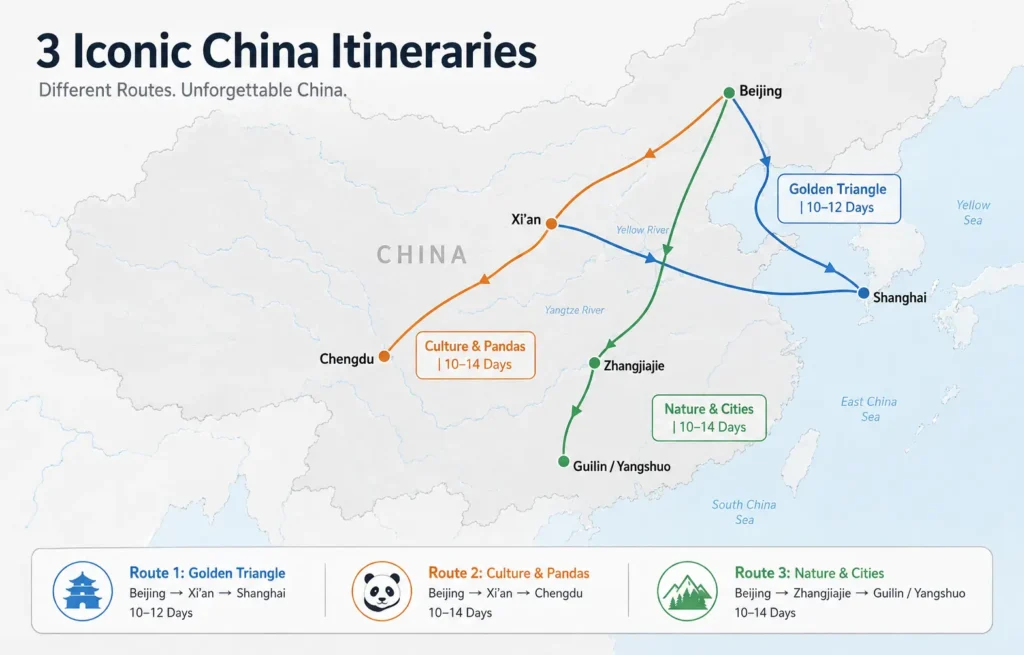
Quick Decision: Which Route Should You Pick?
- You’ve got 10 days and want maximum efficiency. → Route 1. Trim Shanghai to 2 days if you’re tight.
- You’re not in a hurry and want to feel a city’s rhythm. → Route 2. Chengdu will slow you down — in the best way.
- You hike on weekends and travel with a camera. → Route 3. The morning mist in Zhangjiajie and the sunset reflections on the Li River are worth every yuan.
- You’re traveling with older parents and want fewer hotel changes. → Route 1 or 2. Same number of cities, less time on the road.
All three routes start in Beijing for a practical reason: it has the most international flights and the friendliest visa-free transit policies. (More on that in the FAQ.)
How Many Days Do You Need in China?
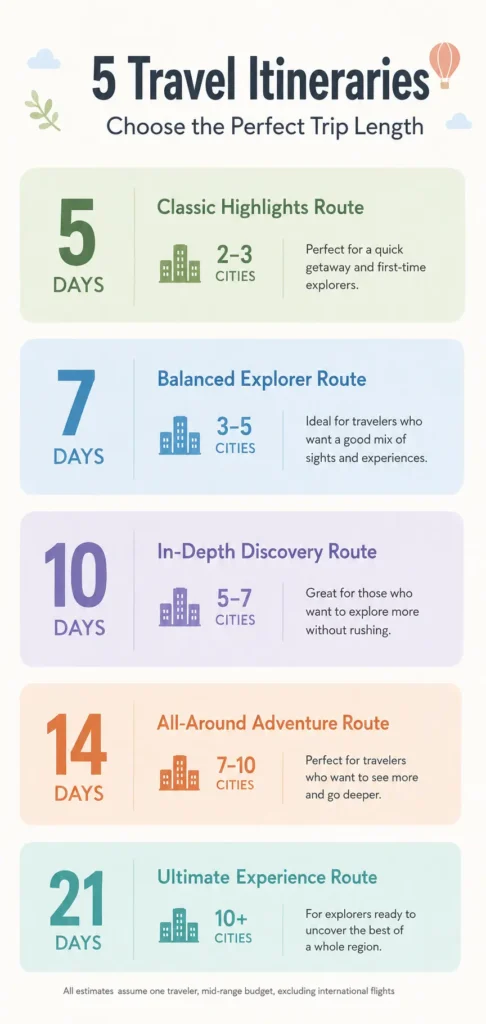
The average foreign traveler to China stays 10 to 14 days — which tells you something about how long a good china trip itinerary should be. You flew across an ocean to get here. Spending fewer than 7 days means you’ll burn two of them just adjusting to the time zone.
Here’s what each timeframe actually gets you:
| Days | What You Can Do | Suggested Route |
|---|---|---|
| 5 days | One city, deep. Beijing or Shanghai only. Don’t try to squeeze in a second. | Route 1 stripped down: Beijing only, covering the Great Wall + Forbidden City + Summer Palace + hutongs |
| 7 days | Two cities, brisk but doable. The classic Beijing + Xi’an pairing fits perfectly here. | Route 1 compact: Beijing 4 days + Xi’an 3 days. See our detailed 7-day China itinerary for the full plan. |
| 10 days | Three cities, Golden Triangle territory. This is the sweet spot for most first-timers. | Route 1 (full) |
| 14 days | Three cities with breathing room. You can linger over tea in Chengdu or add an extra day of cycling in Yangshuo. | Route 2 or Route 3 (full) |
| 21+ days | Four or more cities, or deeper regions like western Sichuan, Yunnan, or Tibet. | Beyond the scope of this guide — explore our full collection of China itineraries for extended trip ideas. |
The bottom line: For a first trip to China, 10 days is the floor. Fourteen days is the comfort zone. Anything under 7 and you’re better off picking one city and settling in.
How to Plan a Trip to China — A 4-Step Framework
You’ve seen the routes. Now let’s turn someone else’s blueprint into your trip. Planning a trip to China feels overwhelming because the country is enormous and information is scattered. These four steps break it down into decisions you can actually make over a weekend.
Step 1 — Pick Your Cities (and Know What Each One Gives You)
China’s cities differ from each other more than European capitals do. Picking the wrong city for your travel style is the fastest way to waste half your trip.
| City | One-Sentence Vibe | Minimum Stay |
|---|---|---|
| Beijing | The imperial heart — Forbidden City, Great Wall, hutongs, and 3,000 years of history crammed into one sprawling capital. | 3–4 days |
| Xi’an | China’s most glorious dynasty is buried under this city. The Terracotta Warriors are the headliner, but the intact city wall and the Muslim Quarter food scene are the sleeper hits. | 2–3 days |
| Shanghai | 1930s Art Deco mansions on one side of the river, sci-fi skyscrapers on the other. China’s most international city. | 2–3 days |
| Chengdu | Pandas, hot pot, and teahouses. A city that has elevated “taking it slow” to a philosophy. | 2–3 days |
| Guilin / Yangshuo | Karst peaks and bamboo rafts. The landscape you’ve seen on every Chinese painting — except it’s real and you can bike through it. | 2–3 days |
| Zhangjiajie | Quartz-sandstone pillars punching through mist. The landscape that inspired Avatar’s floating mountains. | 2–3 days |
| Chongqing | A cyberpunk city built on a mountain — trains run through buildings, Hongyadong glows like a lantern at night, and the hot pot numbs your lips. | 2 days |
For your first trip to China, cap it at three cities. Any more and you’ll spend half your waking hours in transit.
Step 2 — Decide How Many Days (and Be Realistic)
The most common planning mistake? Packing the spreadsheet like this: 8 AM museum → 11 AM bullet train → 2 PM temple → 6 PM night market. It works on paper. Day four, you’ll be horizontal in your hotel room until noon.
A few reality checks for your China travel plan:
- Budget 2 full days minimum per city — not counting arrival and departure days.
- Every city-to-city move eats half a day. The high-speed train might only take 4.5 hours, but door to door — pack, check out, get to the station, clear security, board, ride, disembark, navigate a new station, find your new hotel — you’re looking at 5–6 hours minimum.
- Cap your daily sightseeing at 2–3 major attractions. Leave room for getting lost, standing in line, sitting on a bench, and stumbling onto something you didn’t plan for.
Step 3 — Order Your Route Logically (Transport Tips)
China’s high-speed rail network is the largest on earth. The major cities connect smoothly — as long as you don’t draw zigzags across the map.
| Route | Duration (G/D trains) | 2nd Class (~USD) |
|---|---|---|
| Beijing → Xi’an | 4.5–5.5 hours | ¥515–550 (~USD 74–79) |
| Xi’an → Chengdu | 3–4 hours | ¥263–310 (~USD 38–44) |
| Beijing → Shanghai | 4.5–6 hours | ¥526–662 (~USD 75–95) |
| Chengdu → Chongqing | 1–1.5 hours | ¥96–154 (~USD 14–22) |
| Chengdu → Zhangjiajie | No direct train; transfer via Changsha (~8–9.5 hrs total) | ~¥600–750 (~USD 86–107) |
A few guiding principles:
- Beijing almost always makes sense as your first stop — most international flights land there, and the airport supports visa-free transit.
- Move north to south or east to west. Don’t backtrack.
- For Route 3, the Chengdu-to-Zhangjiajie leg is best flown (¥500–800 / ~USD 71–114, about 1.5 hours). The train alternative burns an entire day on transfers.
Once you’ve mapped your route, bookmark our China high-speed rail map for reference.
Step 4 — Estimate Your Budget (What a China Trip Really Costs)
Here’s what mid-range travel actually costs on the ground — 3-to-4-star hotels, sit-down meals at decent restaurants, second-class high-speed train seats.
| Category | Tier-1 Cities (Beijing/Shanghai) | New Tier-1 (Xi’an/Chengdu/Chongqing) | Scenic Towns (Zhangjiajie/Guilin) |
|---|---|---|---|
| Hotel / night | ¥450–800 (~USD 64–114) | ¥350–600 (~USD 50–86) | ¥280–500 (~USD 40–71) |
| Meal / person | ¥90–180 (~USD 13–26) | ¥60–120 (~USD 9–17) | ¥50–100 (~USD 7–14) |
| Metro (base fare) | ¥3 (~USD 0.4) | ¥2 (~USD 0.3) | No metro; taxi from ¥7 (~USD 1) |
Street food runs ¥20–40 (~USD 3–6) per snack. You can eat well all day for ¥150 (~USD 21).
The quick-estimate formula: Mid-range travel in China = roughly ¥800–1,000 per person per day (~USD 114–143), covering accommodation, three meals, local transport, and attraction tickets. Intercity transport is extra. Think of this section as your built-in china trip planner — no app download required. A 10-day trip with three cities will land somewhere between ¥8,000–12,000 (~USD 1,140–1,710), not counting your international flight.
This is what a realistic China travel plan looks like on a spreadsheet. Numbers on a page — but at least they’re honest ones.
China Trip Tips — 7 Mistakes First-Timers Always Make
Every one of these comes from actual travelers who learned the hard way. (I was three of them.)
1. Assuming cash still rules. China went cashless years ago. Street vendors selling grilled squid take QR codes. Download Alipay or WeChat Pay and link your international credit card before you board the plane — some banks require SMS verification that won’t reach you once you’re in China.
2. Showing up at the Forbidden City without a reservation. The Forbidden City caps daily visitors and requires bookings 7 days in advance via a WeChat Mini Program. Foreign passport slots are limited and vanish within minutes of release. The Terracotta Army is easier to book, but still reserve 3 days ahead. Don’t bet your trip on walk-up tickets.
3. Trusting Google Maps. It’s offset by hundreds of meters in China and useless for walking directions. Download Amap (Gaode Maps) — it has an English interface — or use Apple Maps. Both are dramatically more accurate. Download offline maps before you land.
4. Underestimating train station security. Chinese train stations screen passengers like airports. Swiss Army knives, aerosol cans over 150ml, and self-heating meal packs will be confiscated. Arrive 45–60 minutes early. During holidays, double that.
5. Forgetting to set up your internet before departure. Instagram, Google, WhatsApp — all blocked. Free VPNs are unreliable at best. Buy an eSIM with data (Holafly, Airalo) or install a reputable paid VPN before you leave home. Do not wait until you land and stare at a “No Connection” screen.
6. Cramming the itinerary to the breaking point. “Badaling Great Wall in the morning → Forbidden City in the afternoon → Wangfujing night market” — this looks feasible on a map. In reality, it’s a 12-hour day that leaves you too exhausted to enjoy any of it. Pacing is everything.
7. Traveling during China’s two mega-holidays. Labor Day (May 1–5) and National Day (October 1–7) trigger the largest human migration on earth. Attractions become shoulder-to-shoulder. High-speed train tickets sell out instantly. Hotel rates jump 50% or more. The sweet spot for weather and crowds is April–May and September–November.
For a deeper dive into preparation, see more China travel tips on the full guide.
FAQs About Planning Your China Trip
Do I need a visa?
Most nationalities need a tourist visa (L-visa). But China now offers 15-to-30-day unilateral visa-free entry for 50+ countries, and a 240-hour (10-day) transit visa-free policy covering 55 nationalities — the catch is you need an onward ticket to a third country or region. London → Beijing → Hong Kong → London qualifies. London → Beijing → London does not. Check the latest policy before booking. Our full visa guide has the details.
Can I get by without speaking Chinese?
In major tourist cities, yes — signs in metro stations, attractions, and hotels are bilingual. Restaurant ordering works fine with photos and a translation app (Pleco is the gold standard). Learn “xiè xie” (thank you) and “duō shǎo qián” (how much). You’ll be fine.
Is China safe?
Exceptionally. Walking alone at midnight in any major city feels uneventful. The one caveat: be wary of overly friendly strangers near tourist sites who offer to take you to an “authentic local shop.” They’re on commission, and you’re the product.
Can I drink the tap water?
No. Tap water is not potable anywhere in China. Hotels almost always provide free bottled water daily. Convenience stores stock it everywhere.
When’s the best time to visit?
Beijing and Xi’an shine in autumn (September–November) — crisp air, golden light. Shanghai and Hangzhou are best in spring (March–May) or autumn. Chengdu and Chongqing: avoid July–August (furnace season). Zhangjiajie and Guilin: April–October, with September–October offering the most stable weather for hiking.
Do I need a tour guide?
For the three routes in this guide — no. The cities are well-connected, attractions are signposted, and independent travel is straightforward. If you’re heading deeper into regions like western Sichuan, Tibet, or Xinjiang, a guide or group tour becomes genuinely useful.
China isn’t a “one and done” destination. The three routes on this page are entry points — the Golden Triangle shows you China’s sheer scale, Chengdu teaches you its rhythm, and Zhangjiajie and Guilin reveal its wilder side.
Pick one. Pack light. The rest you’ll figure out on the road.
Ready to go deeper?
- Need a ready-made schedule? → Grab the 10-day China itinerary or 2-week China itinerary
- Want city-level guides? → Browse all China itineraries
- First time building a china trip itinerary? Start here — you just did.
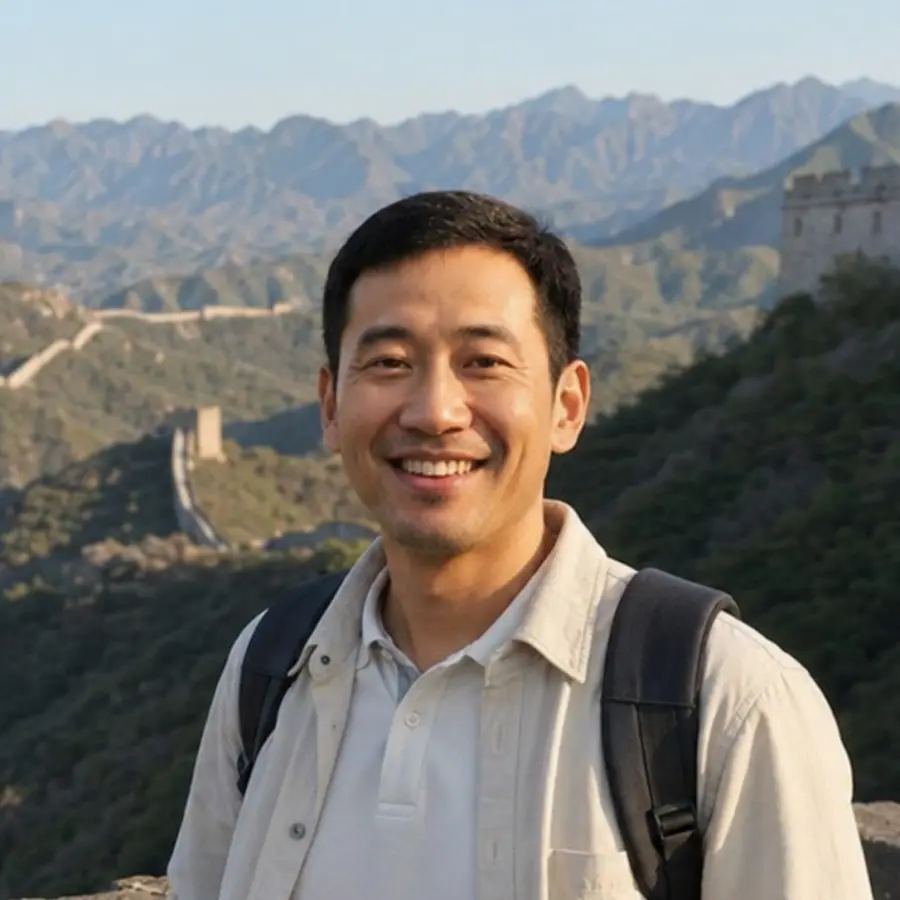
Ke Ping — Founder, InsiderChinaTravel
I personally reply to every email and create free, custom trip frameworks. Already have a plan? I can arrange vetted local guides and private drivers. Over 5,000 travelers from 30+ countries have started their journey this way.
📋 Tell me about your trip ideaReplied within 24 hours. No charge, no obligation.