Chinese Dining Etiquette & Table Manners: 18 Dos and Don’ts Every Traveler Should Know
The chopstick stood straight up in the bowl of rice — like two incense sticks at a funeral.
I was at a wedding banquet in Chengdu, autumn 2023. The American tourist sitting across from me had, without thinking, jabbed his chopsticks into his rice while reaching for his beer. The entire table went quiet. The groom’s mother froze mid-sentence.
He had no idea. Nobody had told him.
I leaned over and whispered: “Lay them flat on the rest. Never upright.” He pulled them out fast, face flushed. Later I explained the funeral connection. He looked horrified. “I almost… at someone’s wedding?”
Look — Chinese dining etiquette is not obvious. Nobody hands you a rulebook when you sit down. But the rules exist, and every local at the table knows them. Here’s the thing about Chinese dining etiquette — nobody teaches it, but everyone notices when you break it. This guide covers 18 dos and don’ts of Chinese table manners — the unspoken code that keeps you from being that guest. If you’ve already sorted out the practical China travel tips, this is the cultural layer you need next.
- Before You Sit Down — Chinese Table Manners Start at the Door
- Chopstick Rules — Chinese Chopstick Etiquette in 6 Taboos
- How to Share a Chinese Table — Chinese Table Etiquette for Communal Dining
- Tea, Toasts, and Unspoken Signals — Chinese Drinking Etiquette Explained
- Clean Plate or Leave a Bite? — A Chinese Eating Etiquette Puzzle
- The Bill "Fight" — Why Nobody Splits the Check (and Tipping China Rules)
- Red Packets, Gifts, and When Money Speaks — Chinese Red Envelope Etiquette
- At a Glance — Formal Banquet vs Family Meal vs Casual Gatherings
- Quick Answers to Common Questions About Chinese Dining Etiquette
- Save This — 18 Chinese Table Manners and Etiquette Rules at a Glance
Before You Sit Down — Chinese Table Manners Start at the Door
#1 Don’t just grab a chair. Wait.
You walk into a private dining room. Big round table. Lazy Susan in the middle. Your instinct says pick a seat and settle in. Resist it.
In Chinese table etiquette, seating doesn’t start until the host or the eldest person signals it — usually with a wave and a “来来来,坐坐坐” (lái lái lái, zuò zuò zuò — “come, come, sit down”). Wait for that cue. This is one of the first lessons of Chinese dining etiquette — the meal flows at the host’s pace, not yours.
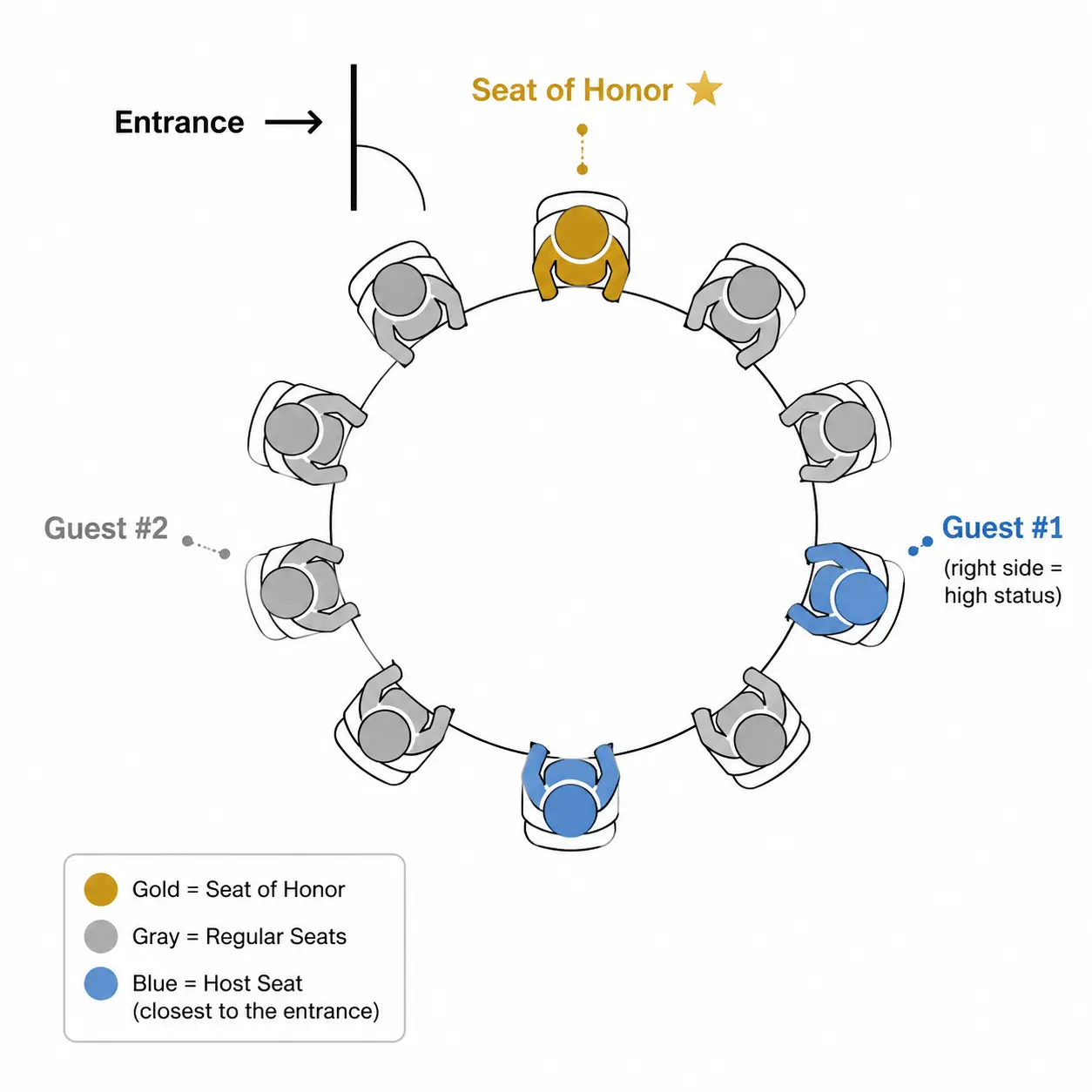
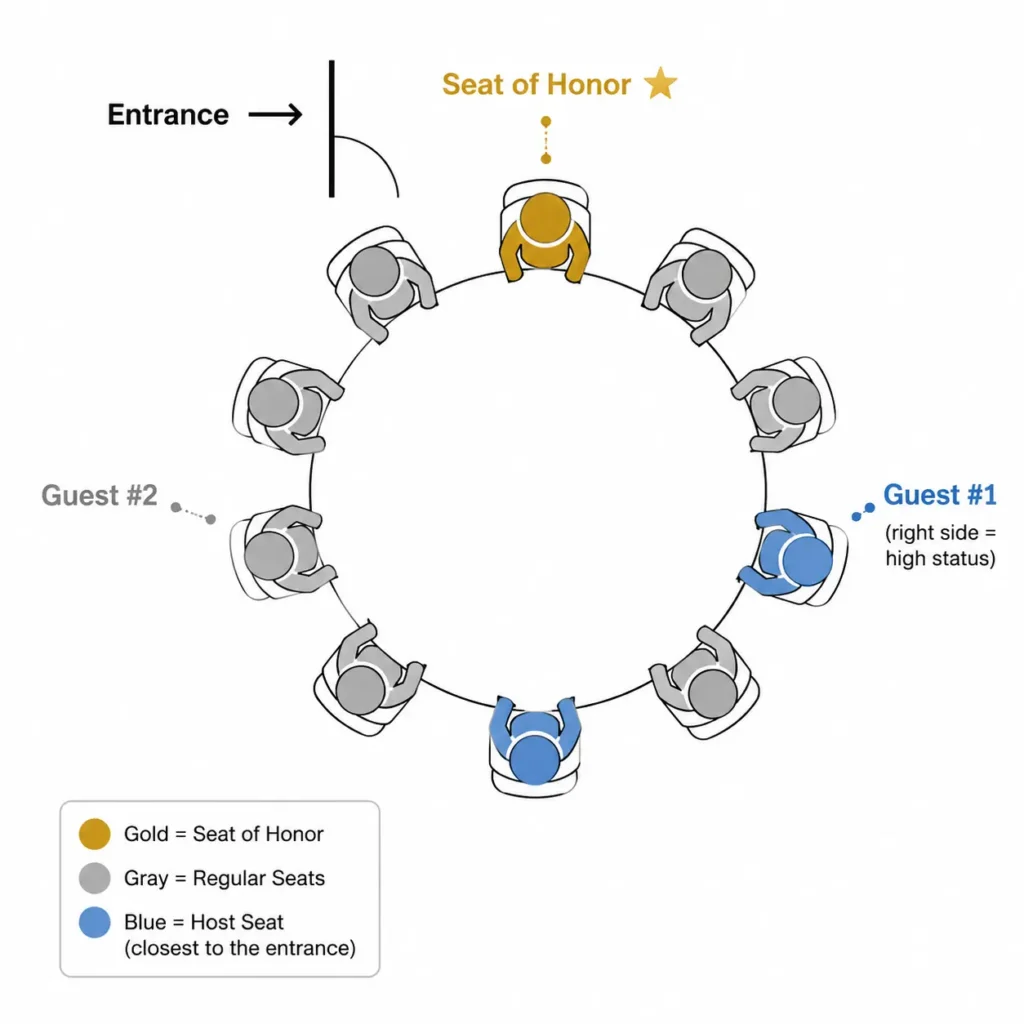
#2 The seat facing the door is never yours
On a round table, the chair directly facing the main entrance is the seat of honor. Reserved for the host. Or the most important guest. Or the oldest person in the room.
The seat to its right is second in status. Left side, third. The spot nearest the door — sometimes near the service entrance — is the lowest-status seat. That’s usually where the host’s assistant or the person handling the bill sits.
How do you know where to park yourself? Stand aside. Let the host point. If they guide you to a spot right next to the seat of honor — congratulations, you’re being treated as a distinguished guest. If nobody directs you, grab a mid-tier seat: not facing the door, not right next to it. You’ll be fine. (And if you’re still unsure, a quick trip to the restroom buys you 90 seconds to come back and see where everyone else settled.)
Once you know how chinese table manners and etiquette handle seating, getting to the restaurant itself is straightforward — most venues in major cities are easy to reach once you understand getting around Chinese cities.
#3 In southern China, wash your dishes first
Guangdong. Hong Kong. Parts of Fujian. The server brings a plastic basin and a pot of hot water or tea before any food arrives. This is not for drinking. You’re meant to rinse your bowl, cup, chopsticks, and spoon in the hot water — a quick swish, then pour the water into the basin. Locals do this without thinking. Join them and you’ll earn a nod of approval. Skip it and nobody will care either. It’s a ritual, not a requirement. Small customs like this are what make Chinese dining etiquette feel lived-in — something people do, not something they recite.
Chopstick Rules — Chinese Chopstick Etiquette in 6 Taboos
Chopsticks have been used in China for nearly four thousand years. The rules piled up. The six rules below are the backbone of Chinese dining etiquette when it comes to chopsticks — get these right and you’ve cleared the biggest hurdle. Here are the ones that trip up foreigners most often.
#4 Use the serving chopsticks. They’re not decorative.
Many restaurants place a separate pair of chopsticks — often a different color — next to each shared dish. These are public chopsticks (gōng kuài). Use them to transfer food from the communal plate to your own bowl. Then eat with your personal pair. Post-COVID, this is nearly universal at mid-range and upscale restaurants. If there’s only one pair per person, just touch only the piece you intend to take — no stirring through the dish.
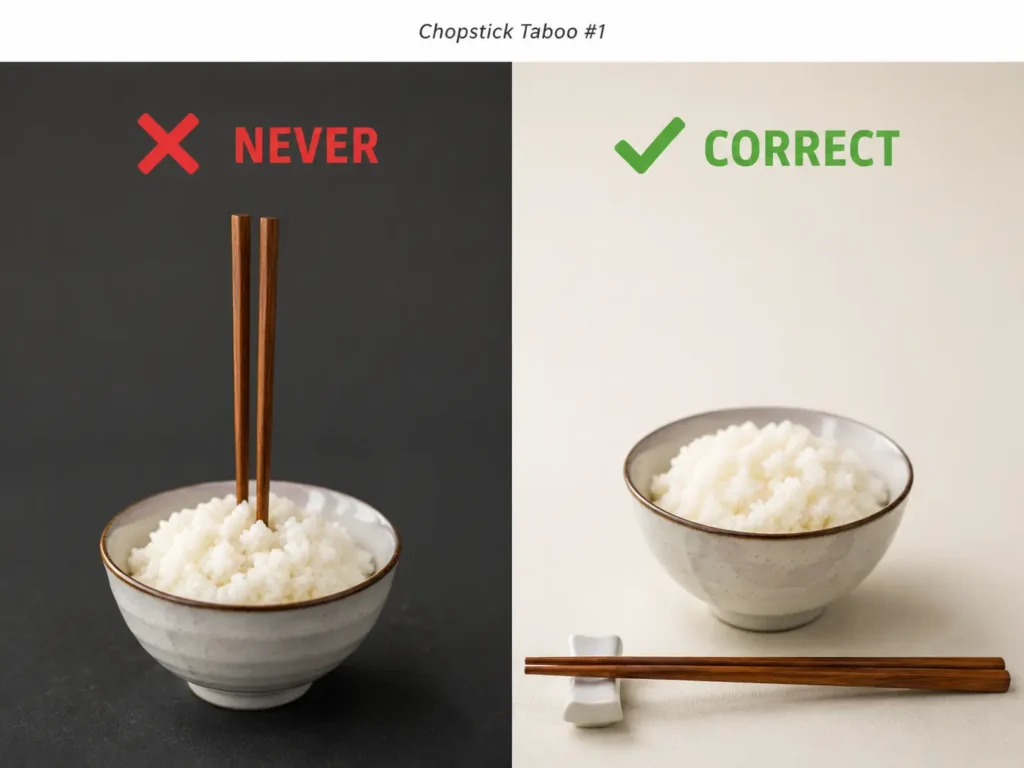
#5 Upright chopsticks = funeral incense
This is the single biggest taboo in Chinese dining etiquette. Never. Stick. Chopsticks. Vertically. Into. Rice.
A Reddit user on r/chinesefood described exactly this — at a Chengdu hotpot restaurant, waiting for the meat to cook, he absentmindedly planted his chopsticks in his rice bowl. “Suddenly everyone at the table froze and my friend quickly pulled them out with a panicked face.” He’d unknowingly mimicked the incense sticks placed upright in offerings to the dead.
Rest your chopsticks on the chopstick rest. No rest? Lay them flat across the rim of your bowl or plate. Just not upright. Never upright.
#6 Don’t point with your chopsticks
Talking with chopsticks in hand? Fine. Pointing them at someone while you talk? Not fine. In Chinese body language, pointing with chopsticks at another person reads as aggressive — the equivalent of jabbing a finger in someone’s face during an argument. Put them down before you make your point.
#7 Don’t drum on your bowl
Tap-tap-tapping chopsticks against a bowl or plate makes a cheerful sound. It also makes you look like a beggar — historically, that clinking noise was how street beggars drew attention. Elders will correct you. Waitstaff will notice. Just don’t.
#8 Chopsticks are not forks. Don’t stab.
Spearing a chunk of braised pork belly and lifting it to your mouth like a kebab looks wrong at a Chinese table. If something is slippery — tofu, fish balls, mushrooms — cradle it from underneath with your chopsticks or use the ceramic soup spoon to help. Stabbing is for the grill, not the dinner table.
#9 Lay them parallel, never crossed
When you pause during the meal, rest your chopsticks flat — parallel to each other, tips pointing toward you — on the chopstick rest or the edge of your plate. Crossed chopsticks (forming an X) are considered unlucky. In traditional thinking, crossed objects signal rejection and conflict. It’s a tiny detail. It matters. These details are what separate someone who’s studied Chinese dining etiquette from someone who’s winging it.
How to Share a Chinese Table — Chinese Table Etiquette for Communal Dining
#10 Serve others before yourself
A dish arrives. The Lazy Susan spins it your way. Before you dig in, glance left and right. Elders haven’t moved yet? Wait. Guests haven’t taken any? Offer first — use the serving chopsticks to place a piece in your neighbor’s bowl and say “尝尝这个” (cháng cháng zhè ge — “try this”). Hosts do this constantly. As a guest, you don’t need to serve everyone, but never be the first to reach. In practice, Chinese dining etiquette revolves around one simple idea — the table is shared, so the care is shared.
#11 Don’t “mine” the dish
The Lazy Susan brings a platter of stir-fried everything within reach. Your chopsticks go in — and start flipping, digging, searching for the perfect piece of pork. Stop. This is called “fān cài” (翻菜 — “flipping the food”) and it signals greed. Take the piece closest to you. Take what you touch first. The dish will come around again.
Also: spin the Lazy Susan clockwise. And if someone is mid-reach with their chopsticks over a dish, freeze — don’t touch the turntable until they’re done.
Tea, Toasts, and Unspoken Signals — Chinese Drinking Etiquette Explained
Tea and alcohol add another layer to Chinese dining etiquette — a quiet language of gestures that locals read fluently and visitors almost always miss. Here’s how to stay in the conversation.
#12 Pour for everyone else first. Yourself last.
The teapot lands near you. Your cue: fill your neighbors’ cups before your own, starting with the eldest or the guest of honor. Pour until the cup is about 70% full — the old saying goes “chá qī fàn bā jiǔ shí fēn” (茶七饭八酒十分): tea seven-tenths, rice eight-tenths, liquor ten-tenths. Overfilling tea is like telling someone to leave.
A quick detail: the teapot’s spout should point toward empty space, never directly at a person. A spout aimed at someone is an old signal of rejection. And when someone hands you a cup of tea — use both hands to receive it. One-handed grabbing reads as careless, especially from someone younger to someone older.
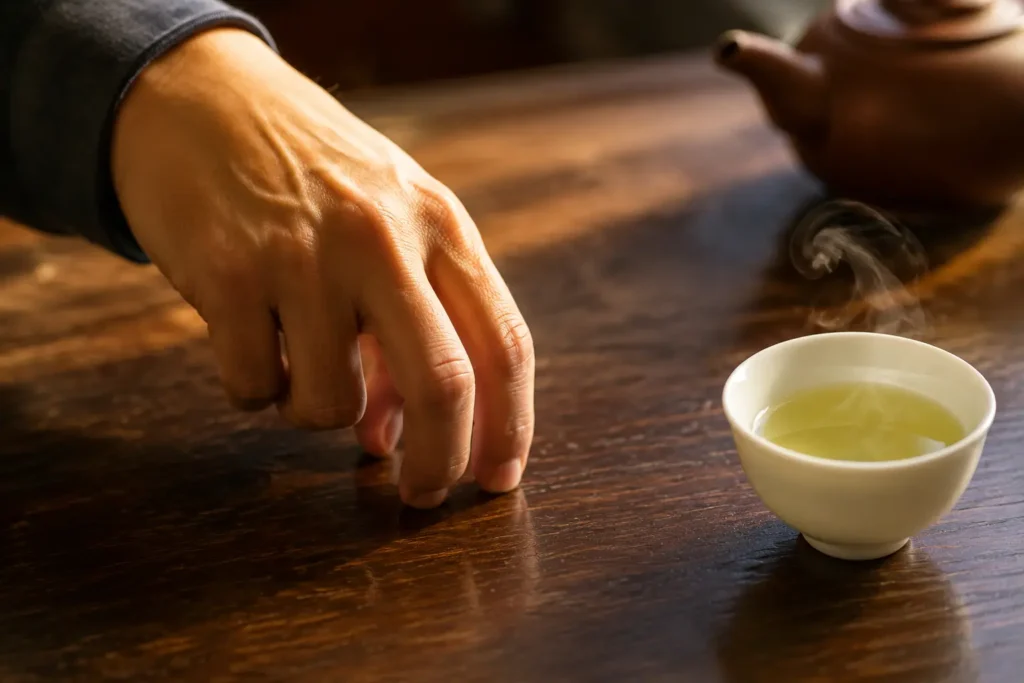
#13 When someone pours tea for you, tap two fingers on the table
The first time I saw this at a dim sum restaurant in Guangzhou, I was baffled. A friend poured me tea. I said “thank you.” Our local colleague — instead of speaking — curled his index and middle fingers and tapped them twice on the tabletop.
A Reddit user on r/China had the same confusion: “Every time the waiter poured tea, my host would tap two fingers on the table. Is this some secret signal or is he just impatient?”
Neither. It’s finger tapping — kòu zhǐ lǐ (叩指礼), a miniature bow of gratitude. Legend traces it to Emperor Qianlong traveling incognito: to avoid revealing his identity when served tea, he tapped his fingers instead of kneeling. Now it’s shorthand for “thanks for the pour.” Try it. Two light taps. You’ll look like you’ve been eating at Chinese tables for years. The longer you observe Chinese dining etiquette, the more of these subtle signals you’ll start catching.
#14 When you clink glasses, yours goes lower
Toasting with an elder, a boss, or the host? Hold your glass slightly lower than theirs when you clink. The lower your glass, the higher your respect. If the other person also tries to go low — and they will — a brief “who can go lowest” shuffle is normal. Let them win once, then move on. It’s a gesture, not a competition.
If you’re seated and the person toasting you stands, you stand too.
#15 Can’t drink alcohol? Tea is a perfectly valid substitute.
At a formal banquet, the host or honored guest will likely raise a glass to you. If you don’t drink, the worst move is a flat “I don’t drink.” Instead, lift your tea cup or juice glass, smile, and say “我以茶代酒” (wǒ yǐ chá dài jiǔ — “I’ll use tea in place of wine”). It’s graceful. It’s accepted. If the host keeps pressing — some will, out of hospitality, not aggression — hold firm with “真的不能喝,身体原因” (zhēn de bù néng hē, shēn tǐ yuán yīn — “I really can’t, health reasons”). Nobody argues with health reasons.
The broader principle in Chinese drinking etiquette: the toast is about connection, not consumption. What’s in your glass matters less than the fact that you raised it.
Clean Plate or Leave a Bite? — A Chinese Eating Etiquette Puzzle
#16 It depends entirely on where you’re eating
This is the most context-dependent rule in all of Chinese dining etiquette — and the answer flips depending on where you sit.
At someone’s home, or a casual family restaurant: finish your food. Clean plate. Leaving leftovers at a family meal sends a message: “The food wasn’t good enough.” Or worse — “You didn’t prepare enough.” Your host will worry.
At a formal banquet — wedding, business dinner, holiday feast: leaving a little on each plate is not just okay. It’s correct. If every dish comes back spotless, the host loses face — it looks like they under-ordered and left guests hungry. A small amount remaining says: “The meal was so abundant, I couldn’t possibly finish.”
Two settings. Opposite rules. Now you know the difference. If there’s one recurring theme in Chinese dining etiquette, it’s this — context is everything.
The Bill “Fight” — Why Nobody Splits the Check (and Tipping China Rules)
#17 Don’t split the bill. Don’t fight too hard to pay.
My first dinner out in Beijing: a friend treated me to shuàn yáng ròu (lamb hotpot). When the bill arrived, I reached for my wallet. “我来我来” (wǒ lái wǒ lái — “I’ve got this”). My friend grabbed the receipt out of my hand. We wrestled — politely but firmly — for a full minute. The waiter stood there, face blank, waiting. I lost.
A Reddit thread on r/China captured this perfectly: “I offered to pay my half, but my colleague almost wrestled the receipt out of my hand. I was so confused — should I have fought harder or just said thank you?”
Say thank you. In China, the person who extended the invitation pays. That’s the default. The guest offering to pay — while well-intentioned — can accidentally insult the host, as if implying they can’t afford the meal. Your job as a guest: express genuine gratitude, and say “下次我来” (xià cì wǒ lái — “next time, my treat”). Then actually treat them next time.
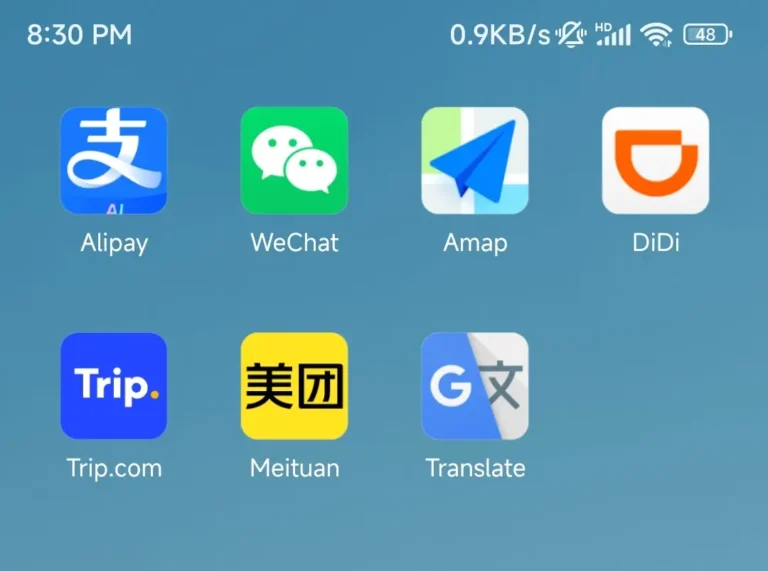
That scuffle at the counter? It’s not a fight. It’s two people trying to show they value the relationship more. Make a gesture, then let the host win. These days most people pay via mobile — once you’ve set up Alipay for foreigners, you can quietly slip off to the front desk mid-meal and settle the bill before anyone notices. That’s the pro move.
#18 Tipping in China? Don’t.
I know. It feels wrong. You’re wired to leave something on the table. Resist the wiring.
In mainland China, tipping is not expected — not in restaurants, not in taxis, not in hotels. A server might literally chase you down the street to return money you left behind, thinking you forgot it. You’re not being generous. You’re creating an awkward moment.
The narrow exceptions: high-end international hotels (think Ritz-Carlton, Peninsula) where bellhops and housekeeping may accept ¥20–50 (USD 3–7), and private tour guides serving foreign clients. At a street noodle joint? A night market stall? A mid-range restaurant? Keep your change. This is one of the clearest differences between china dining etiquette and Western habits — and it takes about two meals to get used to. For anyone raised on Western dining norms, this might be the single most counterintuitive rule in Chinese dining etiquette.
Red Packets, Gifts, and When Money Speaks — Chinese Red Envelope Etiquette
#19 For special occasions, a red envelope beats any gift
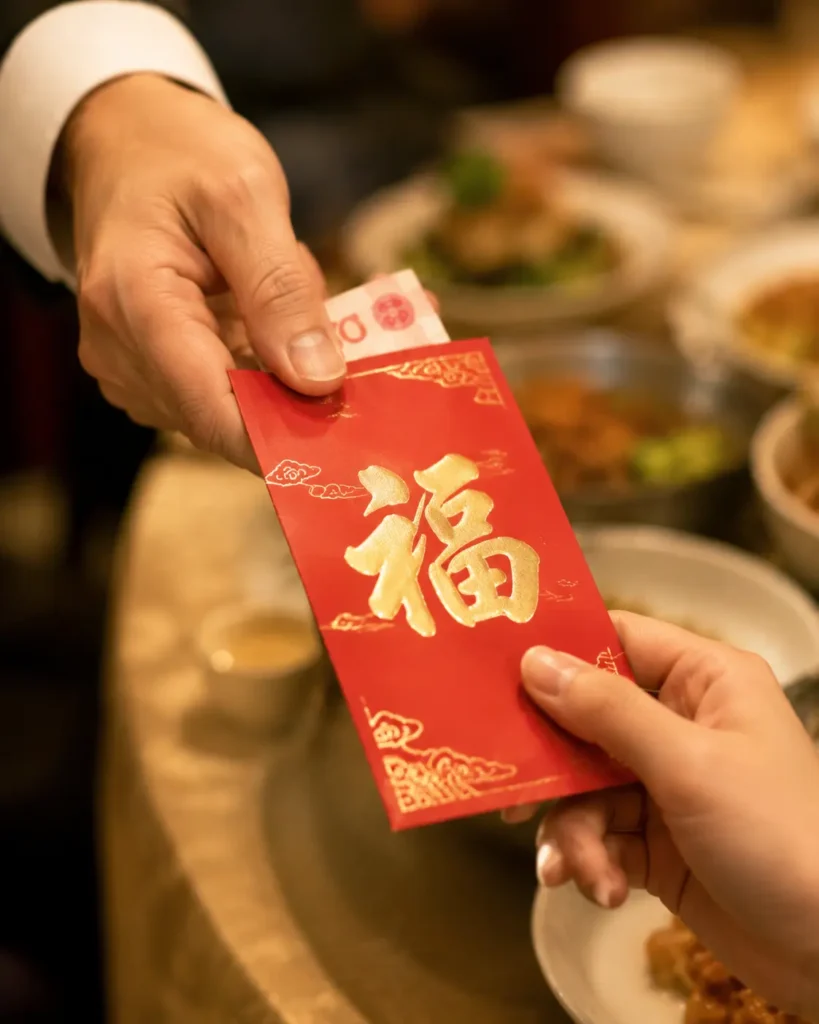
Weddings. Birthdays. Spring Festival visits. In these settings, a red envelope — hóng bāo (红包) — is the standard offering. Red symbolizes luck and wards off bad spirits. What’s inside matters, too.
The rules:
- Even numbers only. 200, 500, 600, 800. The numbers 6 (smooth), 8 (prosperity), and 9 (long-lasting) are lucky. The number 4 — sì, a near-homophone for “death” — should never appear. ¥400 is cursed money.
- How much? For a wedding: ¥200–500 (USD 29–71) for a colleague or casual friend, ¥600–1,000+ (USD 86–143+) for a close friend, ¥1,000+ (USD 143+) for close family. For a birthday: ¥100–300 (USD 14–43) for acquaintances, ¥300–600 (USD 43–86) for good friends. Spring Festival red envelopes from elders to children: ¥50–200 (USD 7–29).
- Both hands, always. Give and receive the envelope with two hands. One hand reads as dismissive.
- Never open it in front of the giver. Tearing open a red envelope and counting the cash on the spot is the fastest way to embarrass everyone in the room. Pocket it. Open it at home.
Chinese red envelope etiquette isn’t complicated once you grasp the underlying logic: the envelope itself — its color, the way it’s given — carries as much meaning as the amount inside. If you’re visiting during Spring Festival (the best time to visit China for cultural immersion, though it’s crowded), carry a few red envelopes in your bag. You’ll use them.
At a Glance — Formal Banquet vs Family Meal vs Casual Gatherings
Chinese dining etiquette isn’t one-size-fits-all. The rules shift depending on where you’re sitting and who’s across the table. Here’s how the three most common scenarios compare.
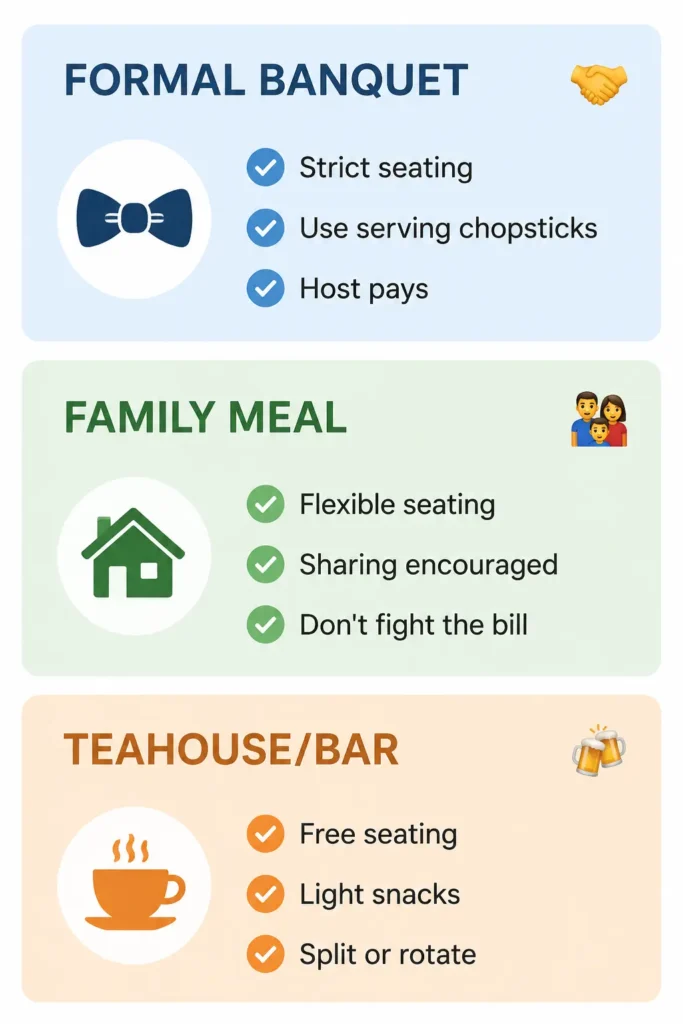
| Rule | Formal Banquet | Family Meal | Teahouse / Bar |
|---|---|---|---|
| Seating | Strict — seat of honor faces door | Flexible, elder sits main seat | Free seating |
| Serving chopsticks | ✅ Mandatory | Depends on the household | 🚫 Not needed |
| Serving others | Host handles it | Common — shows closeness | Help yourself |
| Pouring tea/drinks | Pour for others, with order | Pour for whoever’s cup is low | Top up neighbors when you can |
| Toasting | Follow host’s lead, glass lower | Casual, with elders first | Relaxed |
| Clean plate | Leave a little (abundance) | Finish (appreciation) | No rules |
| Paying | Host / inviter pays | Host pays, don’t fight it | AA or take turns |
| Tipping | 🚫 No | 🚫 No | 🚫 No |
Street food and night markets deserve a special mention: all the rules above evaporate. You queue, you order, you find a spot, you eat, you leave. Nobody cares where you sit or who pours your drink. The three chopstick taboos — no upright rice-stabbing, no drumming, no pointing — still apply. They always apply. Even at the most casual street stall, the core of Chinese dining etiquette stays intact — respect the food, respect the people eating with you.
If you’re traveling with kids who might find formal meals challenging, a family trip to China is often best anchored around casual dining and street food — far less pressure, far more fun.
Quick Answers to Common Questions About Chinese Dining Etiquette
Q: What are the 7 most important rules of Chinese etiquette for dining?
1. Wait for the host to invite you to sit.
2. Leave the seat of honor to elders or the guest of honor.
3. Never stick chopsticks upright in rice.
4. Don’t point or drum with chopsticks.
5. Pour tea for others before yourself.
6. Hold your glass lower when toasting.
7. Don’t fight the host for the bill.
Q: Is it disrespectful to not finish your food?
It depends — and this trips people up. At a family meal, finishing your plate shows the food was good. At a formal banquet, leaving a little shows the host ordered generously. Read the room. This is one of those Chinese dining etiquette questions where the answer genuinely flips depending on context.
Q: What if I can’t use chopsticks? Can I ask for a fork?
Absolutely. Most mid-range restaurants and above have forks — just ask. Using chopsticks badly is more “authentic” than using a fork, but launching a piece of tofu across the table is worse than either option. Night markets and hole-in-the-wall joints might not have forks, so consider traveling with a foldable pair to practice.
Q: Should I bring a gift to a dinner invitation?
Nice, not required. Fruit (avoid pears — lí sounds like “separation”), a bottle of wine, or a box of decent tea all work. Never bring a clock (sòng zhōng = “attending a funeral”) or an umbrella (sǎn sounds like “scattering”). Hand it over with two hands and a casual “一点心意” (yī diǎn xīn yì — “just a small gesture”).
Q: What if I break a rule by accident?
Relax. Most Chinese people are remarkably forgiving of foreigners who stumble on Chinese dining etiquette — they know you weren’t raised with these rules. A genuine apology and a smile go a long way. The only two things that genuinely offend: upright chopsticks in rice, and opening a red envelope in front of the giver. Memorize those two. The rest you can learn as you go. China is an overwhelmingly welcoming place — as we’ve covered in our guide on “Is China safe?,” the biggest risk at a Chinese dinner table is overeating, not offending anyone.
Save This — 18 Chinese Table Manners and Etiquette Rules at a Glance
If you take away one thing from this guide to Chinese dining etiquette, let it be this checklist. Screenshot it. Before your next Chinese meal, spend 15 seconds scanning these 18 rules. Everything else you can figure out by watching the people around you. These are the lines you don’t want to cross.
🥢 Chopsticks
| ✅ | Rest chopsticks flat on the holder or bowl rim when not in use |
| ❌ | Stick chopsticks upright in rice (funeral symbolism) |
| ❌ | Drum on bowls or plates (beggar behavior) |
| ❌ | Point at people with chopstick tips |
| ❌ | Dig through dishes hunting for choice pieces |
| ❌ | Cross chopsticks into an X when resting them |
🍵 Tea & Alcohol
| ✅ | Tap two fingers on the table when someone pours tea for you |
| ✅ | Pour tea to 70% full — never overflowing |
| ✅ | Hold your glass lower than elders’ when toasting |
| ✅ | Receive cups, cards, and gifts with both hands |
| ❌ | Pressure anyone to drink — tea is a valid substitute |
| ❌ | Point the teapot spout directly at a person |
💰 Bill & Red Packets
| ✅ | Use even numbers and lucky digits (6, 8, 9) in red envelopes |
| ✅ | Give and receive red envelopes with both hands |
| ✅ | Sneak off to pay the bill mid-meal if you want to treat |
| ❌ | Open a red envelope in front of the person who gave it |
| ❌ | Use amounts with the number 4, or odd numbers |
| ❌ | Stage a loud, dramatic fight over the check at the table |
Now go eat. The food is worth it.

Ke Ping — Founder, InsiderChinaTravel
I personally reply to every email and create free, custom trip frameworks. Already have a plan? I can arrange vetted local guides and private drivers. Over 5,000 travelers from 30+ countries have started their journey this way.
📋 Tell me about your trip ideaReplied within 24 hours. No charge, no obligation.